Five European Union governments have thrown their weight behind a plan to send irregular migrants to Rwanda, opening a new front in the continent's long-running argument over asylum and returns. Greece, Denmark, Germany, Austria and the Netherlands are behind the partnership, which would establish so-called return hubs on Rwandan soil, with the first pilot facilities expected to be running by the middle of 2027.
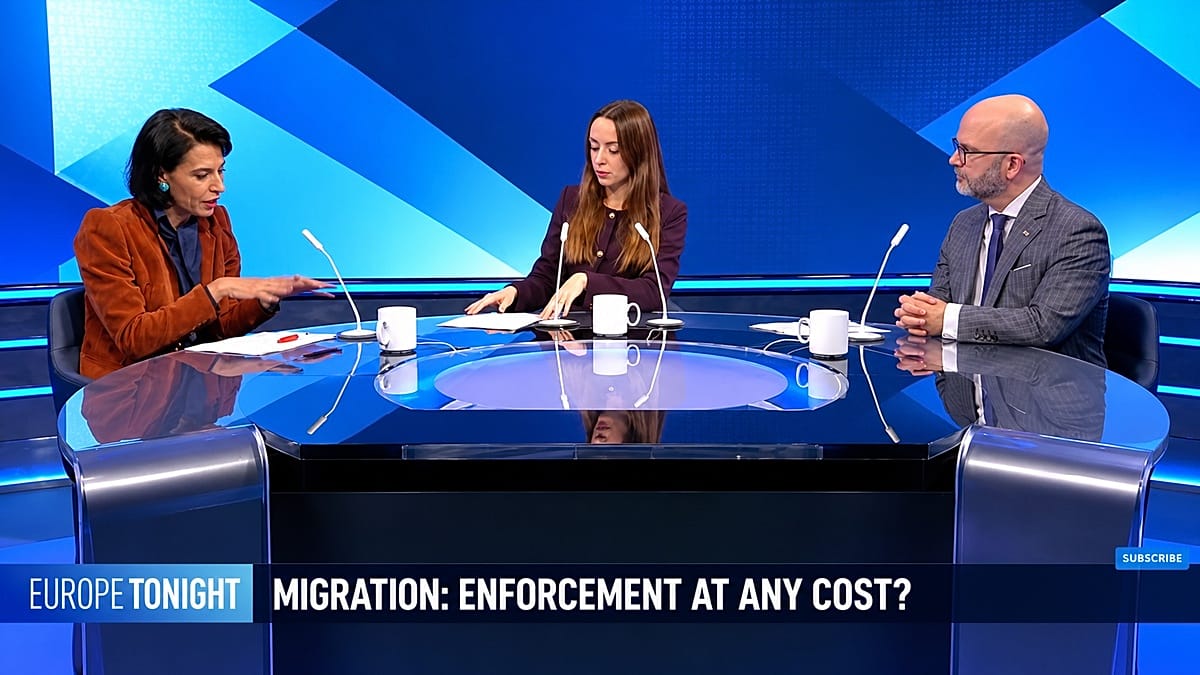
The scheme was the opening subject on the debut edition of Europe Tonight, the new flagship programme from Euronews, where presenter Mared Gwyn Jones led a studio debate on what the arrangement means for EU migration policy. Reporting from Vienna, correspondent Vincenzo Genovese described the move as unprecedented: the bloc would be sending people to a country with which they have no prior connection, a model that inevitably invites comparison with the approach pursued in the United States.
A small pilot with large ambitions
According to people briefed on the negotiations, the first facility would house roughly 100 people. Rather than closed detention, the hub is envisaged as an open site, with residents free to move around the country. The stated aim is to give them a route into local society and the labour market — an unusual framing for a policy usually sold on deterrence.
Danish Prime Minister Mette Frederiksen called the agreement a game changer, arguing it would help European capitals regain control of their borders and strip away the incentives that drive irregular arrivals. On Monday she added that she had a strong sense that further countries would sign up.
The legal basis matters. EU law permitting return hubs outside the bloc restricts eligibility to non-EU states where international human rights standards are respected. Rwanda's record in that area is contested, though interior minister Vincent Biruta insisted the country was ready, had relevant experience and would uphold fundamental rights. Legal challenges are widely expected once deportations begin next year, mirroring the litigation that dogged the UK's own Rwanda arrangement.
Political arithmetic in the Council is already telling. Nineteen of the twenty-seven governments support the deportation plan. Only France and Spain have stated their opposition outright. Italy, meanwhile, has pursued its own parallel model with Albania. The five-state announcement follows the earlier agreement to open Rwanda return hubs by 2027.
Two Swedish MEPs, two visions
Jones put the plan to two members of the European Parliament, both Swedish and both in office since 2019. Charlie Weimers of the European Conservatives and Reformists backed Frederiksen's language, calling the policy a game changer and noting that every system begins small. If the pilot leads to further steps on EU migration policy, he argued, it will have succeeded. Pressed on value for money — Italy's Albania scheme costs taxpayers €670 million over five years while covering just 0.3% of irregular arrivals — Weimers reframed the purpose: the deal is meant as a deterrent.
Abir Al-Sahlani of Renew Europe, who was born in Iraq, took a different view. She questioned how Rwanda could return people to their countries of origin when European states themselves have struggled to do so. "If we in Europe were not able to send them back to their countries, what makes us believe Rwanda will be able to?" she asked, pointing to Kigali's dependence on development aid and to unresolved security questions.
Al-Sahlani also warned that far-right narratives are shaping European migration policy, and that governments are failing to use the legislation and tools already at their disposal. Political leaders, she said, too often cast refugees as a threat and make them scapegoats for broader social problems. Migration debates, she added, are increasingly driven by emotion rather than evidence — fuelled by misused statistics, selective truths and invented stories that vilify people seeking protection.
The exchange captures a wider split across the continent. For supporters, external processing is the only credible answer to a system that has lost public confidence. For critics, it exports responsibility to a third country, invites court defeats and may deter few while costing a great deal. Either way, the pilot will be watched closely in Copenhagen, Athens, Berlin, Vienna and The Hague — and in Brussels, where the next legal and political battles are already forming.