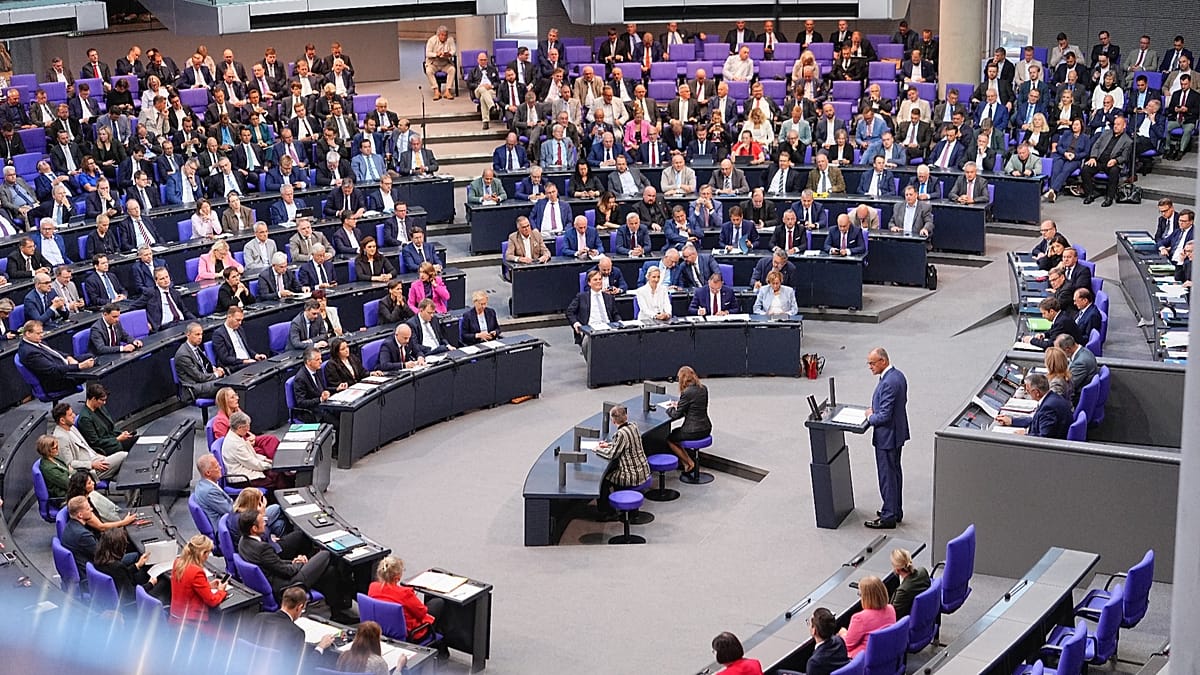
Berlin — Chancellor Friedrich Merz launched a blistering attack on the far-right Alternative for Germany (AfD) on Wednesday, accusing the party of advocating a policy that amounts to “ethnic cleansing by skin colour and origin.” The remark came during a tense parliamentary debate in the Bundestag, just three days after the AfD scored a decisive victory in the eastern state of Saxony-Anhalt.
Merz, leader of the centre-right Christian Democratic Union (CDU), directly challenged AfD co-leader Alice Weidel over the party’s flagship demand for mass “remigration” — a term used by the AfD to describe the large-scale deportation of rejected asylum seekers and migrants who entered the country irregularly.
“The word ‘remigration’ is nothing other than a synonym for ethnic cleansing,” Merz told the chamber, drawing loud protests from AfD lawmakers. He repeated the charge for emphasis: “Remigration is nothing other than ethnic cleansing by skin colour and origin.”
The confrontation underscores the growing polarisation of German politics as the AfD continues to gain ground, particularly in the former East Germany. In Sunday’s state election in Saxony-Anhalt, the AfD took nearly 44% of the vote, dwarfing the CDU’s 17% — a result that has shaken the country’s political establishment and raised questions about the future of coalition politics in the region.
The AfD fell just three seats short of an absolute majority in the state parliament, and party officials said they were now in talks with other groups and individual lawmakers in an attempt to form a state government. Such a move would be unprecedented in post-war Germany, where mainstream parties have long refused to cooperate with the far right.
Weidel, who spoke before Merz, declared that the days of the chancellor’s coalition were “over.” She said voters wanted “a change of course in politics at last” and rejected “business as usual.” She also attacked the government’s immigration policy, claiming it had made Germany unsafe.
“German citizens have to live with the daily consequences of mass migration,” Weidel said, citing “knife violence every day, attacks on trains and in stations, with run-down and threatening cityscapes.”
Merz hit back, arguing that the AfD’s immigration proposals would devastate the labour market. “Not a single care home could operate, not a single hospital, not a single restaurant,” he said, pointing to the reliance of many sectors on migrant workers.
The chancellor also accused the AfD, which has been friendly toward Moscow, of contributing to Russian efforts to destabilise Germany. He referenced a foiled drone attack at Leipzig airport last month, which Berlin has blamed on Russia. “There has been nothing from you, Mrs Weidel, on what happened on August 4 at Leipzig airport,” Merz said. “You are part of the problem we have here in Germany.”
The debate was marked by frequent heckling from AfD lawmakers, prompting parliamentary speaker Julia Klöckner to intervene and call for order.
The rise of the AfD has unnerved many in Germany, where the memory of the Nazi era imposes a special responsibility to guard against extremism. The party’s success in Saxony-Anhalt has also raised concerns beyond Germany’s borders, as other European countries watch closely to see how the political landscape in the EU’s largest member state evolves.
For more on the implications of the AfD’s victory, see our analysis of how the result shakes Germany’s centrist consensus and the political risk it adds to Germany’s economic recovery.