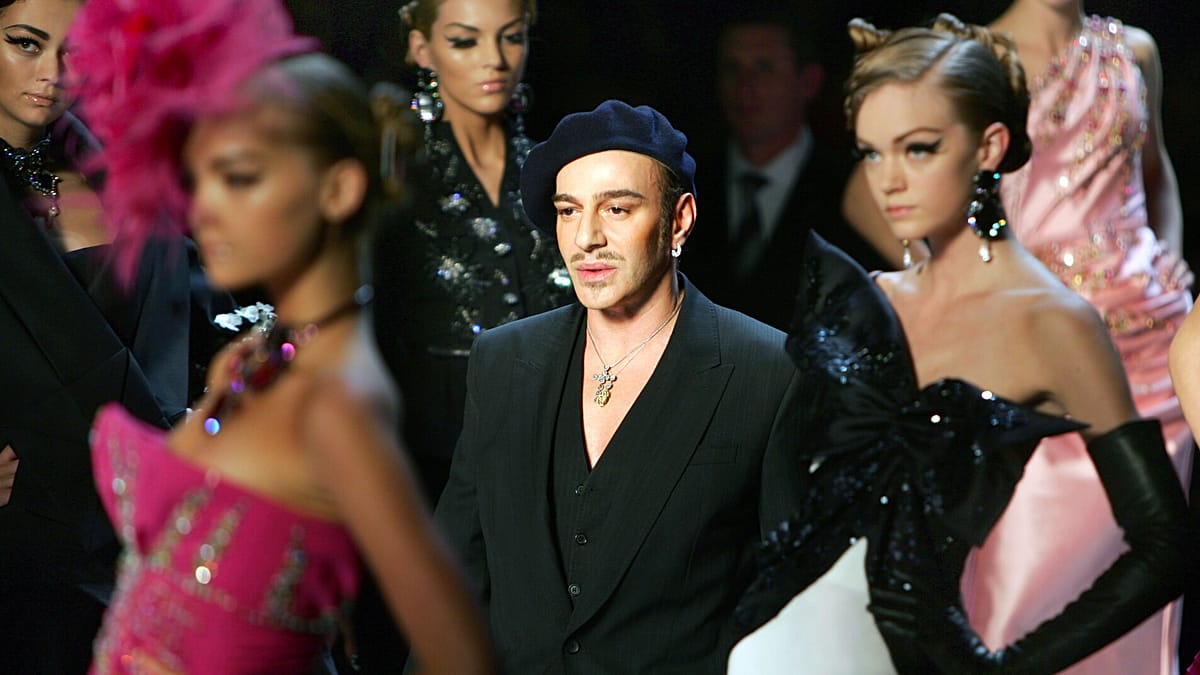
Nearly a year before the next Met Gala, the event is already stirring controversy. On 31 July, the Metropolitan Museum of Art’s Costume Institute announced that its spring 2027 exhibition will celebrate the work of British designer John Galliano. Titled John Galliano: Horizons, the retrospective will span his decades-long career, and the accompanying Met Gala will take the designer as its theme.
The decision drew immediate criticism from across the pop culture world. Galliano, who led Givenchy and Dior in the 1990s and 2000s, is perhaps as well known for his antisemitic and racist outbursts in 2011 as for his creative genius. That year, he was convicted of a hate crime in France.
From Gibraltar to Paris
Born in Gibraltar, Galliano moved to the UK at age six and studied at Central Saint Martins in London, graduating in 1984. His final collection, Les Incroyables, inspired by post-revolutionary aristocratic excess, was bought by the London department store Browns. With support from Vogue’s Anna Wintour, a Met Gala regular, he broke into Paris in the early 1990s. In 1994, he became head designer at Givenchy, the first Briton to lead a major French fashion house. Two years later, LVMH moved him to Dior, where he created the iconic saddle bag, popularised by Sex and the City’s Carrie Bradshaw.
The 2011 scandal
Galliano’s career collapsed in early 2011, just before Paris Fashion Week, when a video surfaced of him hurling racist and antisemitic abuse at a couple in a Paris café. In the footage, he says, “I love Hitler.” Dior fired him, and a French court found him guilty of public insults based on origin, religion, race, or ethnicity. The prosecutor called his remarks “pitiful and dreadful.” He was fined €6,000, and his defence of emotional distress after a friend’s death was rejected.
His rehabilitation began quickly. In 2013, Wintour helped him secure a temporary residency at Oscar de la Renta’s studio in New York, where his theatrical touch was praised. In 2014, he became creative director of Maison Margiela, a post he held until 2024. This March, he signed a two-year creative partnership with Zara.
Forgiveness or forgetting?
Galliano, now 65, has repeatedly apologised, citing alcoholism and addiction. Many Jewish leaders have accepted his contrition as sincere. Before announcing Horizons, Wintour and curator Andrew Bolton consulted with groups including the Anti-Defamation League and the Union for Reform Judaism, all of whom signed off. Wintour said, “There is no one more deserving of an exhibition of this scale than John Galliano. He’s a great designer and his career isn’t defined by a moment – something that he will live with for the rest of his life.”
Yet the announcement has reignited debate. Critics question whether it is appropriate to elevate Galliano to fashion’s pantheon, making him only the third living designer to receive a solo Costume Institute exhibition, after Yves Saint Laurent in 1983 and Rei Kawakubo in 2017. This comes at a time when antisemitism is rising across Europe and the US. Jonathan Greenblatt, CEO of the Anti-Defamation League, told Page Six: “As the decision is made, now it’s on the Met and partners, not with token gestures around one exhibit, but with real action against antisemitism.”
Fashion journalist Dana Thomas also highlighted Galliano’s less publicised troubling behaviour, from rude trash-talking to an incident at the Ritz in London where he stripped naked, occupied an elevator, and growled at guests, claiming he was a lion.
The museum insists the exhibition will not be a hagiography. Horizons will feature more than 200 garments, sketches, and archival materials, but one section will address his 2011 remarks and his subsequent return to fashion. In a statement, the museum said: “Alongside Galliano’s extraordinary creative accomplishments, the exhibition will address the derogatory conduct that fundamentally altered his career and public reception. In doing so, the exhibition will consider how artistic achievement should be understood alongside ethical accountability.”
The debate touches on broader questions of redemption and accountability in the arts, a conversation that resonates across Europe, where fashion houses like Dior and Margiela are cultural pillars. As the fashion world watches, the Met’s decision may set a precedent for how the industry handles its own history of misconduct.