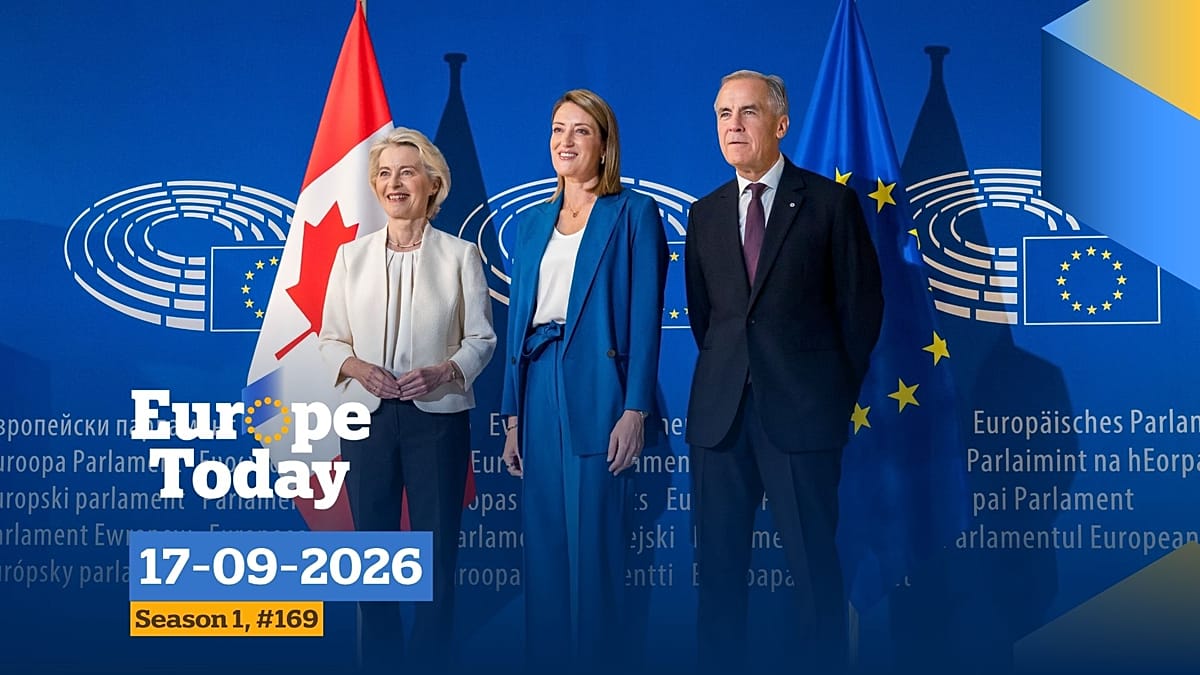
Strasbourg was the stage for a significant moment in EU-Canada relations on Tuesday, as Canadian Prime Minister Mark Carney addressed the European Parliament. The speech came just a day after European Commission President Ursula von der Leyen proposed making Canada the EU's first "associate member," a plan that has drawn sharp criticism from US President Donald Trump, who called it "laughable" and threatened "very serious tariffs."
In an exclusive interview with Euronews, European Parliament President Roberta Metsola defended the proposal, framing it as a natural extension of the EU's commitment to building alliances with like-minded democracies. "Canada shares our values and our vision for a rules-based international order," Metsola said. "This is not about picking sides; it's about strengthening partnerships that benefit both Europeans and Canadians."
Carney's address and the transatlantic rift
Carney's address to MEPs was met with a standing ovation, reflecting the chamber's enthusiasm for closer ties with Ottawa. The Canadian leader emphasized the shared challenges facing Europe and Canada, from climate change to economic security, and called for a "new era of cooperation" between the two blocs.
The timing of the proposal is no coincidence. As Carney heads to Europe, Ottawa is actively seeking to diversify its economic relationships amid an escalating trade rift with Washington. The EU's offer of associate membership would give Canada privileged access to the single market and closer political alignment, a move that Trump has interpreted as a direct challenge to US influence.
Trump's threats of tariffs have cast a shadow over the proceedings, but EU officials remain resolute. "We will not be deterred by threats," said Valdis Dombrovskis, the European Commissioner for Trade. "Our partnership with Canada is based on mutual respect and shared interests, and we will pursue it regardless of external pressure."
Reactions to the State of the Union
The debate over Canada was not the only item on the agenda. MEPs and commissioners alike were still digesting von der Leyen's State of the Union speech, delivered the previous day. The address touched on a wide range of issues, from competitiveness to defense, but some observers noted a conspicuous absence of new initiatives on Ukraine support or Russia sanctions.
Jorge Liboreiro, a political analyst, questioned whether the speech would "move the needle" on the EU's most pressing challenges. "Von der Leyen announced nothing new on Ukraine or Russia, despite expectations," Liboreiro noted. "The question now is what comes next for her after her biggest speech of the year."
Commissioners Maroš Šefčovič, Wopke Hoekstra, and Andrius Kubilius offered their own perspectives, with Hoekstra emphasizing the need for a robust European response to climate change and Kubilius highlighting the importance of defense cooperation. MEP David McAllister (EPP, Germany) echoed these sentiments, calling for a "united and assertive" Europe in the face of global uncertainties.
Metsola's vision for Europe
In her interview, Metsola also reflected on the broader state of the Union, urging member states to focus on delivering tangible results for citizens. "We have the tools and the will to shape our own destiny," she said. "But we must act with urgency and unity."
The European Parliament president's remarks come at a time when the EU is navigating a complex geopolitical landscape, from the war in Ukraine to the rise of protectionism. The proposed associate membership for Canada is seen by many as a strategic move to bolster the EU's global standing.
As Carney concluded his address, the mood in Strasbourg was one of cautious optimism. The path forward will require careful diplomacy, particularly with Washington. But for now, the EU and Canada appear determined to deepen their partnership, with or without US approval.