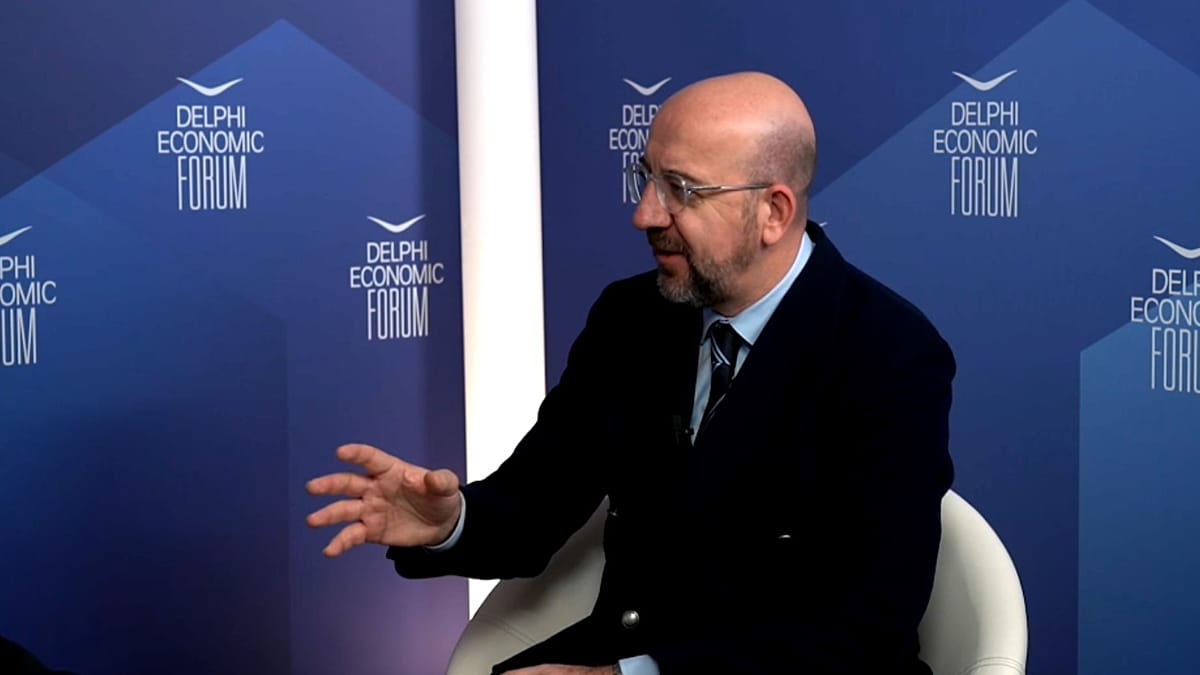
Former European Council President Charles Michel has urged EU leaders to proceed with caution before moving to scrap the unanimity requirement in decision-making, warning that such a step could undermine the bloc's cohesion and international standing.
Michel, who chaired the European Council from 2019 to 2024, told Euronews that the "European dream" depends on collective agreement among all twenty-seven member states. While acknowledging the frustrations caused by repeated vetoes, he stressed that the principle of unanimity, enshrined in the Treaty of Lisbon, should only be abandoned after careful deliberation.
"What is a bit frustrating for all those like me who are absolutely convinced that this project is more needed than ever, the European project, the European dream, the European principles, the European values, the European coexistence… We know what we have to do, we know exactly what we have to do," Michel said. However, he added that safeguarding unity as set out in the treaties remains "not easy to achieve."
The Orbán Factor and Hidden Sympathies
Michel's comments come amid ongoing tensions over Hungarian Prime Minister Viktor Orbán's use of veto power, particularly regarding a €90 billion loan for Ukraine and the EU's twentieth package of sanctions against Russia. Both measures were approved on Thursday after Orbán and Slovak Prime Minister Robert Fico withdrew their months-long objections.
Asked whether Orbán's recent electoral defeat in Hungary could improve EU cohesion, Michel expressed hope for more united European Council meetings but suggested that the change would not automatically lead to greater harmony. "Some in the European Council were hiding behind Viktor Orbán," he said, implying that certain leaders share elements of his political stance, including on Ukraine.
Michel emphasized that the veto should be reserved for vital national interests and warned against its misuse. "Unanimity is a challenge, there is no doubt," he said. "But decisions to abandon it should not be taken lightly. If you stop trying to involve every country, you risk weakening the EU's weight on the international stage."
The debate over unanimity has gained urgency as Ukraine, which applied for EU membership in 2022 following Russia's full-scale invasion, faces repeated delays in accession talks due to Budapest's objections. Ukrainian President Volodymyr Zelenskyy has acknowledged that discussions are taking place on "various possible formats of Ukraine's membership in the EU" if full support from all twenty-seven member states cannot be secured.
Michel's remarks align with broader discussions within the EU about reforming decision-making processes. A recent article in European Pulse explored how the EU is debating ending unanimity to prevent future vetoes, a move that could reshape the bloc's internal dynamics. Meanwhile, the EU's reliance on external partners for critical infrastructure, such as defense cloud systems, has also raised concerns about vulnerabilities, as highlighted by a think tank warning of a US "kill switch" vulnerability.
As the European Council considers potential treaty changes, Michel's call for caution serves as a reminder of the delicate balance between efficiency and inclusivity. The former president's warning underscores the need for EU leaders to weigh the benefits of streamlined decision-making against the risk of alienating member states and weakening the union's collective voice on the global stage.



