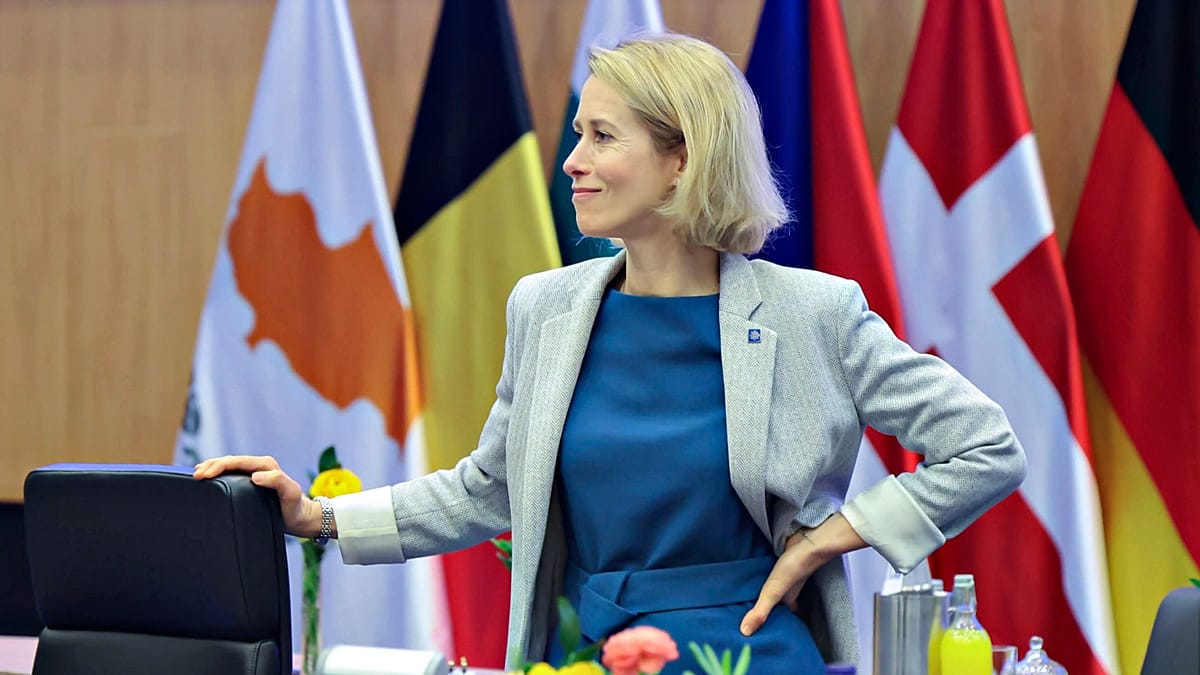
As Washington escalates its criticism of the transatlantic alliance over the war in Iran, the European Union's top diplomat has moved to clarify the relationship between the bloc's mutual defence clause and NATO's collective security guarantee. High Representative Kaja Kallas told Euronews that Article 42.7 of the EU treaties and Article 5 of NATO are not in conflict but are designed to coexist.
“I wouldn't contradict those two articles because they have been always coexisting,” Kallas said on the sidelines of an informal EU summit in Cyprus. “There's a very strong European pillar in NATO that is there and is actually stronger now because we are all making more investments in our defence.”
Article 42.7 allows an EU member state under “armed aggression” to request assistance from other member states, which can take military, economic, diplomatic, or medical forms. NATO's Article 5, by contrast, states that an armed attack against one ally “shall be considered an attack against them all” and explicitly authorises military force to restore security. Kallas stressed that the two clauses are not alternatives: “It is in no way that if Article 5 is not working, then we can go for 42.7. These are complementary to each other.”
From Obscurity to Urgency
Until recently, Article 42.7 was a little-known provision, invoked only once—by France in 2015. However, US President Donald Trump's contentious attempt in January to seize Greenland from Denmark through punitive tariffs thrust the clause into the spotlight, raising fears that the crisis could precipitate NATO's collapse. Weeks later, the war in the Middle East brought further attention when an Iranian-made Shahed drone struck a British military base in Cyprus.
Cyprus, one of the few EU countries outside NATO, cannot rely on Article 5 and would therefore depend on the bloc's mutual assistance. President Nikos Christodoulides put the matter on the agenda of the informal summit, where Kallas briefed leaders. Christodoulides called for a “clear manual that ensures the union acts as a credible guarantor of security.”
Kallas is now working with member states to give practical meaning to Article 42.7. The exercise is based on three hypothetical attack scenarios: an attack on an EU country that is not a NATO ally (such as Austria, Cyprus, Ireland, or Malta); an attack on a country that is both an EU and NATO member, to test how the two articles would interact; and an attack that falls below NATO's threshold due to its hybrid nature. A new exercise among EU ambassadors in Brussels is scheduled in the coming days.
“How do we operate in these three scenarios? The treaties are quite general. We need to operationalise this article by mapping what we have done, what the possibilities are, who does what in what case, and how we are all working together,” Kallas said. “We need to do it fast.”
Trump's Threats and the Hormuz Crisis
The urgency around Article 42.7 has been amplified by Trump's public threat to withdraw the US from NATO, which he revived after allies refused to send military warships to secure the Strait of Hormuz, currently under Iran's tight grip. A leaked email suggests the Pentagon has outlined options to penalise allies that rejected calls to assist in the war on Iran, including suspending Spain's membership of NATO and undermining support for British territorial control of the Falklands. Spanish Prime Minister Pedro Sánchez, while in Cyprus, dismissed the report, saying the government relies on “official documents and positions,” not leaks.
In response, France and the UK have proposed a “strictly defensive” multinational force to escort commercial ships and demine the seas. The plan, involving nations from Europe and beyond, is still in early stages. Kallas says the EU can contribute by strengthening and expanding its two naval missions in the region—Aspides and Atalanta—to allow them to operate in the Strait of Hormuz. However, securing the necessary unanimity for legal changes may be difficult given sharp divisions among member states.
“Everybody around the table has been very clear that this can only be done after the cessation of hostilities,” Kallas said. “But the easiest way, of course, is to ramp up the operations that have a command structure that are already in place and can be used.”
The debate over Article 42.7 is part of a broader discussion about European strategic autonomy. For more on the summit's outcomes, see EU Leaders in Cyprus Tackle Ukraine, Hormuz Crisis, and Mutual Defence Clause. Kallas has also been vocal about the need to protect EU decision-making from national vetoes, as reported in Kallas: Orbán-Style Vetoes Undermine EU Democracy, Hopes for Reset with New Hungarian Government.



