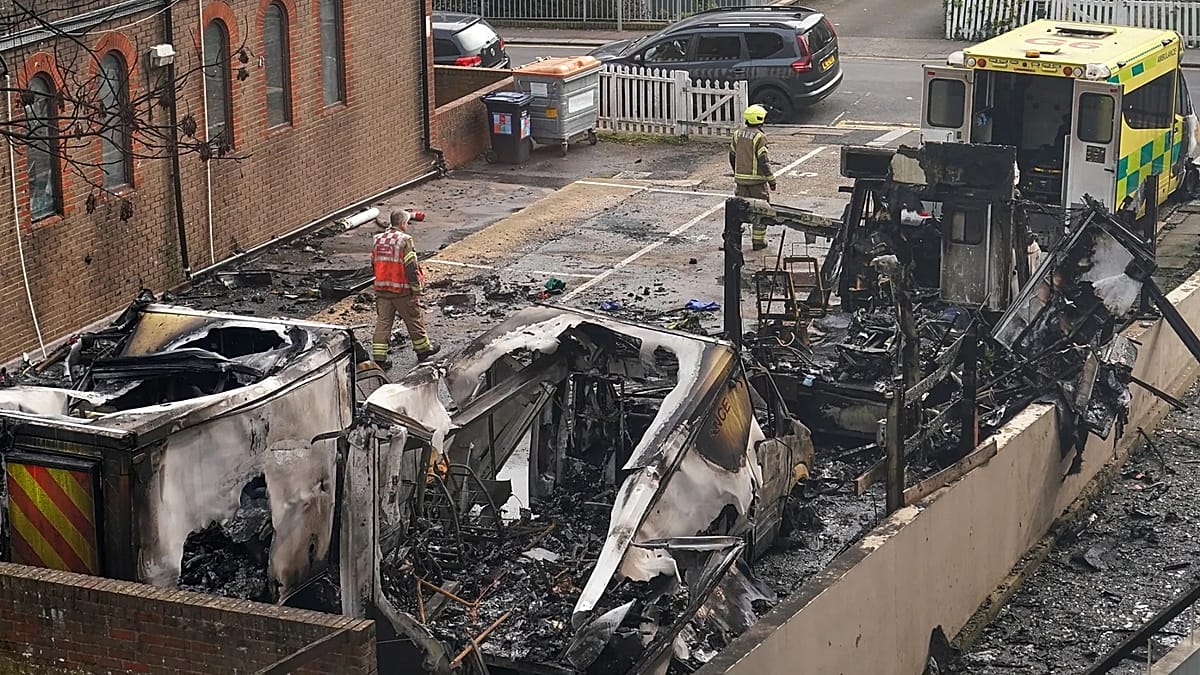
Four men charged with setting fire to ambulances belonging to a Jewish volunteer medical service in north London appeared before a judge at the Old Bailey on Friday, who scheduled their trial for January 2027. The attack, which destroyed four vehicles parked near a synagogue in Golders Green on 23 March, has heightened concerns about antisemitic violence and the alleged use of criminal proxies by Tehran on European soil.
The defendants—Hamza Iqbal, 20, and Rehan Khan, 19, both from Leyton; Judex Atshatshi, 18, from Dagenham; and a 17-year-old of dual British-Pakistani nationality from Walthamstow, who cannot be named due to his age—are accused of targeting the Hatzola charity. Founded in 1979, Hatzola provides free emergency medical transport and response services to north London communities, operating entirely with volunteers.
During the brief hearing, Khan described detention conditions as “hard” to Judge Bobbie Cheema-Grubb. The judge ruled that all four could be tried together at the Old Bailey rather than sending the minor’s case to a youth court, citing the small age gap and other factors. The trial is expected to last four weeks.
Broader Pattern of Attacks
The Golders Green arson is part of a wave of incidents targeting venues in London linked to Israel or Jewish people. London police have arrested 25 individuals in connection with these attacks and are investigating whether those involved were paid proxies. Multiple gas cylinders on the ambulances exploded, shattering windows in a nearby apartment block and forcing the evacuation of adjacent homes; no injuries were reported.
Prime Minister Keir Starmer condemned the incident as a “deeply shocking antisemitic arson attack,” adding that his thoughts were with the Jewish community. The UK government has accused Tehran of using criminal proxies to conduct attacks on European soil, targeting opposition media outlets and Jewish communities. Britain’s MI5 domestic intelligence service says it disrupted more than 20 “potentially lethal” Iran-backed plots in the year leading up to October 2025.
This case echoes broader European security concerns. In a separate incident, Iran executed a man convicted of mosque arson and alleged ties to Israel, highlighting the transnational nature of such tensions. Meanwhile, the ethical challenges of including children in clinical trials across Europe remain a pressing issue, as noted in recent analyses.
The four defendants remain in custody pending trial. The case underscores the persistent threat of antisemitic violence in European cities and the complex web of state-sponsored proxy operations that law enforcement agencies are grappling with across the continent.