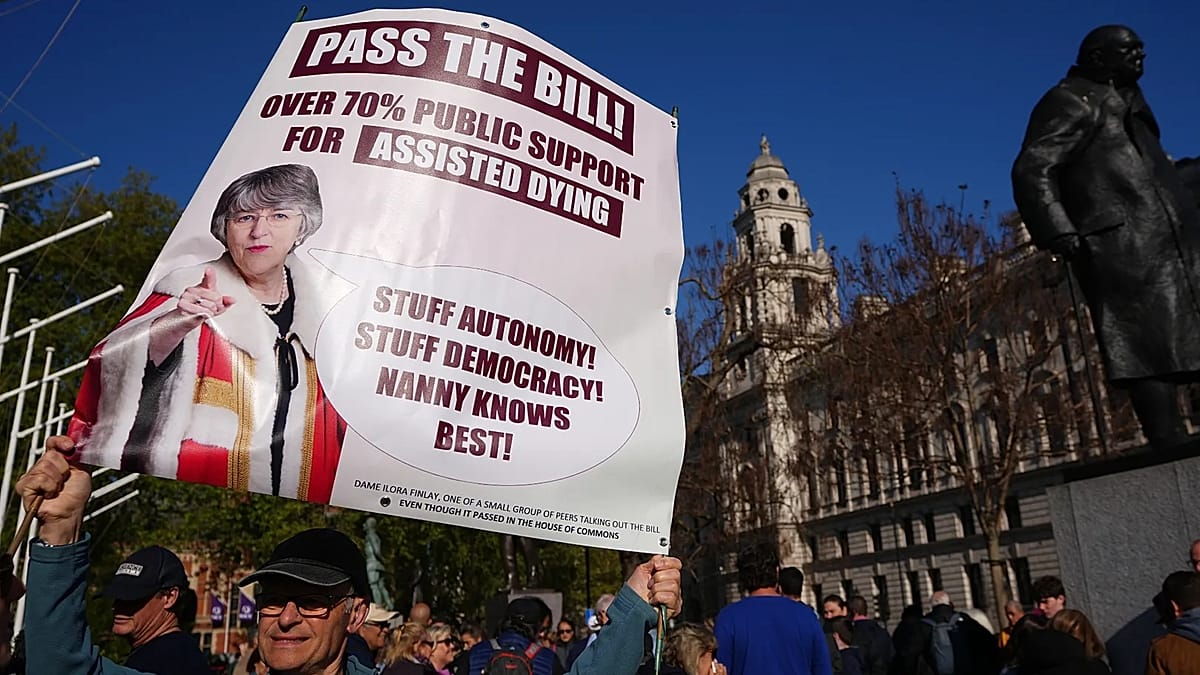
LONDON — A proposed law to legalise assisted dying for terminally ill adults in England and Wales collapsed in the UK Parliament on Friday, after becoming mired in procedural delays in the House of Lords. Campaigners have vowed to continue the fight, accusing a small group of peers of deliberate obstruction.
The Terminally Ill Adults (End of Life) Bill, which had passed the House of Commons in a historic vote last June, ran out of parliamentary time before the current session ends next week. More than 1,200 amendments were introduced in the Lords, a chamber whose members are appointed rather than elected, effectively stalling progress.
Charlie Falconer, the Labour peer who sponsored the legislation in the upper house, described the outcome as “an absolute travesty of our processes.” He said a minority of Lords had “manipulated” the system by tabling hundreds of amendments and then “talking and talking and talking.” Falconer accused opponents of “pure obstructionism.”
Historic Commons Vote Undone
The bill would have allowed adults with a prognosis of six months or less to live, and who could clearly express their wish to die, to request life-ending medication. Under the proposed framework, two doctors and a panel of experts would have to approve each case, and the patient would administer the substance themselves.
Kim Leadbeater, the Labour MP who introduced the bill in the Commons in 2024, expressed anger and disappointment. “There is a real sense of injustice that what’s happened is wrong,” she said. Leadbeater added that terminally ill patients would continue to be denied “choice, compassion and dignity.”
More than 200 MPs signed a letter late Thursday blaming the bill’s failure on “deliberate delaying tactics pursued by a minority of peers opposed to its passage.” The letter underscored the frustration among supporters, who note that the Commons had already given the measure democratic legitimacy.
Rebecca Wilcox, a campaigner for the bill, told AFP: “We’re incredibly angry with what’s happened but we’re determined to get it through, this is not the end, we will not be stopped.” She expressed confidence that an MP would reintroduce the legislation when Parliament reconvenes in mid-May.
The bill was a private member’s bill, meaning it was not government-sponsored and faced greater hurdles in securing parliamentary time. If reintroduced, the legislative process would restart from scratch, though supporters hope the momentum from the Commons vote will carry over.
Opponents of the measure, including the Christian Medical Fellowship (CMF), welcomed its failure. A CMF spokesperson said: “It is not possible to construct an assisted suicide service that is safe, equitable, and resistant to placing unacceptable pressure on the most vulnerable.”
Leadbeater countered that public opinion in Britain shows strong support for change, and that the global trend is moving toward legalisation. Several European countries, including Belgium, the Netherlands, and Luxembourg, already permit some form of assisted dying, while others, such as Austria and Germany, have seen recent legal shifts.
The collapse of the bill highlights the peculiarities of the UK’s bicameral system, where the unelected House of Lords can delay legislation passed by the elected Commons. Critics argue that this undermines democratic accountability, especially on matters of conscience and personal liberty.
As the parliamentary session ends, the future of assisted dying legislation in England and Wales remains uncertain. But supporters insist the issue will not disappear. “The issue is not going away, there’s a very clear direction of travel around the world,” Leadbeater said.