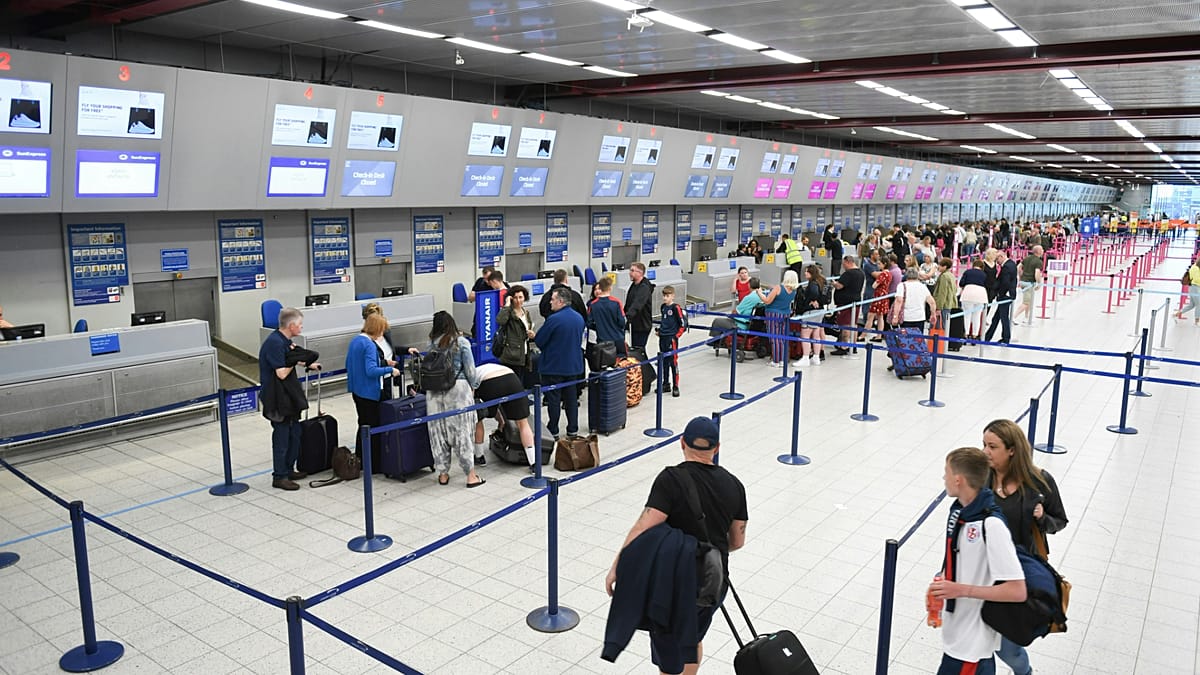
For the first time since the COVID-19 pandemic, the number of passengers flying across Europe has fallen compared to the same month last year. According to ACI EUROPE, the airport trade association, traffic across the European airport network declined by 0.7% in April 2026 relative to April 2025. While the drop is modest, the organisation describes it as “a significant milestone” for the continent’s aviation sector.
Multiple Factors Behind the Decline
ACI EUROPE attributes the downturn to a combination of pressures. The ongoing conflict in the Middle East has dampened demand for long-haul routes, particularly to and from that region. The timing of Easter—which fell partly in March this year—also shifted some travel out of April. But the most acute factor was widespread industrial action in Germany, which severely disrupted operations at several major hubs.
Germany’s airports saw passenger numbers fall by 8.5% year-on-year, with Munich down 16.4% and Frankfurt down 11% due to seven days of strikes. The United Kingdom and France also recorded declines of 2.1% and 0.9% respectively. Among the hardest-hit markets were Cyprus (−16.1%) and Iceland (−11.7%), followed by Austria (−7.4%) and Switzerland (−6.1%).
In contrast, several smaller markets posted strong growth. Slovakia led with a 125.2% surge, followed by Slovenia (+14.6%), Malta (+13.5%), Estonia (+12.1%), and Poland (+8.3%). Among the largest EU+ markets, Spain (+3.7%) and Italy (+2.2%) bucked the trend, driven by robust tourism demand.
Airport Size and Route Networks Matter
The decline was not uniform across airport categories. ‘Major’ airports (those handling 25–40 million passengers annually) saw a 3.5% drop, while ‘mega’ airports (over 40 million) fell 1%. ‘Large’ airports (10–25 million) were essentially flat at +0.1%. These larger hubs are most exposed to long-haul routes, including those to the Middle East, where geopolitical tensions have reduced travel.
Among the major airports, only Barcelona (+4.1%), Madrid (+3.3%), and Amsterdam-Schiphol (+2.7%) recorded passenger growth. Istanbul Airport (−6.8%) and Sabiha Gökçen (−3.4%)—usually top performers—both contracted. London Gatwick (−8.8%) and London Heathrow (−5.34%) also saw significant declines, while Rome-Fiumicino (−0.6%) and Paris-CDG (flat) were stable.
Conversely, ‘medium’ airports (5–10 million passengers) grew 2.1%, and ‘small’ airports (under 5 million) rose 5.5%. These airports rely heavily on intra-European routes served by low-cost carriers, which have not reduced capacity. Some demand has also shifted from long-haul to medium- and short-haul travel. However, small airports remain 27.7% below their pre-pandemic (2019) levels, reflecting structural challenges and financial viability concerns.
EES System Adds to Passenger Frustration
Olivier Jankovec, Director General of ACI EUROPE, described April as “a clear inflexion point” for European air traffic. “While we were already seeing a normalisation of passenger traffic growth after the strong post-pandemic bounce-back, geopolitical instability—most notably the war in the Middle East—is now further weighing on growth and exposing significant differences in performance across markets,” he said.
Jankovec noted that demand remains generally strong, airline capacity adjustments are limited, and fears over potential jet fuel shortages have eased. However, he highlighted that “the most immediate concern remains the severe disruptions and hardship imposed upon passengers by border control processes linked to the Schengen Entry/Exit System.” The EES, which requires biometric checks for non-EU travellers, has caused long queues and delays at many airports, particularly at major hubs.
The broader context includes ongoing geopolitical tensions beyond the Middle East. The war in Ukraine continues to affect airspace and travel patterns, while US strikes on Iranian military sites have further destabilised the region. These factors, combined with domestic disruptions like strikes, are reshaping Europe’s aviation landscape.
As the summer travel season approaches, the industry will be watching closely to see whether the April decline is a one-off or the start of a longer trend. For now, the data suggests that Europe’s air travel recovery is entering a more complex phase, where external shocks and internal frictions are testing the sector’s resilience.