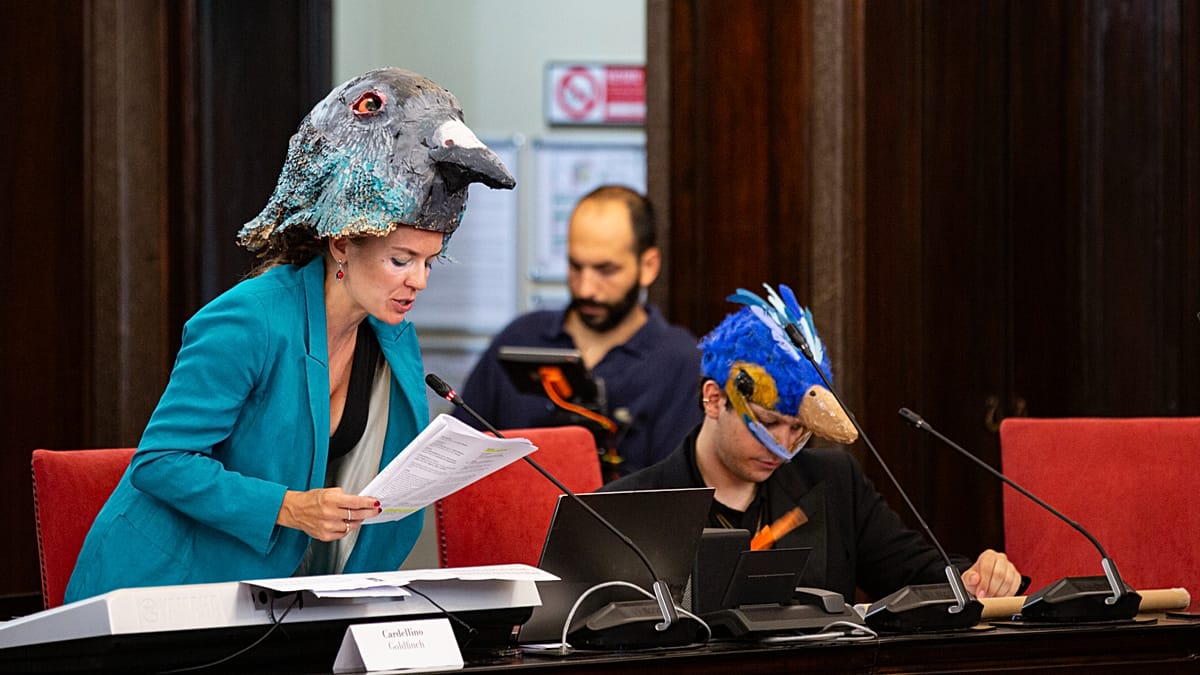
Milan’s City Hall recently echoed with birdsong as pigeons, frogs, goldfish, and beetles—or rather, their human proxies—took their seats for the inaugural Parliament of Living Species. This unconventional assembly, held in Italy’s second-largest city, sought to give a voice to the often-overlooked animal inhabitants of urban spaces.
Fifty animals, each selected for their vulnerability to urban development and represented by masked participants, gathered to debate issues ranging from the demolition of the San Siro Stadium to the reopening of the Navigli canals. A swift decried the planned destruction of the football ground, which serves as a nesting site for thousands of its species. The stadium, snubbed by UEFA for the Champions League final and Euro 2032, faces demolition due to rising maintenance costs.
Advocating for Green Corridors and Waterways
A fox spoke on behalf of underground dwellers, urging the city to prioritize green corridors over new surface parking. The potential reopening of the Navigli canals—paved over in the late 1920s when railways made them obsolete—sparked fierce debate. A coypu, a large semi-aquatic rodent, welcomed the prospect of a new watery habitat, while a representative of small mammals opposed the creation of new urban barriers.
While the topics were serious, the meeting maintained a comedic tone, providing a playful yet collaborative space for human guardians to imagine the concerns of Milan’s voiceless inhabitants. The event was a collaboration between the Urban Planning Laboratory of the Polytechnic University of Milan, the Piccolo Teatro di Milano, and the City of Milan, building on the Animals in the City project that earlier this year took over the Fondation Cartier contemporary art museum in Paris.
In that French exhibition, designer Andrea Branzi and architect Stefano Boeri—the creative minds behind the project—explored how urban planning could foster harmonious coexistence between humans and wildlife. They created playful collages overlaying unexpected animals on images of Parisian monuments and boulevards, envisioning a new urban landscape. The Milanese installment is part exhibition, part research project, examining how urban planning can better accommodate the needs of both permanent and migratory animal species.
Organizers hope participants will leave with a heightened sensitivity to urban species and consider them in decisions affecting the entire ecosystem. “The opportunity to create a space that gives voice to the often invisible creatures that coexist with us in Milan, besides helping us recognize the multitude of non-human life present in the urban space, can contribute to a more informed approach to the major decisions that affect the future of our cities,” said Stefano Boeri.
Matteo Moscatelli, who helped coordinate the event, suggested that turning certain Milanese sites—such as the former Marchiondi Spagliardi complex, a brutalist ‘school of life’ for disadvantaged youth designed by Vittoriano Viganò in the 1950s and abandoned in the 1980s—into “hubs for the protection and enhancement of urban biodiversity” could be a “courageous choice.” Restoring abandoned buildings and degraded ecosystems to their natural states, he argued, can “help reduce conflicts between humans and non-domesticated species and enrich the city's ecological heritage.”
Elena Grandi, Councillor for the Environment and Green Spaces of the Municipality of Milan, emphasized the city’s inclusive vision: “The city, as an inclusive place, is and must increasingly be a space capable of welcoming and protecting the animal world. Our space is also their space, which is why we must protect this great heritage of biodiversity.”
This initiative reflects a broader European trend of rethinking urban spaces to accommodate wildlife, a topic that resonates with ongoing debates about air conditioning and heatwaves in European cities. As Milan grapples with development pressures, the Parliament of Living Species offers a novel approach to inclusive urban planning.