During the darkest days of the pandemic, Europeans gathered around their televisions as government scientists delivered daily updates on infection rates, hospital pressures, and the rules that would keep families safe. In the United Kingdom, those broadcasts became a national ritual. Simon Oldridge, a science communicator, watched them and wondered: what if the same format were applied to the climate crisis?
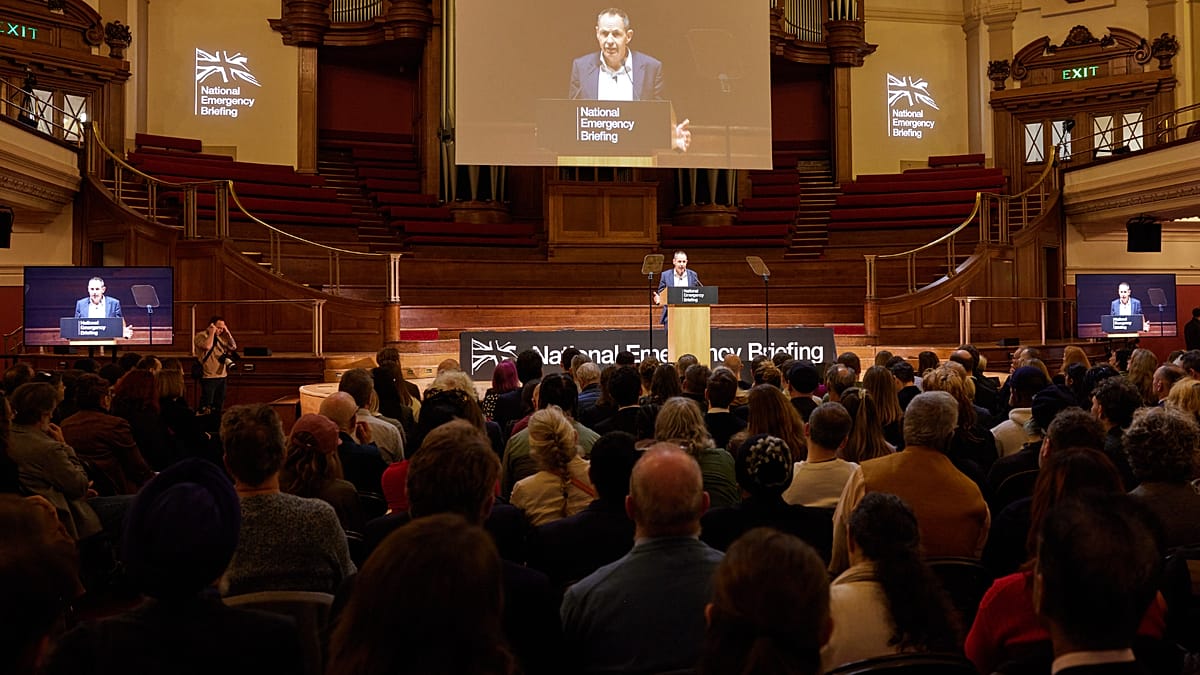
That question gave birth to the National Emergency Briefing (NEB), a project that has since evolved into the People’s Emergency Briefing. The idea is simple: put leading scientists in front of politicians, business leaders, and the public, and let them lay out the facts without media filters or political spin. The first event, held in November 2025 at Westminster Central Hall in London, drew nearly 1,300 invited guests, including government chief scientists and industry executives.
From COVID lecterns to climate science
The briefing was deliberately styled to mimic the official COVID broadcasts. Nick Oldridge, Simon’s brother and co-founder, explained that the team wanted it to “look and feel and sound like we are the government.” They wore sharp suits, a departure from their usual attire, to appeal to the business community. “Everything was designed to appeal to people in industry, people who are in the world of business as usual and think ‘we're indestructible, nothing can really harm us’,” he said.
The strategy worked. Invitations were oversubscribed, with emails arriving from senior officials asking to attend. The event felt like “owning a really famous nightclub,” Nick recalled. Once inside, the audience heard ten-minute presentations from experts on how climate change is affecting weather systems, food supply, health, and national security. The room was silent, and the emotional impact was profound. “Even hardened NGO people came out and said ‘I was profoundly moved’. Lots of people cried,” Nick said. “There was a profound feeling of that pain being inspired and uplifted, as if a secret had finally been shared.”
From one room to thousands of screens
The scientists’ presentations were filmed, and their reactions were captured on camera. The result is a 50-minute documentary, the People’s Emergency Briefing, which is now available for free screenings across the UK. The team’s goal is to reach every person over 16, not just climate activists. “We've really got to get the multiplier effect going,” said Mike, another organiser. “The number one ask at a screening is to try and recruit one, two or three groups of people within that audience to do another screening.”
The film has been screened nearly 2,000 times across the UK, from village halls to corporate offices. It has also crossed the Channel: Germany is preparing its own version, adapting the format for a different political and cultural context. The initiative is part of a broader European conversation about how to communicate climate urgency effectively. In Austria, for example, the drying up of the Bärenschützklamm has become a stark symbol of the Alps’ vulnerability.
The film does not shy away from hard truths. Scientists speak plainly about the risks of continued inaction, but they also end on a note of empowerment, explaining what can be done starting now. One particularly moving moment comes when a scientist tears up, saying he wants to be able to tell his teenage son that he did everything he could to avert the worst consequences.
For the Oldridges, the project is about restoring trust in expertise. “The moment in time when we all sat in front of our TVs and listened to an expert, it was quite a moment,” Nick said. “You realise that the majority of our fellow country people respect the rule of law, value their communities, and want to act for the benefit of others.”
As the briefings spread, the team hopes to build a pan-European movement. The format is adaptable, and the science is universal. Whether in London, Berlin, or Warsaw, the message is the same: the facts are on the table, and the time to act is now.