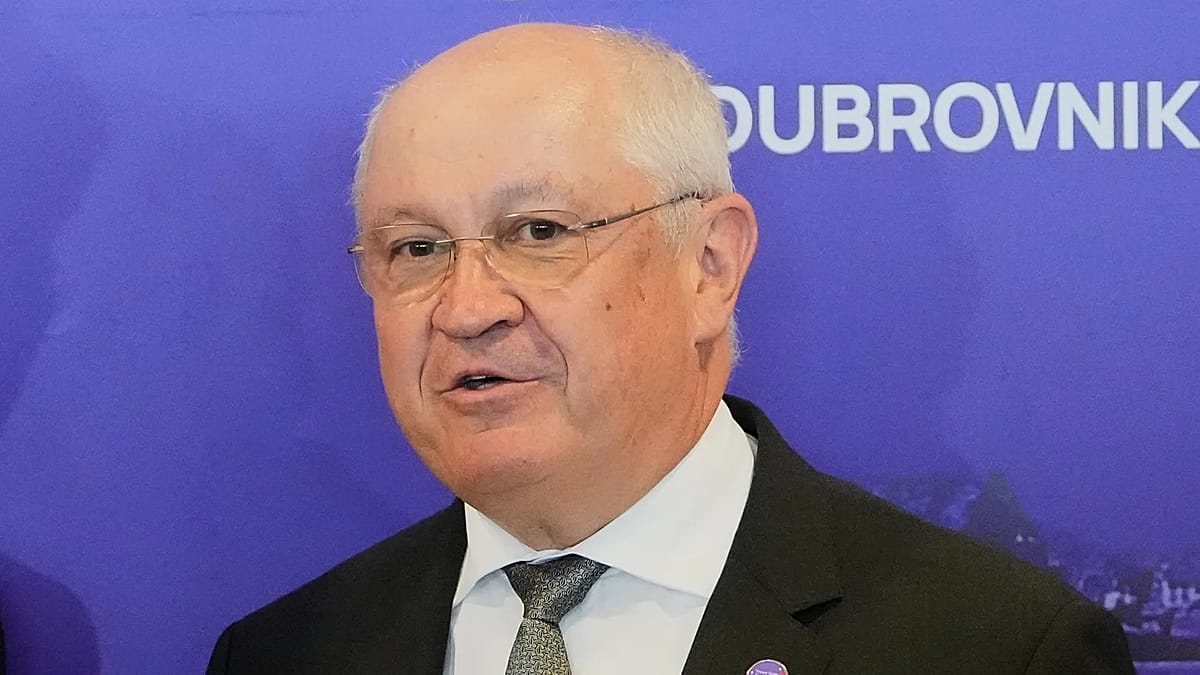
Moldovan Prime Minister Alexandru Munteanu announced his resignation on Friday, stepping down after just eight months in office. In a brief social media post, Munteanu stated that he could no longer carry out his mandate in line with his “principles and convictions,” offering no further elaboration on the specific reasons behind his decision.
“I accepted the responsibility of serving as Prime Minister with a deep sense of duty and the firm conviction that I could help bring about positive change,” Munteanu wrote. “The moment I realized that I could no longer carry out my mandate in accordance with my principles and convictions, I chose to step down.”
President Maia Sandu responded on X, thanking Munteanu for his work and confirming that she would begin consultations with Moldova’s political parties on Monday to select a new prime minister. “Moldova’s path remains unchanged: reforms and EU accession,” Sandu added, signaling continuity in the country’s strategic direction.
During a press conference, Sandu rejected suggestions that Munteanu had resigned because he was “not allowed to fight against abuses,” calling such claims “false.” She insisted that the prime minister had “a free hand to lead the government as he saw fit.”
Background and Context
Munteanu took office in November 2025, bringing a background in finance from roles at the National Bank of Moldova and the World Bank in Washington, D.C. He is also the founder and managing partner of 4i Capital Partners, an investment firm managing portfolios across Moldova, Ukraine, and Belarus. His resignation adds to a pattern of short-lived governments in Chișinău, echoing recent instability in the region—similar to the resignation of Lithuanian Prime Minister Inga Ruginienė after ten months.
The departure comes at a critical juncture for Moldova, which is pursuing European Union accession while managing tensions with the breakaway region of Transnistria. Sandu’s government has framed EU integration and the Transnistria settlement as parallel processes, as noted by a recent ministerial statement on Moldova's EU accession and Transnistria settlement. The political vacuum could slow reforms, though Sandu’s firm control over the pro-European majority in parliament may mitigate disruption.
Munteanu’s resignation also highlights broader challenges for small European states balancing internal governance with external pressures from Russia and the EU. Moldova, a candidate for EU membership since 2022, has faced energy crises and hybrid threats, but remains committed to its European path. The next prime minister will need to navigate these issues while maintaining public trust.
Analysts in Chișinău note that Munteanu’s brief tenure and vague resignation may reflect deeper friction within the ruling coalition, though Sandu’s public support suggests a managed transition. The president’s consultations starting Monday will likely focus on finding a candidate who can continue reforms without triggering early elections.