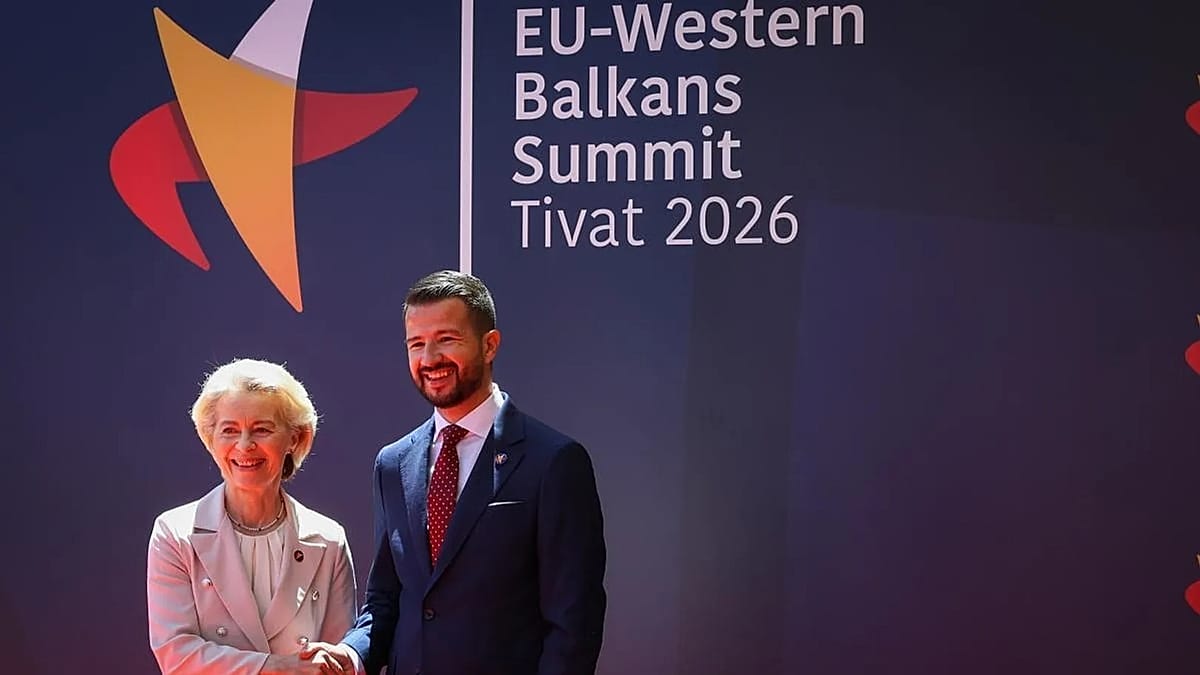
Montenegro has signalled its willingness to accept stronger EU rule-of-law safeguards designed to prevent future members from backsliding on democratic standards — but only if those safeguards are anchored in objective, case-by-case assessments and do not create a permanent second tier of membership.
Petar Marković, Montenegro's ambassador to the European Union, told European Pulse that Podgorica broadly supports the principle of post-accession guarantees, noting that the country already outperforms several current member states on rule-of-law reforms, according to the European Commission's latest enlargement report. However, he insisted that any mechanism for suspending voting rights or imposing other penalties must be triggered only by clear, verifiable evidence of systematic breaches.
“Montenegro has an interest in introducing guarantees meant to maintain EU standards. But the potential breaches would have to be assessed on a case-by-case basis against objective criteria to prove systematic backsliding,” Marković said.
Debate Over Enlargement Reform Intensifies
The debate comes as five of the six founding EU member states — including France, Germany, and the Netherlands — have called for tougher safeguards against democratic rollback after accession, a direct response to the erosion of rule-of-law standards in Hungary under Prime Minister Viktor Orbán. The proposal has gained traction as the EU seeks to avoid repeating past mistakes with future members.
Marković argued that the criteria for triggering safeguards must be agreed before a country joins, and should not be used to pre-emptively curtail a new member's voting rights through a transitional period. He described such an approach as politically and legally dubious, warning it could effectively create a second-class membership.
“This is not about what we deserve. This is a rational choice,” he added. “Discussions on a new methodology should focus on the candidate countries for which the current methodology has not worked. For Montenegro, it clearly has.”
Montenegro is the most advanced candidate in the accession process, having opened all negotiating chapters and aiming to become the 28th EU member state by 2028. But its bid could be complicated by a broader push to overhaul how enlargement works, including proposals for “gradual integration” championed by France and Germany, which would allow candidate countries to access certain EU benefits earlier in the process.
Marković welcomed the return of enlargement as a top political priority in European capitals, but cautioned against changing the rules after 14 years of intensive negotiations. “For far too long, there has not been a real discussion on the enlargement methodology,” he said. “But it would be unfair to change the rules this late — especially since Montenegro was the first country to accept, and the most advanced country approaching the finishing line under the current methodology.”
The ambassador acknowledged that one of Montenegro's main incentives for accepting new safeguards is that they could smooth the ratification process, providing additional reassurance as the political spectrum in some founding members shifts rightward and grows more sceptical of enlargement. This is particularly relevant as Montenegro's EU accession could reshape budget negotiations, making the stakes high for both Podgorica and Brussels.
Marković's remarks come amid broader discussions on EU reform, including calls from Ursula von der Leyen and Mark Rutte for European NATO members to shoulder more defence burden, and ongoing debates about the bloc's capacity to absorb new members. The outcome of these negotiations will have significant implications for the Western Balkans and the EU's strategic autonomy.
As the EU grapples with internal divisions and external pressures, the question of how to balance enlargement with institutional integrity remains central. For Montenegro, the path to membership hinges on a delicate equilibrium: embracing necessary reforms without being relegated to a permanent probationary status.



