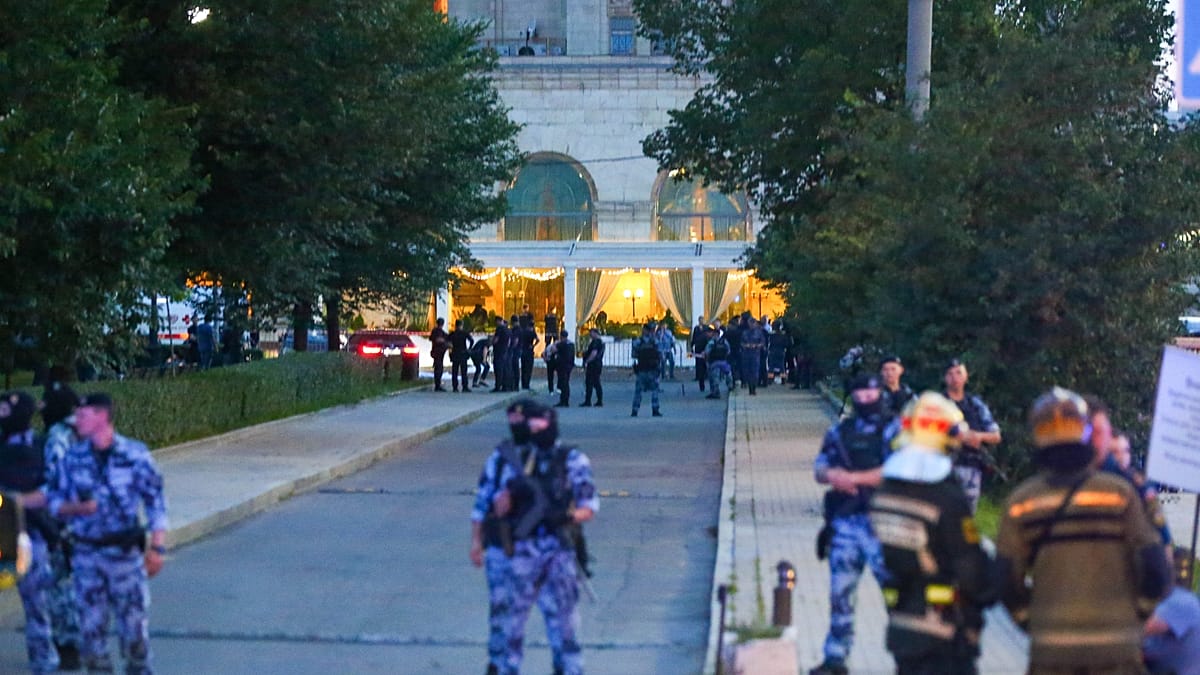
An explosion tore through a restaurant in central Moscow on Saturday evening, killing three people and injuring 21 others. Russia's national anti-terrorism committee said the blast was caused by a homemade explosive device, according to the state news agency Tass.
The incident occurred at a venue on Kudrinskaya Square, a busy area in the Russian capital. The committee reported that the device was carried into the restaurant by a woman, who was among the dead. A security guard who intercepted her and a customer also lost their lives.
Initial reports from the Telegram channel Baza, which has close ties to Russian security services, suggested a gas explosion from the kitchen. However, the anti-terrorism committee's statement confirmed the use of an explosive device, shifting the focus to a deliberate attack.
The restaurant had been booked for a private birthday party, and according to reports, the commander of the Russian Air Force, Alexandre Tchaïko, was present at the time. Moscow police told the Ria Novosti news agency that investigators and forensic specialists were at the scene, while images on Russian Telegram channels showed fire engines and ambulances outside the building.
A pattern of attacks on Russian soil
Russia has experienced a series of explosions and assassinations in recent years, many linked to the war in Ukraine. Since the full-scale invasion began in 2022, Ukraine's security services have either claimed responsibility or been accused of carrying out attacks on military officers and public figures who support the conflict.
In April 2025, Russia blamed Ukraine for the car bomb killing of senior general Yaroslav Moskalik. Earlier, in August 2022, Darya Dugina, daughter of ultranationalist ideologue Alexander Dugin, was killed when a bomb attached to her car exploded outside Moscow. Many believe her father was the intended target.
In April 2023, pro-Kremlin military blogger Vladlen Tatarsky, whose real name was Maxim Fomin, died when a statuette he was handed detonated at a café in Saint Petersburg. A bomb on a scooter killed General Igor Kirillov, head of the Russian army's chemical weapons division, and his assistant in December 2024. The writer and nationalist Zakhar Prilepin was seriously wounded in a car bombing in May 2023 near Nizhny Novgorod.
The latest explosion in Moscow adds to a growing list of violent incidents that have shaken the Russian capital and beyond. While the anti-terrorism committee has not yet named any suspects, the pattern of attacks targeting military and political figures suggests a possible connection to the ongoing conflict in Ukraine.
European observers will be watching closely, as such incidents could further escalate tensions between Moscow and Kyiv, with potential repercussions for the wider continent. The attack also raises questions about security in Russian cities and the effectiveness of counter-terrorism measures.
As investigations continue, the international community awaits more details. For now, the focus remains on the victims and the broader implications of this latest act of violence in the heart of Moscow.