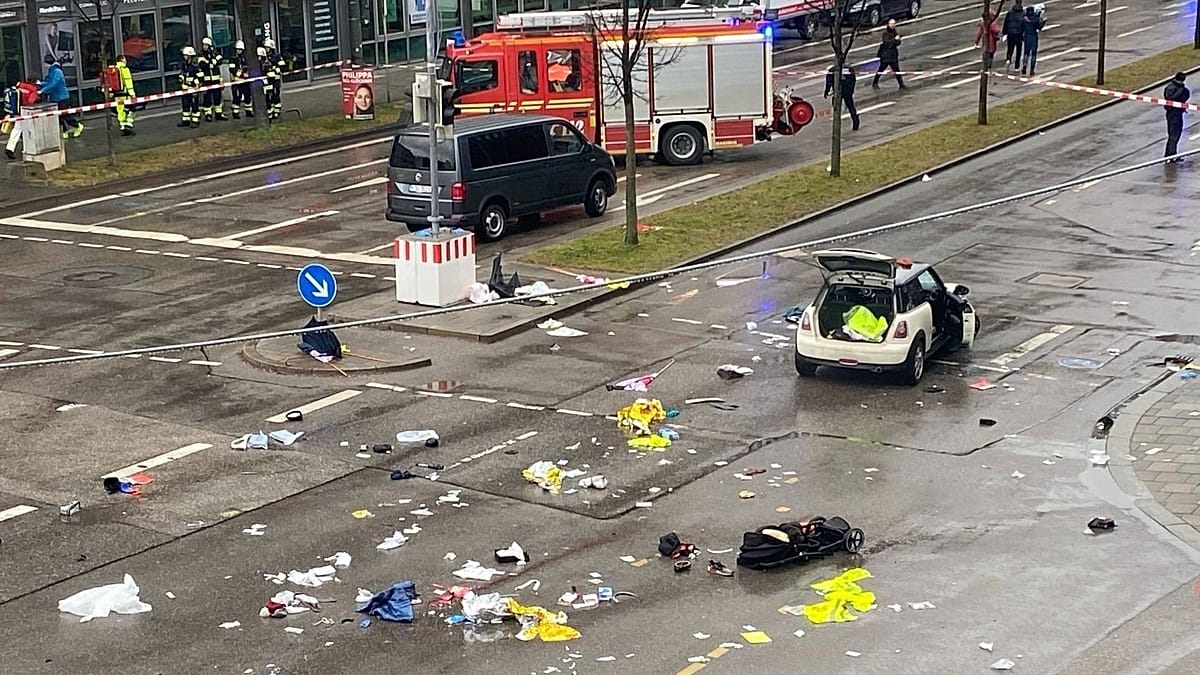
A Munich court on Thursday sentenced Farhad N., a 25-year-old Afghan national, to life imprisonment for the car-ramming attack that killed a two-year-old girl and her mother and injured dozens of others in February 2025. The verdict, delivered by presiding judge Michael Hoehne, found Farhad N. guilty of two counts of murder, 23 counts of attempted murder, and 22 counts of bodily harm, 19 of them serious.
The court also determined that the offences carried a "particular gravity of guilt," a legal designation that significantly reduces the possibility of early release. Farhad N. showed no emotion as the sentence was read out.
Attack on a trade union march
The attack occurred on 13 February 2025, on the eve of the Munich Security Conference, a major gathering of global political and defence leaders. Farhad N. drove a Mini Cooper around a police car and accelerated into a 1,400-strong trade union march, hurling a 37-year-old woman and her daughter through the air for ten metres. Both sustained severe head injuries and died days later.
Judge Hoehne described the aftermath as "a field of nothing but debris, 12 metres wide," and noted that some victims "are still suffering today." He quoted one victim as saying they had lived "one life before the attack and another one after it." The judge also remarked that the attack would have been even deadlier had the car not been slowed and eventually stopped by the number of people it ran over.
The mother had deliberately chosen to walk at the back of the march, believing it was safer due to a stronger police presence, Hoehne said.
Motivation and radicalisation
Prosecutors argued that Farhad N. acted out of "religious motivation," citing his utterance of "Allahu Akbar" after the rampage. However, they did not link him to any organised jihadist network such as the so-called Islamic State. Instead, they pointed to his loneliness and anxiety as contributing factors. Farhad N. himself did not disclose any motivation during the trial.
Judge Hoehne described Farhad N. as having "a fragile sense of self-worth" while trying to present "an idealised image of himself." The defence had requested that he be sent to a psychiatric facility, but court-appointed experts concluded that his mental health issues did not diminish his criminal responsibility.
Farhad N. arrived in Germany unaccompanied in 2016 at the age of 15. His asylum application was rejected, but he was permitted to remain in the country and work. Police said he had been employed in the security sector and was heavily involved in fitness training and bodybuilding. Investigators believe he was radicalised in the months before the attack by consuming online content from radical Afghan preachers.
Political fallout
The attack came just days before Germany's federal election in February 2025, and was one of several violent incidents involving foreign nationals that inflamed the national debate on immigration and security. The far-right Alternative for Germany (AfD) achieved its best-ever result, securing over 20% of the vote. The centre-right CDU/CSU emerged as the largest bloc, and its leader Friedrich Merz became chancellor, promising a tougher line on immigration to counter the AfD's rise.
Since then, however, the CDU/CSU has seen its support slump, while the AfD has established a steady lead in opinion polls. The case has also resonated beyond Germany, as similar incidents have occurred elsewhere in Europe, including a murder in Greece that has raised questions about security and migration. The Munich verdict is likely to keep these issues at the forefront of political discourse across the continent.