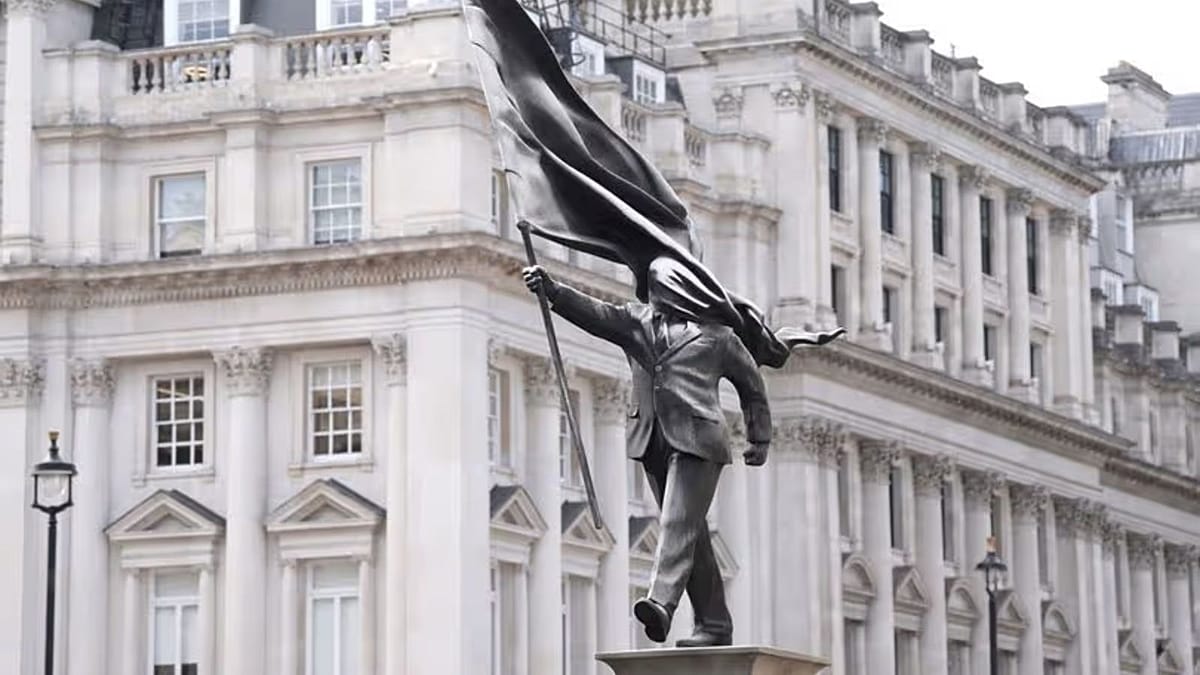
An enigmatic statue appeared overnight in central London, drawing crowds and sparking intense speculation. The figure, a man in a suit, is depicted walking off the end of a plinth, his face obscured by a flag attached to a pole he carries. The installation was discovered in Waterloo Place, just 450 metres from Downing Street, near statues of Edward VII and the Crimean War Memorial.
Given the location and the politically charged imagery, many have assumed this is the latest work from the elusive street artist Banksy. A signature resembling his scrawl at the base of the statue has fuelled this suspicion. However, Banksy typically confirms his authorship by posting on his Instagram account, and as of now, no such post has appeared. This silence, combined with the fact that none of his recent London murals have been signed, leaves the matter unresolved.
A Political Statement in Stone
If this is indeed a Banksy, it aligns with his history of making pointed political statements. The suited figure could be interpreted as a politician—given the proximity to the seat of British government—who is blinded by a flag, symbolising misplaced patriotism, and walking off a cliff edge. This imagery offers a stark commentary on the current state of political leadership, not just in the United Kingdom but across Europe, where nationalist rhetoric often obscures rational decision-making.
The statue's appearance comes at a time of heightened political debate in Europe, from the ongoing war in Ukraine to the rise of populist movements in countries like Italy and France. The message of a leader blindly following a flag into disaster resonates beyond London, touching on broader European anxieties about the direction of governance.
Banksy's work has often engaged with European themes. His murals in Calais, for instance, highlighted the migrant crisis, while his pieces in Ukraine during the war drew global attention. This latest installation, if authentic, would continue that tradition of using public art to provoke thought about pressing issues.
Renewed Interest in Banksy's Identity
The statue's appearance coincides with renewed media interest in Banksy's identity. A recent report by Reuters claimed to have uncovered evidence that the artist is Robin Gunningham, a 51-year-old from Bristol. The report cited a trip to Ukraine in 2022, photographs posted by former associates, and a handwritten confession note from an arrest in New York in 2000. According to the investigation, Gunningham changed his name to David Jones years ago to avoid identification.
While this report has not been independently verified, it has reignited debates about the artist's anonymity. Banksy has managed to maintain his mystique for decades, a feat that has become increasingly difficult in the age of social media and surveillance. The statue in London, whether or not it is his work, serves as a reminder of his enduring ability to capture public attention.
For now, the statue remains in place, drawing curious onlookers and art enthusiasts alike. The lack of official confirmation from Banksy only adds to the intrigue. In the meantime, London continues to be a hub for cultural and political events, from the London Stock Exchange ETF adding first Ukrainian firms to a reconstruction fund to the EU pushing for tough shipping emissions rules at IMO talks in London.
Whether this statue is a Banksy or not, its message is clear: blind nationalism leads to ruin. In a continent grappling with the consequences of populism and war, that message is as relevant as ever.