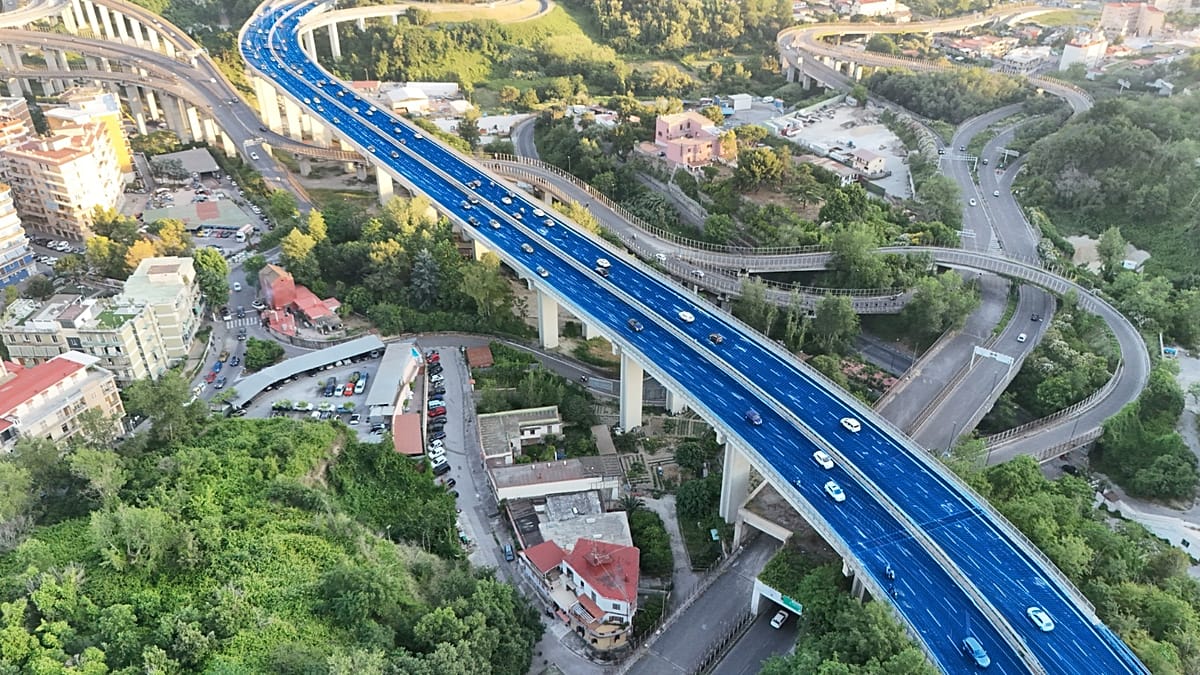
Italy's smart mobility ambitions have taken a concrete step forward in Naples. The Tangenziale di Napoli, the city's ring road, has been officially certified as the country's first Smart Road by the Ministry of Infrastructure and Transport. The designation confirms that the infrastructure meets advanced standards for real-time monitoring, intelligent traffic management, and two-way communication between road and vehicle.
The project is a collaboration between Tangenziale di Napoli (part of the Autostrade per l'Italia Group), the ministry, the National Centre for Sustainable Mobility (MOST), and Movyon, the technology arm of Aspi. The goal is to transform a vital urban artery in southern Italy into a national model for safer, more efficient, and sustainable mobility.
Three Pillars of the Smart Road
To earn the certification, the ring road had to meet three core requirements. First, intelligent traffic monitoring: a network of sensors along the entire 22-kilometre route collects continuous data on vehicle flow. This information is processed by advanced traffic models, allowing operators in the control centre to anticipate congestion and intervene before problems escalate.
Second, environmental monitoring: weather stations and dedicated sensors track rainfall, road surface conditions, water levels, and surrounding terrain. The system is designed to detect hydrogeological risks such as floods or landslides, alerting operators when safety thresholds are exceeded. This is particularly relevant for a region like Campania, which has faced severe weather-related disruptions in recent years.
Third, and most innovative, is vehicle-to-infrastructure (V2I) communication. Using ITS-G5 and Cellular V2X technology, connected vehicles can receive real-time information on accidents, roadworks, obstacles, weather, and recommended speeds. In turn, vehicles transmit data back to the infrastructure, giving operators a more precise and immediate picture of traffic conditions. This shifts traffic management from reactive to proactive.
Technology in Numbers
The infrastructure upgrade is substantial. Along the 22 kilometres, the project has installed 217 smart cameras, 15 traffic detection gantries, 8 weather stations, and 40 communication antennas. All data flows into Movyon's C-ITS central platform, which integrates information from the road with external sources to provide continuous monitoring of vehicle position, speed, and direction.
Currently, 30 connected vehicles operate on the ring road, communicating constantly with the network. The system can warn drivers of dangerous situations—roadworks, broken-down vehicles, adverse weather—and suggest optimal speeds to prevent queue build-up.
Autonomous Driving Tests
One of the most striking aspects of the project is the testing of self-driving vehicles. On the stretch between Vomero and Fuorigrotta, engineers conducted Italy's first test in which an autonomous vehicle changed its speed in real time based on instructions from the road infrastructure. This marks a significant step toward integrating autonomous driving into everyday traffic.
Arrigo Giana, chief executive of Autostrade per l'Italia, said: “The goal achieved today by the Autostrade per l'Italia Group is a very important result. One of the pillars of this process is technology. Thanks to the synergies developed within our Group, we have shown that we can be a trailblazer and a testing ground for the mobility of the future.”
The Naples ring road project is part of a broader European push toward smart infrastructure. While Italy has lagged behind some northern European countries in digital transport innovation, this certification signals a shift. The European Union has been promoting connected and cooperative mobility through initiatives like the C-Roads platform, and Italy's progress in Naples could serve as a template for other southern European cities facing similar challenges of congestion and ageing infrastructure.
As the continent grapples with the need to modernise transport networks while reducing emissions, projects like the Tangenziale di Napoli demonstrate that incremental, technology-driven improvements can yield immediate safety and efficiency gains. The next step will be scaling these systems across Italy's motorway network and integrating them with broader smart infrastructure initiatives that are reshaping Europe's critical assets.