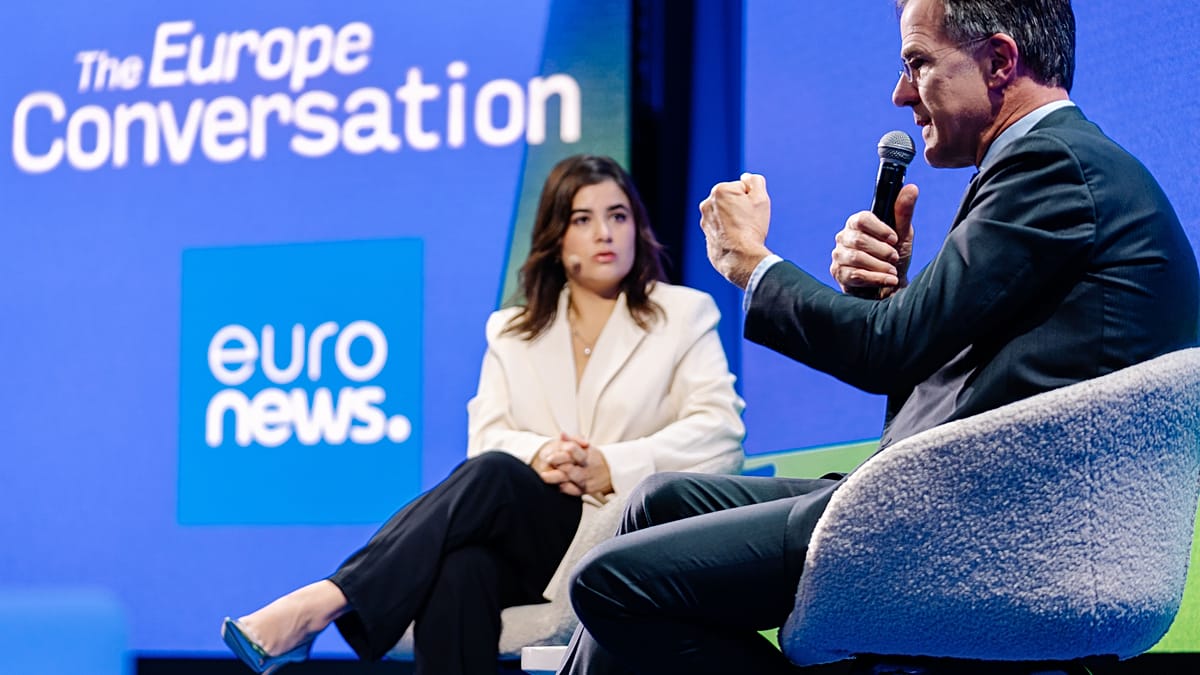
BRUSSELS — The debate over whether European countries should favour their own defence manufacturers is a 'luxury' when the real problem is that neither Europe nor the United States can produce enough weapons, NATO Secretary General Mark Rutte said on Wednesday.
Speaking at the Euronews Defence & Space Summit in Brussels, Rutte dismissed the argument that has divided EU capitals in recent months. 'The problem is not: do you buy in Europe or do you buy it in the United States? The problem is: can you buy? The money is there. But the defence industrial base in Europe is underdeveloped. It is not producing enough,' he said.
The EU has been wrestling with whether to introduce a 'European preference' in public defence contracts, a proposal strongly backed by France, which wants to protect its domestic industry, while Germany prefers a more open approach that includes NATO allies. Rutte, who comes from a free-market tradition, said the debate is misplaced because neither side of the Atlantic can meet surging demand.
'It's always better if you have these free markets functioning as open and independent as possible. But at the moment, I think it is a discussion of luxury, whether you buy European or American, because we cannot buy on both sides. There's not enough production,' he said.
Industry urged to invest and innovate
Rutte called on defence companies to invest in expanding capacity and to innovate to produce state-of-the-art equipment. He pointed to the transatlantic nature of the industry, noting that European firms like Thales are investing in the US, while American companies are investing in Europe. 'It is a transatlantic defence industrial base that is working as one, and that's exactly as it should be,' he said.
The NATO chief cited Ukraine's urgent need for anti-ballistic missile interceptors as a stark example. Neither the Franco-Italian SAMP/T nor the US-made Patriot systems are being produced in sufficient numbers to supply Kyiv, he said.
His comments come as European leaders gather in Brussels to discuss defence readiness and hybrid threats. The summit, which Rutte joined, is part of a broader effort to rethink Europe's security posture. Earlier, Estonian MEP Riho Terras warned that Europe's defence industry is not ready for rearmament, and Belgian Foreign Minister Bernard Francken called for faster action amid a 'dark winter' warning.
Rutte's remarks highlight a growing consensus that Europe must do more to bolster its defence capabilities, but the path forward remains contentious. While France pushes for a 'Buy European' policy, others argue that such protectionism could undermine NATO unity and drive up costs.
For now, Rutte's message is clear: the immediate challenge is not where to buy, but whether anyone can deliver. As he put it, 'The money is there' — but the production is not.