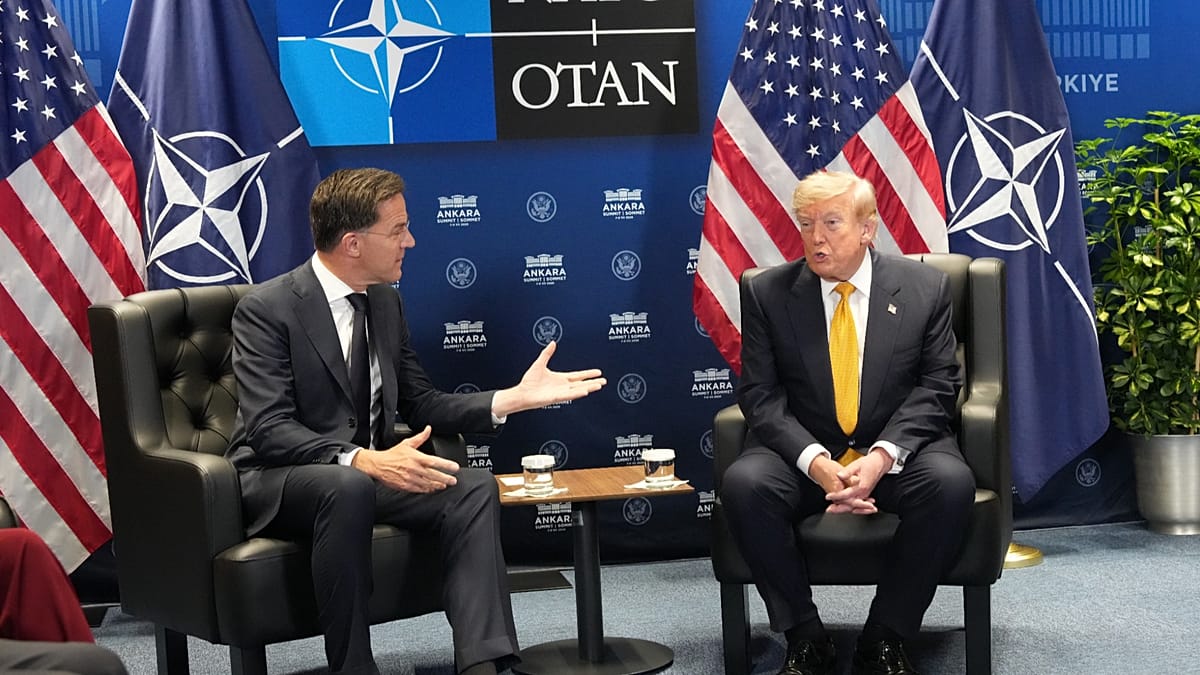
This week's NATO summit in Ankara was the most anticipated in years, as European allies sought to demonstrate their commitment to taking greater control of their own defence. After five years of war on the continent and two years of friction with a confrontational White House, the gathering was a pivotal moment for Europe to prove it is serious about reducing its reliance on US military support.
At Tuesday's Industry Defence Forum, European allies heralded $50 billion (€43 billion) in deals for defence production and procurement, covering submarines, Patriot missile defence systems, interceptors, and ammunition. These announcements were presented as evidence that the alliance is on a credible path to spending 5 percent of its GDP on defence by 2035.
Among the headline announcements was a decision by NATO to choose Swedish company Saab to manufacture surveillance planes, replacing the Airborne Warning and Control System currently operated with US Boeing planes. This move underscores Europe's ambition to develop its own military capabilities.
In addition, NATO's Drone Hedge initiative commits $40 billion (€35 billion) to counter-drone capabilities over the next five years, covering the entire alliance. It also focuses on hiring and training pilots and will be fully interoperable across all allied states. "Drones have fundamentally altered, as we all know, the character of modern warfare," said NATO Secretary General Mark Rutte at the Defence Industry Forum. "They have become a decisive factor on the battlefield. This is clear from what we see in Ukraine, in the Middle East, and across the alliance."
Drone incursions into NATO territory, particularly in the Baltic countries, are becoming increasingly frequent, and the alliance has been under pressure to respond in an agile, cost-effective manner. Daniel Fiott of the EU Institute for Security Studies noted, "The really interesting thing is how much work the European allies have done behind the scenes when it comes to defence and arms deals. Working together on different aspects of security, and frankly that's what we need. We need more of it, and we need it on steroids at this precise moment in time."
Made in Ukraine
In a significant and welcome move, US President Donald Trump appeared to approve the licensing of the US Patriot defence systems to Ukraine. Patriots have proven the best interception systems for responding to Russian ballistic missile attacks; Kyiv has been lobbying for the right to produce its own for some time, but there was no guarantee Trump would agree. "A little birdie told me this, about the fact that we'll give them the right to make Patriots," said Trump, sitting next to Ukrainian President Volodymyr Zelenskyy ahead of their meeting in Ankara. "We'll show them how to do it, it's very complex actually. But it's – you'll figure out the complexity quickly."
Max Bergmann of the Centre for Strategic and International Studies said Trump's openness on this front is testament to Ukraine's strength. "President Zelenskyy and Ukraine have a lot of cards now, and Trump has realised he can't bully the Ukrainians now because Ukraine has moved on and is interacting with Brussels," Bergmann told Euronews' NATO special report.
Still, US dominance within NATO is far from over. As Nico Lange, analyst with Rasmussen Global, put it, the Europeanisation of the alliance will not become a reality unless its members "replace NATO's strategic enablers with European ones". This includes fundamental military infrastructure needed to connect soldiers and assets across the alliance, including "satellite based time code, navigation, airborne electronic warfare and precision deep strike," he said. Lange explained that while the consensus among leaders is that the summit passed off relatively incident-free, Europe needs to take Trump's renewed threats toward Greenland seriously and never forget his mercurial nature, where at any moment he could choose a vastly different path, damaging the alliance.
But Fiott says that while Europe will rely on the US for defence for some time, the direction of travel—a move away from US dependency—is clear. "We'll still need the US, at least for the short term as some weapons are only available from there," said Fiott. "But the direction of travel is very clear for the longer term. We're not going to be spending taxpayers' money in Europe without a return. And the return is jobs and European-made capabilities, and I think that is the longer-term trajectory for Europe here."
That was the message Rutte delivered at a press conference on Tuesday, as he tried to frame the summit as a story of Europe stepping up. "New capabilities are being delivered, industry is expanding production, and European Allies and Canada are assuming greater responsibility for our shared security," said Rutte. "The Europeans have stepped up. The EU has stepped up and is now the major military financial backer for Ukraine."
However, at the start of the summit, it looked as if Trump was about to ignore his partners' best efforts to impress him. A bristling US President arrived in Ankara Tuesday evening, clearly unhappy to be there and telling allies he was only present out of respect for the host, Turkish President Recep Tayyip Erdoğan. Almost immediately upon his arrival, he began castigating European countries for not supporting Washington as part of its war in Iran. But Trump's claims in this regard are exaggerated, and during a press briefing on Wednesday, Rutte softly intervened to correct the record, saying that certain states' refusals to let the US use European airbases as waystations for its air campaign were "isolated" incidents. Rutte pointed out that 5,000 US aircraft had taken off from European bases at the peak of the conflict, illustrating that "Europe again is one big platform of power projection for the United States."
For more on the summit's outcomes, see our coverage of NATO Summit Ends with Trump's Greenland Ultimatum and EU Sanctions Stalemate and Trump's Iran Strikes Overshadow NATO Summit as Allies Pledge Record Spending.