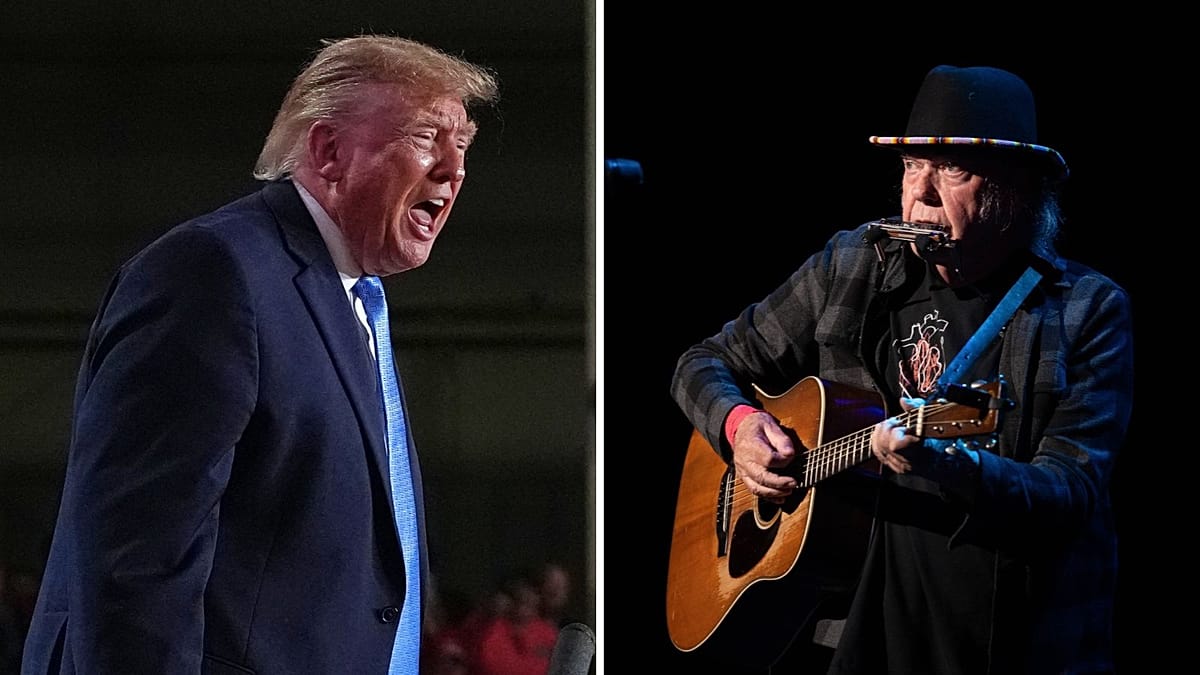
Canadian rock legend Neil Young has taken legal action once more against Donald Trump's political machinery, filing a $10 million (€8.9 million) copyright infringement suit against Trump 47 Committee Inc. The complaint, lodged on Monday and seen by Variety, centres on the continued use of Young's 1989 anthem 'Rockin' in the Free World' as walk-on music at rallies, including a recent event in Youngstown, Ohio.
The lawsuit argues that the committee's use of the song breaches the terms of a settlement reached in 2020, when Young and his publishing company, Silver Fiddle Music, sued Trump's presidential campaign over the same track. That earlier case was dismissed only after the campaign agreed not to play the song without explicit permission. The new filing states: "The Committee does not now have, and did not at the time of the Youngstown Rally or any other rally financed and conducted by the Committee, have a license or Young's permission to play the Song at any public political event."
Young's legal team is seeking damages and an injunction to prevent the committee from using the song in public. The suit also claims that Young "has suffered and continues to suffer from great injury" and that his reputation and brand have been damaged by the implication that he supports Trump.
A song that mocks the American dream
The lawsuit takes pains to explain why the song is fundamentally at odds with Trump's political message. Written during the presidency of George H.W. Bush, 'Rockin' in the Free World' is a scathing critique of American society, highlighting poverty, homelessness, and the hollow promises of political rhetoric. The legal document describes it as "a blistering anthem that contrasts the hollow promises of American political rhetoric with the harsh realities faced by the poor, homeless and forgotten." It adds: "The lyrics paint vivid street-level portraits - a mother discarding her baby, addicts lost in despair, garbage piling in the shadows of prosperity - while the repeated chorus delivers a savage irony, celebrating freedom that clearly isn't shared by all."
In short, the suit concludes, "the song is the opposite of everything that Donald J. Trump stands for." The opening lines—"There's colours on the street / Red, white and blue / People shufflin' their feet / People sleepin' in their shoes"—hardly require deep analysis to grasp the irony.
Young has long been one of Trump's most vocal critics in the music world. Last year, he defended Bruce Springsteen and Taylor Swift after Trump attacked them, writing on his Neil Young Archives website: "Bruce and thousands of musicians think you are ruining America. You worry about that instead of the dyin' kids in Gaza. That's your problem. I am not scared of you. Neither are the rest of us." He also criticised Trump's handling of FEMA during disasters and urged Republicans to "wake up."
Earlier this year, Young offered Greenlanders free access to his music archive in response to Trump's threats to annex the island. "I'm honoured to give a free year's access to neilyoungarchives.com to all of our friends in Greenland," he wrote. "I hope my music and music films will ease some of the unwarranted stress and threats you are experiencing from our unpopular and hopefully temporary government."
Young is not alone in taking legal or public action against Trump's unauthorised use of music. Over the years, artists including The Rolling Stones, Adele, Foo Fighters, Céline Dion, The White Stripes, ABBA, and Creedence Clearwater Revival have objected. Bruce Springsteen protested in 2016 when 'Born in the U.S.A.' was used as a patriotic anthem, despite its critical take on the treatment of Vietnam veterans. Rihanna demanded Trump stop playing 'Don't Stop the Music' after a 2018 rally, and R.E.M. expressed outrage over the use of 'Losing My Religion' and other tracks.
In 2020, Leonard Cohen's estate issued a statement criticising the unauthorised use of 'Hallelujah' at the Republican National Convention, noting they had specifically rejected permission. The estate wryly added they might have considered 'You Want It Darker' instead. More recently, Ariana Grande called out the White House for using one of her songs in a social media post promoting ICE arrests, writing: "Please do not ever use my music in relation to this barbaric, inhumane, heinous nonsense. F*** ICE."
This latest lawsuit underscores a recurring pattern: musicians across genres and generations have repeatedly sought to distance themselves from Trump's political brand. For Young, the fight is personal and principled. As he wrote in his blog: "You are forgetting your real job. You work for us. Wake up Republicans! This guy is out of control. We need a real president!"
The case also highlights broader questions about political campaigns' use of copyrighted music without consent—a issue that resonates beyond the United States, as European artists and politicians watch closely. While the legal battle unfolds in American courts, the message from Young and his peers is clear: music is not a prop for political theatre.