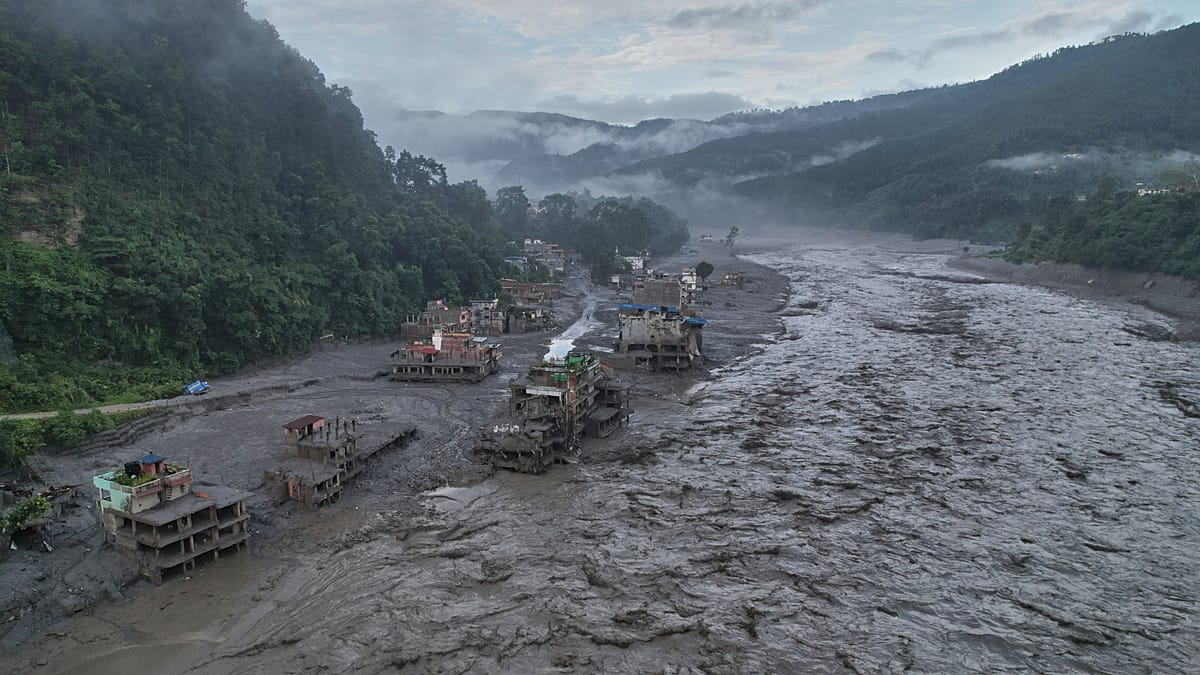
Authorities in Nepal have issued fresh flood warnings for Sunday, urging residents in affected districts to remain alert after the Bhotekoshi River's water level rose again. The alerts, sent to mobile phones throughout the morning, came as rescue teams worked to clear a key route linking Kathmandu to one of the areas hardest hit by Wednesday's catastrophic floods.
In the town of Galchhi, residents gathered on a nearby bridge to watch the river surge past, pointing at enormous boulders carried downstream by the earlier deluge. Others standing on a suspension bridge were warned off with whistles as the water roared below.
The thick grey-brown mud that has engulfed entire communities in the worst-hit areas was visible along the river, with houses, cars, and farm tractors protruding from the debris. Landslides have also carved away parts of the rice terraces that line the river valley.
Rising toll and missing thousands
By Sunday, the combined death toll in Nepal and Tibet had climbed to 750, with more than 3,000 people still unaccounted for. Nepal's disaster agency reported 734 deaths and 2,498 missing, while Chinese authorities confirmed 16 deaths and 546 missing, including over a hundred Nepalis and nationals from more than a dozen countries.
The latest warnings followed an alert from Chinese officials about increased water flow upstream, according to Dharam Raj Uprety, chief executive of Nepal's National Disaster Risk Reduction and Management Authority.
But residents in the flood-hit villages said they were struggling to cope with the near-constant alarms. “Sometimes they say a flood is coming, then we have to run again to higher ground, even at night. There is also rain,” said local resident Govind Shreshta. “It's really difficult for me. I have a 72-year-old father and a 70-year-old mom. I must carry them, and I am exhausted. It's going on like this for those who are still alive.”
The floods have destroyed both large concrete and smaller suspension bridges, cutting off communities on the far side of the river. “Those that are there are now stuck there. Those who are here are stuck here. It's going to be very difficult,” said Sattan Singh Tamang, 47, who was working near a bridge when the floods hit.
Even homes and businesses that survived the initial flooding remain without electricity, with twisted power poles and tangled wires lying in the mud. The disaster has also raised concerns about the region's vulnerability to climate-related events, with scientists pointing to a likely glacier collapse as a trigger for the catastrophic flooding.
International aid efforts are underway, with the Nepali army rescuing hundreds from a flooded tunnel and the diaspora mourning in New York. The UNICEF has warned that 17,000 children need urgent assistance, while hundreds of foreign nationals remain unaccounted for, complicating the relief operation.
As the region braces for further rain, the immediate priority remains evacuating those trapped and restoring basic services. But the scale of the destruction—and the prospect of more floods—has left many residents exhausted and fearful of what comes next.