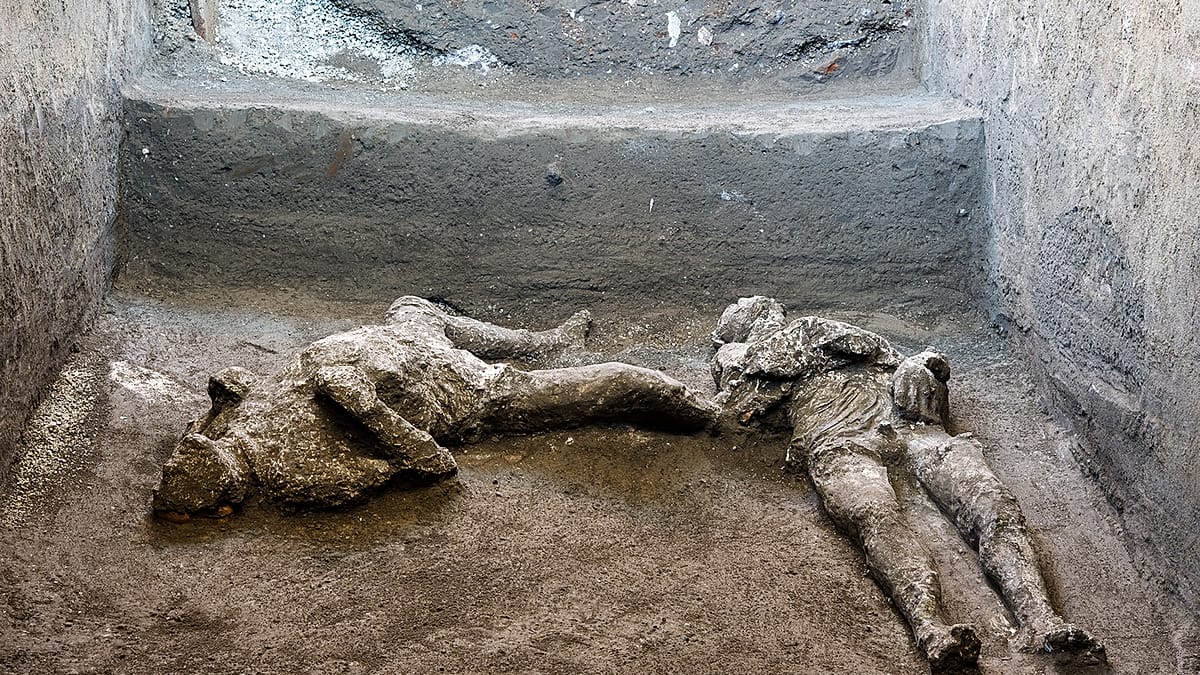
For centuries, the story of Pompeii has been one of sudden catastrophe and eventual rediscovery: a Roman city frozen in time by the eruption of Vesuvius in AD 79, then brought back to light by Bourbon excavations in 1748. But new archaeological finds are complicating that narrative, revealing that the site was not abandoned after the disaster. People lived among the ruins, kept its memory alive, and even used the area during the Renaissance.
The latest evidence comes from the Insula Meridionalis, the southern sector of the ancient city. Archaeologists have uncovered ceramics and other materials dating from the 15th and 16th centuries, providing tangible proof of human activity on the site long before the official excavations began. These finds, announced by the Archaeological Park of Pompeii, add a new chapter to what scholars are calling "Pompeii after Pompeii."
A post-apocalyptic landscape, but not an empty one
After the eruption, Pompeii would have resembled a post-apocalyptic wasteland, buried under meters of ash and pumice. Yet, according to Gabriel Zuchtriegel, director of the Archaeological Park, the city was never completely deserted. "There are traces of people who returned and of communities that continued to use the area," he explains. These were fragile presences, he adds, "faint traces of precarious lives, in the shadow of official history," which is why they remained almost invisible for so long.
The Renaissance-era finds in the Insula Meridionalis now reinforce this picture. The ceramics and other objects point to a period when the area was used for various purposes, centuries before Pompeii regained its place on the map of European heritage. This period is also notable for another reason: it coincides with the creation of the Deposition of Christ, a painting attributed to Andrea Mantegna, recently rediscovered in the Sanctuary of the Blessed Virgin of Pompeii. While the two stories are not directly connected, they both suggest that Pompeii was not a place erased from collective memory.
Local memory versus official history
Zuchtriegel is careful to acknowledge the contributions of early excavators like Gioachino Alcubierre, the Spanish engineer who promoted the first digs in 1748. But he insists that credit must also go to the local community. "Without detracting in any way from researchers such as Alcubierre," he says, "we have to acknowledge that there was a local community here which, from the very day after the eruption, went on living in Pompeii and guarding its memory."
One telling detail supports this view: the place name "Civita," which, according to Zuchtriegel, bears witness to the local persistence of the memory of a buried city. Farmers and shepherds who lived among the ruins may not have had the vocabulary of modern archaeology, but that does not mean they forgot what lay beneath their feet. "Pompeii is and has always been a genuine heritage community," he says.
This shift in perspective has broader implications for how we understand the site. Rather than a city "reborn" from nothing in the 18th century, Pompeii emerges as a place that continued, in different forms, to be part of the life and imagination of the local population. The name itself, then, is not merely a product of archaeological revival but a sign of a memory that has endured for centuries.
The story of "Pompeii after Pompeii" is still largely untold, but the small artefacts found underground this time may prove to be among the most important clues for piecing it together. As Zuchtriegel notes, the theme of the survivors is finally becoming a focus of research and outreach, from docu-dramas to academic studies. The Renaissance finds add a new layer to that narrative, reminding us that history is rarely as simple as it seems.
For those planning a visit, the excavation site remains open, offering a chance to see these latest discoveries firsthand. And for those interested in the broader context of European heritage, the story of Pompeii's enduring memory resonates with other sites across the continent, where local communities have kept ancient histories alive in unexpected ways.