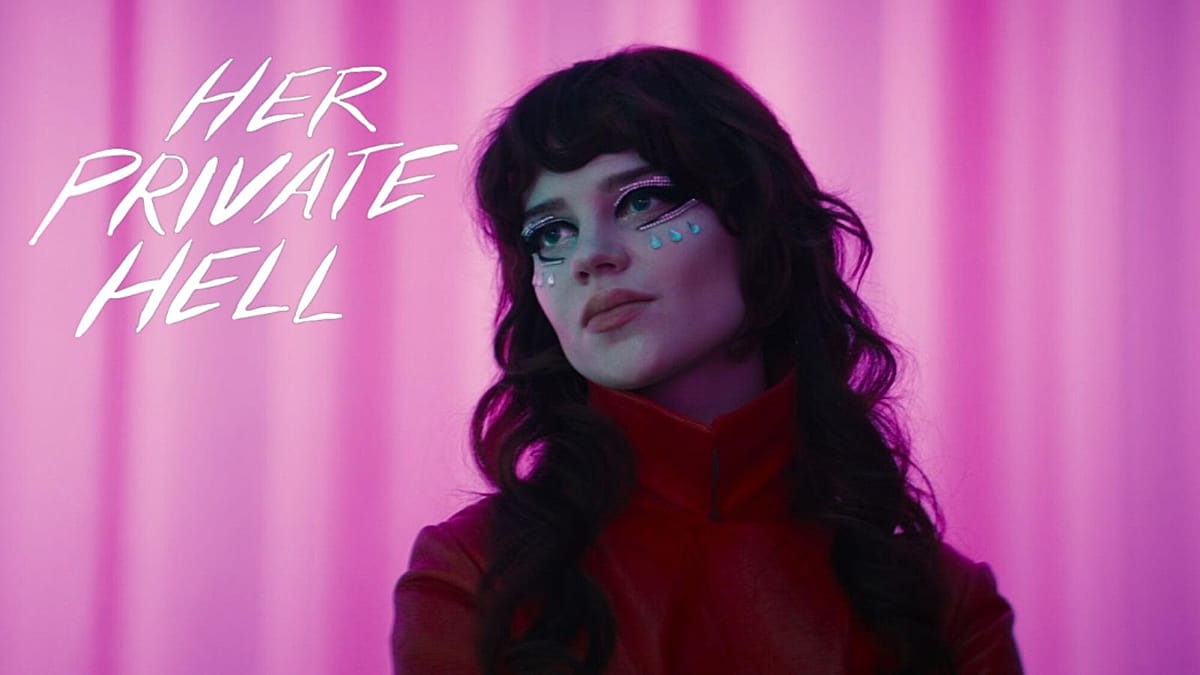
It takes a peculiar kind of talent to make a psychosexual fairytale about a leather-clad serial killer, futuristic cityscapes, and overt homoeroticism feel tedious. Yet Nicolas Winding Refn, the Danish director behind Drive and Only God Forgives, has managed exactly that with his latest feature, Her Private Hell.
Ten years after The Neon Demon, Refn returns with a film that indulges his most self-indulgent impulses. The result is a visually opulent but narratively hollow experience that tests the patience of even the most devoted cinephile.
A Promising Premise Lost in the Mist
The film opens with fog enveloping a neon-drenched metropolis. Elle (Sophie Thatcher), a young woman, meets the seemingly innocent Hunter (Kristine Froseth) in a hotel lobby. They are set to collaborate on a film adaptation of a sci-fi comic called Candy Floss, directed by Elle's father, Johnny Thunders (Dougray Scott). Hunter soon discovers she has entered a world of dysfunction: Elle is grappling with her father's relationship with Dominique (Havana Rose Liu), her former friend and lover, who is now her stepmother.
Meanwhile, the mist brings with it an urban legend: The Leather Man, a BDSM figure with razor-sharp diamond gloves and superhuman strength, who kills women with gruesome precision. Private K (Charles Melton), a military man haunted by the failure to protect his daughter, pursues him, believing that stopping the killer will reunite his family.
Style Over Substance
What cannot be denied is the film's visual prowess. Cinematographer Magnus Nordenhof Jønck crafts moody, atmospheric compositions, while composer Pino Donaggio's score lends a melodramatic weight. The aesthetic initially evokes a fusion of Suspiria and Tron, but this admiration fades quickly.
Once the novelty wears off, what remains is a posturing, deeply banal mess. The film feels like a series of erotic fashion commercials, filled with clichéd non-sequiturs and faux-Lynchian flourishes. The dialogue, co-written by Refn and Esti Giordani, is so stilted that it becomes unintentionally comedic.
“Aren't you the poor little match girl – Hans Christian Andersen.”
Such self-conscious name-dropping is embarrassing, not metatextual. Lines like “Daddy is fascinating” or “I am a wholly unique consciousness, and I am made of stardust” are meant to be provocative but land as pretentious drivel. Even the film's attempts at edginess, such as “I like freaky shit,” feel performative and hollow.
A Few Bright Spots
For those who embrace Refn's horny daydream, Her Private Hell may be defended as a heightened fairytale, with intentionally mannered dialogue and a disjointed fever dream that functions as self-aware provocation. The film-within-a-film, a campy blend of Barbarella and Star Trek, and the bursts of visceral violence in the Private K segments do provide some entertainment. Charles Melton stands out as the only actor who emerges unscathed, offering a performance that momentarily distracts from Sophie Thatcher's grating portrayal and Kristine Froseth's incessant grinning.
Yet for discerning viewers, the film cannot be excused as the uncompromising vision of an enfant terrible. It is far too vacuous and dull for that. Refn's return to the big screen, after a decade away, is a disappointment that will likely appeal only to his most devoted fans.
As European cinema continues to evolve, one hopes that Refn's next project will recapture the energy and narrative coherence that made Drive a modern classic. Until then, Her Private Hell serves as a cautionary tale about the perils of style without substance.