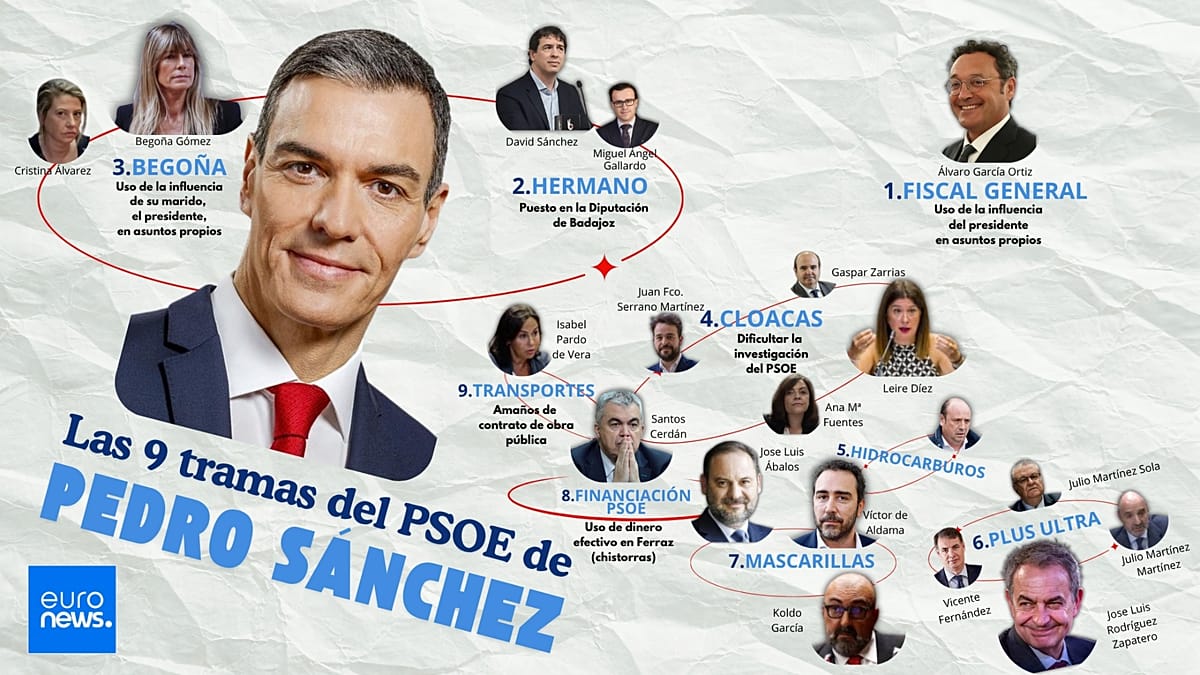
This week, Spanish Prime Minister Pedro Sánchez found himself at the centre of an escalating legal storm as nine separate judicial cases converge on his Socialist Party (PSOE) and its leadership. The pressure intensified on Wednesday when Civil Guard officers spent twelve hours searching the PSOE’s national headquarters on Calle Ferraz in Madrid, acting on an order from National Court judge Santiago Pedraz. The operation sought documents related to the so-called Leire Díez case, which alleges that the party paid €178,000 to a network designed to obstruct judicial investigations targeting Sánchez’s inner circle.
Judge Pedraz has charged former Organisation Secretary Santos Cerdán, former deputy head of the Andalusian regional government Gaspar Zarrías, and PSOE manager Ana María Fuentes. The investigation focuses on payments to Leire Díez, who was arrested in December 2025 and released on bail, for allegedly interfering with judicial proceedings. The court order highlights a meeting held at Ferraz on 26 April 2024, during Sánchez’s self-declared “reflection period,” as particularly significant. The alleged aim was to discredit judges such as Beatriz Biedma, Mercedes Ayala, and Juan Carlos Peinado.
A Cascade of Cases
The same week saw former prime minister José Luis Rodríguez Zapatero named as a suspect in a criminal organisation and influence-peddling investigation linked to the Plus Ultra case. Judge José Luis Calama ordered the freezing of Zapatero’s accounts and those of his daughters, probing alleged illegal commissions tied to the €53 million public bailout of the airline in 2021. Zapatero has been summoned to testify on charges including money laundering and document forgery, though his appearance has been postponed to 17 and 18 June. Prime Minister Sánchez has publicly stood by his predecessor, as reported in Sánchez Stands by Zapatero Amid Corruption Probe Over Airline Bailout.
Meanwhile, the trial of David Sánchez, the prime minister’s brother, began on Thursday at the Provincial Court of Badajoz. Prosecutors are examining whether his 2017 hiring as activities coordinator at the provincial council was a post created specifically for him. The trial could run until mid-June, though prosecutors have ruled that one of the offences is time-barred.
In April, judge Juan Carlos Peinado indicted Begoña Gómez, Sánchez’s wife, on charges of influence peddling, business corruption, embezzlement of public funds, and misappropriation. The case also involves adviser Cristina Álvarez and businessman Juan Carlos Barrabés. Gómez is due to appear at a preliminary hearing on 9 June. This is the same case that prompted Sánchez to write his widely publicised letter to the public in 2024, when he even considered stepping down from the premiership.
The Koldo Case and Its Offshoots
The irregular purchase of face masks during the pandemic has become a central focus of judicial activity linked to the PSOE. The Koldo case, named after a key figure, has spawned multiple branches. One part, directly affecting former minister José Luis Ábalos, was taken over by the Supreme Court due to his parliamentary immunity. Another branch continues at the National Court, where Santos Cerdán, Víctor de Aldama, and several businesspeople remain under investigation.
Two additional cases stem from this main probe: one examining possible illegal financing of the PSOE through cash movements at Ferraz and the so-called “chistorras,” and another focusing on alleged rigging of public works contracts at the Ministry of Transport, which affects former Adif chair Isabel Pardo de Vera. The Hydrocarbons case, investigating VAT fraud, is also linked to the Koldo network through businessman Víctor de Aldama.
Legal sources warn that congestion at the National Court could mean the investigative phase of several cases drags on for three to five years. The first case to conclude involved Attorney General Álvaro García Ortiz, appointed by Sánchez, who was convicted of disclosing confidential data about Isabel Díaz Ayuso’s boyfriend. He received a two-year suspension from the Supreme Court and resigned shortly after, becoming the first Attorney General in Spain’s history to be convicted. He later applied for the conviction to be annulled.
The cumulative effect of these nine cases has placed Sánchez’s government under unprecedented judicial scrutiny, with protests in Madrid demanding his resignation, as covered in Madrid Sees Mass Rally Demanding Sánchez Resignation Over Corruption Claims. The developments underscore the deep entanglement of Spain’s political leadership with the judiciary, raising questions about governance and accountability across Europe.