North Korea launched roughly a dozen short-range ballistic missiles toward the sea on Thursday, according to South Korea's Joint Chiefs of Staff, escalating tensions just a day after Seoul renewed its push for military dialogue to prevent accidental clashes along the heavily fortified border.
The missiles were fired from the eastern coastal area of Wonsan at around 12:30 pm local time and flew approximately 250 kilometres, the South Korean military said. Seoul has stepped up surveillance for further launches and is coordinating with Washington and Tokyo, a standard practice in the region.
A fragile border, a dangerous standoff
The latest provocation comes amid a dispute over landmines in the Demilitarised Zone (DMZ), the buffer strip that has separated the two Koreas since the 1953 armistice. On 21 September, three South Korean soldiers were injured—two seriously—by landmine explosions in the DMZ. Seoul accused Pyongyang of planting the mines south of the Military Demarcation Line (MDL), a charge North Korea denies, calling it a fabrication in a letter to the UN Security Council.
The US-led United Nations Command, which oversees the armistice, said a joint investigation with South Korea confirmed the presence of an active North Korean mine south of the line and concluded that an armistice violation had occurred. The incident has heightened fears of an unintended escalation.
In response, South Korea proposed military talks on 23 October to jointly verify the exact location of the MDL, restore military communication lines, and agree on measures to prevent accidental clashes. Unification Minister Chung Dong-young reiterated the appeal on Wednesday at a forum in Goyang, near Seoul. “South and North Korea should align their positions on the MDL through dialogue,” he said, urging the restoration of communication channels to manage the area peacefully.
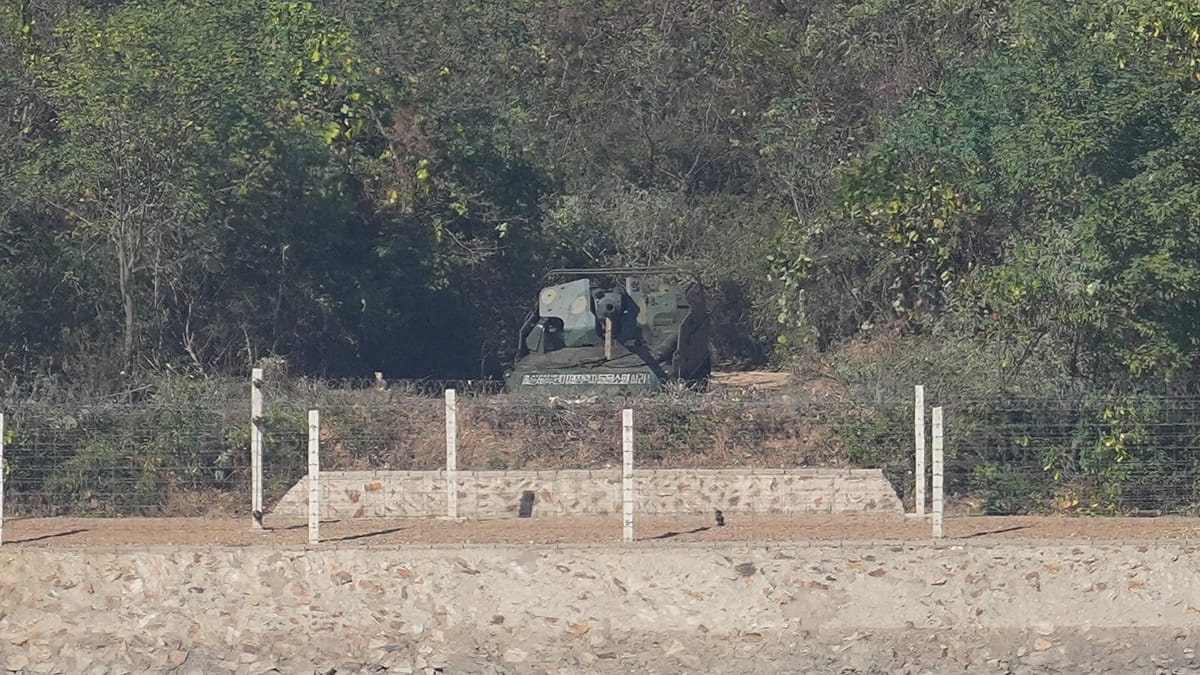
North Korea has not yet responded to the proposal. Meanwhile, its troops have been reinforcing the border with new roads, fences, and landmines, and Seoul reports that North Korean soldiers have repeatedly crossed the demarcation line during these works, prompting warning broadcasts and warning shots.
The situation is complicated by the deteriorating state of the border markers. According to Yonhap, only about 200 of the original 1,292 markers installed under the armistice remain identifiable, leaving room for differing interpretations of the boundary. Seoul warns that such ambiguity could lead to accidental clashes, a risk that has only grown with the recent missile launches.
Thursday's missile test is the latest in a series of provocations from Pyongyang, which has ramped up weapons testing in recent months. The launches also come as the international community watches closely, with NATO allies concerned about security commitments in other parts of the world. While the Korean peninsula remains a flashpoint, the European Union has consistently supported dialogue and denuclearisation, and any escalation would have global repercussions.
For now, Seoul's offer of talks remains on the table, but with Pyongyang silent and missiles flying, the path to de-escalation looks uncertain. The coming days will test whether diplomacy can prevail over brinkmanship.