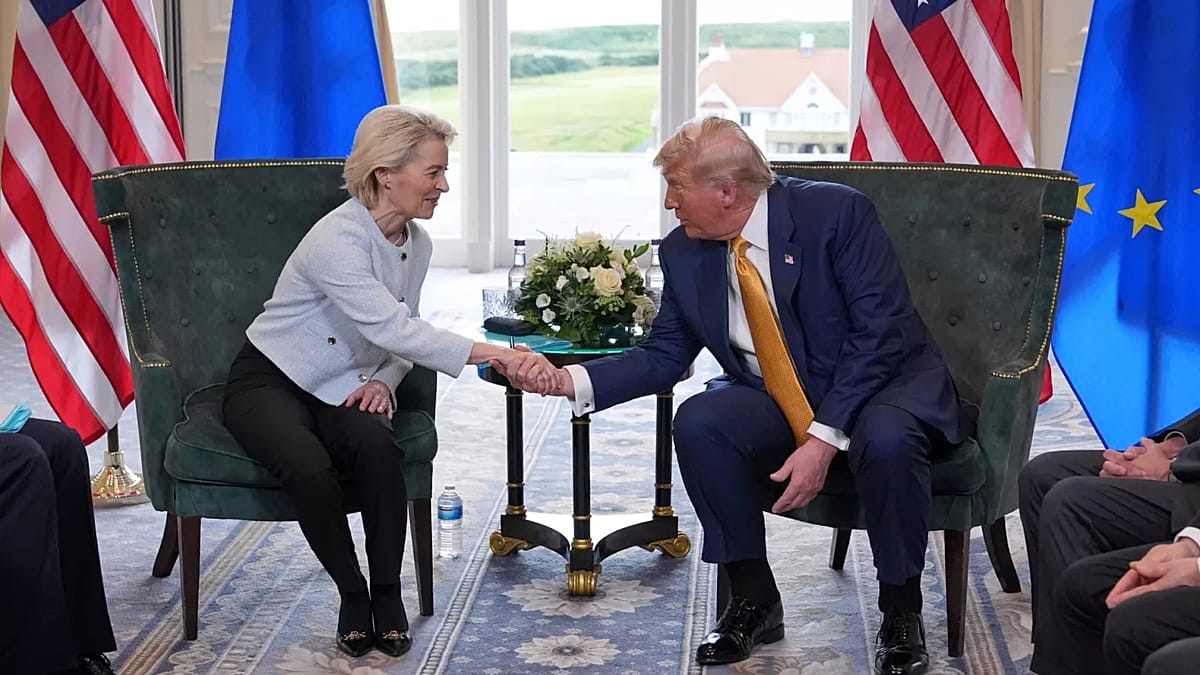
One year after Ursula von der Leyen and Donald Trump shook hands in Turnberry, Scotland, the transatlantic trade deal they struck remains a work in progress. The agreement, which imposed 15% US tariffs on EU imports while the EU removed duties on most US industrial goods, was meant to end a bitter trade dispute. Instead, it has opened a new chapter of negotiations, threats, and legal battles.
Here are four key developments shaping EU-US trade relations as the Turnberry deal marks its first anniversary.
1. Trade Volumes Rose Despite Tariff War
Contrary to fears, transatlantic trade did not shrink. EU-US goods and services trade increased by 4.5% to €1.8 trillion in 2025, driven by companies rushing shipments ahead of Trump's tariffs. However, US importers paid around €31 billion in additional duties since January 2025, compared with €7 billion in pre-tariff years. Following a US Supreme Court ruling in February 2026 that declared the original tariffs illegal, some duties have been refunded—$81 billion globally, according to US data from mid-July.
2. Europe Is Meeting Its Investment Pledges
The European Commission reports that EU companies have pledged €242 billion in US investments across sectors like cars, IT, chemicals, and food. On energy, an EU senior official said the €700 billion target will be exceeded. In 2025 alone, EU buyers imported energy products and signed deals worth over $250 billion. The Iran war and the EU's phase-out of Russian gas have pushed purchases of US LNG and oil to record levels. New nuclear projects are also being developed with US partners.
3. Negotiations on Exemptions and Steel Remain Stalled
Brussels and Washington have begun talks on new tariff exemptions for EU goods. The Turnberry agreement referenced these discussions, but the White House insisted the EU implement its side first. Last autumn, the Commission and European businesses drew up a list of hundreds of products—worth around €150 billion in exports—for which they hope to restore pre-existing tariff levels. The list includes iconic items like Roquefort, olive oil, wines, and spirits. The EU also seeks progress on steel and aluminium, still subject to 50% US tariffs globally. The Commission expects tough talks, as the White House aims to reshore production while addressing Chinese overcapacity. For more on the EU's push for exemptions, see EU Seeks Exemptions for €150 Billion in Exports from US Tariffs.
4. New US Tariffs Are on the Horizon
With the current 15% tariffs expiring on 24 July, the US is preparing new duties under Section 301 of the Trade Act of 1974, targeting forced labour and overcapacity. European officials expect forced labour tariffs to come first, despite the EU arguing it already has legislation banning the practice. “Of course we do not agree with the findings on forced labour, and we've made that very clear to our United States counterparts,” an EU senior official said. “But the main objective is to make sure that the agreement is respected and that our companies can benefit from the stability and predictability that was set out there.” As long as future tariffs stay within the 15% cap, the EU will not oppose them. The Commission is also monitoring a US investigation into overcapacity, which could affect sectors like steel and aluminium. Meanwhile, the broader geopolitical context, including the Houthi Threat to Close Bab el-Mandeb Strait Risks Global Shipping and European Trade, adds further pressure on supply chains.
The Turnberry deal has not resolved transatlantic trade tensions. It has created a framework for negotiation, but both sides remain wary. Europe has delivered on its promises, but the US continues to seek new leverage. The coming months will test whether the agreement can provide the stability European businesses need.