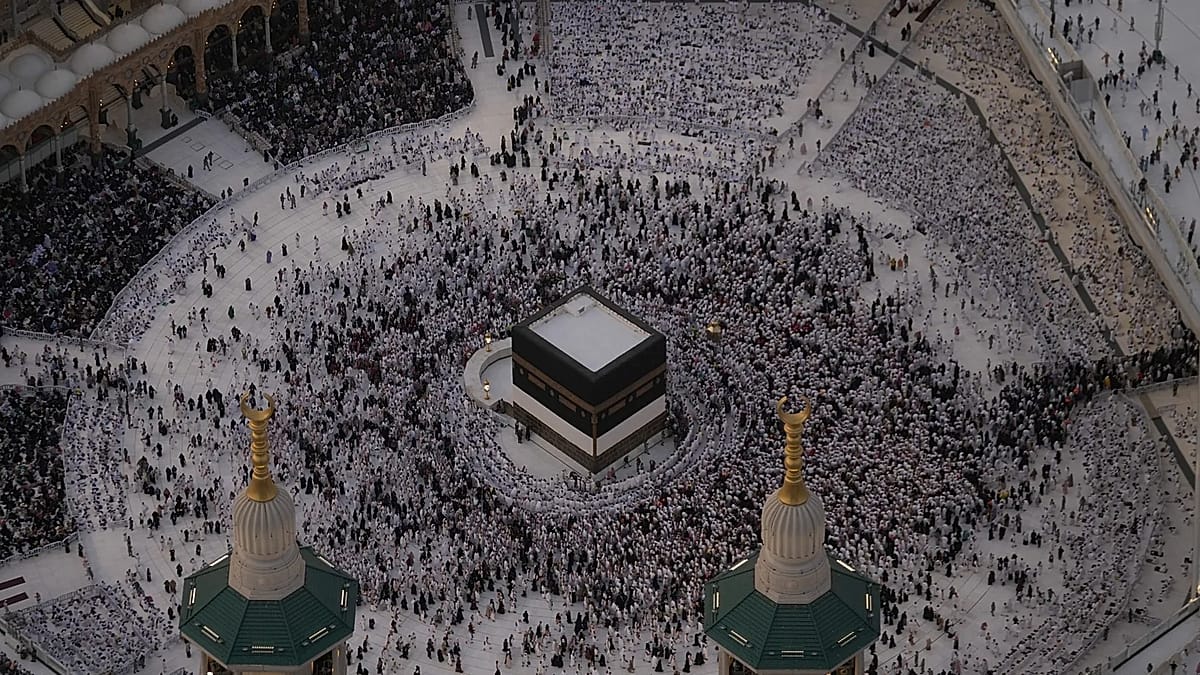
More than 1.5 million Muslims from across the globe converged on Mecca on Monday for the start of the hajj, one of the largest annual religious gatherings in the world. The pilgrimage comes at a moment of heightened geopolitical tension, as hopes for a lasting ceasefire between the United States and Iran remain uncertain.
White-robed pilgrims began the rites by performing the tawaf—walking seven times around the Kaaba, the black cubic structure at the heart of the Grand Mosque—before moving to the sprawling tent city of Mina, about five kilometres away. Temperatures in the region reached 45°C, prompting Saudi health authorities to urge pilgrims to use umbrellas and limit sun exposure to avoid heat exhaustion.
Geopolitical backdrop and Saudi readiness
The start of the hajj coincides with a fragile period in US-Iran relations. President Donald Trump has sent conflicting signals about extending an uneasy ceasefire and reopening the Strait of Hormuz. On his social media platform Truth Social, he wrote: "The deal with Iran will either be a great and meaningful one, or there will be no deal."
Iranian attacks on targets in Saudi Arabia and its Gulf neighbours earlier this year have raised the stakes. Saudi officials have been keen to keep the conflict from overshadowing the spiritual experience of pilgrims, many of whom have travelled long distances. Over the weekend, the kingdom noted that more pilgrims arrived from abroad this year than in 2025.
Nevertheless, the Saudi defence ministry posted a video on social media showing advanced air defence batteries positioned on the outskirts of Mecca. "The air defence forces are responsible for protecting the skies over the holy sites and dealing with all aerial threats, ensuring the safety and peace of mind of the guests," the post read.
For many pilgrims, the desire for peace is personal. Mohammed Chahada, an Egyptian in his 50s, told AFP as he exited the Grand Mosque: "The war in Iran has affected the entire world. Nobody wants wars or harm to countries and peoples."
Rituals and heat
The hajj is one of the five pillars of Islam, required of all Muslims who have the means to undertake it at least once. Men wear a seamless white garment symbolising equality before God, while women wear loose dresses that leave only their faces and hands exposed.
After the tawaf, pilgrims walk seven times between the hills of Safa and Marwa, then proceed to Mina. The climax of the pilgrimage takes place on Tuesday at Mount Arafat, about ten kilometres from Mina, where the Prophet Mohammed is believed to have delivered his final sermon.
Forecasts predict temperatures above 40°C for much of the week, adding physical strain to an already arduous journey. Despite the heat and the geopolitical uncertainty, many pilgrims expressed profound joy. Jreish Mohammed, a 68-year-old Moroccan wearing traditional attire, said: "I have wanted to perform the pilgrimage my entire life, for 40 or 50 years."
The hajj also carries broader implications for European economies, as the Iran conflict has strained energy markets. German business sentiment unexpectedly rose in recent weeks despite these pressures, but the stability of the Gulf region remains a key concern for European policymakers. Meanwhile, EU officials have maintained a firm stance on sanctions, as EU Economy Chief Dombrovskis reiterated there would be no easing of Russia sanctions despite inflation pressures—a reminder of the interconnected nature of global conflicts.
As the hajj continues, the world watches both the spiritual devotion of millions and the fragile diplomatic efforts that could shape the region's future.