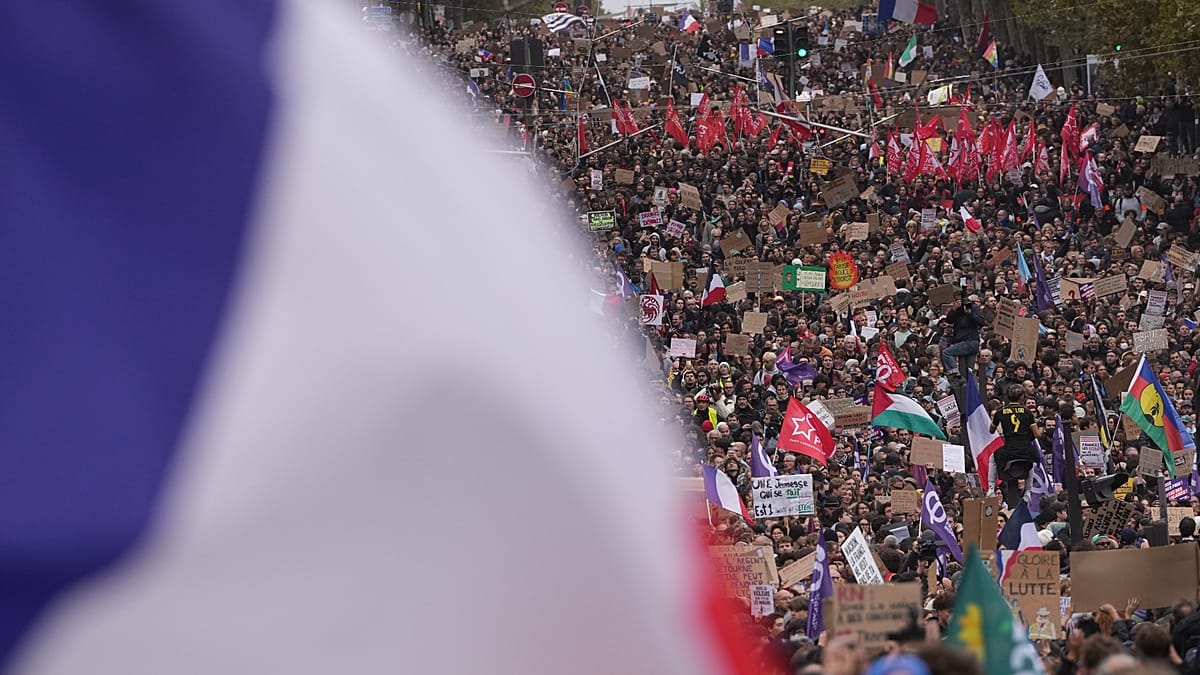
Paris saw one of its largest demonstrations in recent memory on Saturday, as hundreds of thousands of people took to the streets to voice anger over the soaring cost of living, rising fuel prices, and the broader student movement. The protests, which stretched across the capital, were marked by a massive security operation and, despite the precautions, scattered clashes and nearly 1,000 arrests.
A city on edge
The demonstrations came just a week after a peaceful march was overshadowed by violence, prompting the French government to implement a strict security protocol. Military personnel were stationed outside strategic sites across Paris, a rare sight in the capital during protests. Police checkpoints and cordons were set up along the main march routes, and authorities deployed drones to monitor the crowds.
Despite the heavy presence, tensions flared in several areas. Riot police fired tear gas to disperse small groups of masked demonstrators who hurled projectiles and set fire to barricades. By the end of the day, the interior ministry reported that 987 people had been taken into custody, with dozens of officers injured.
Government points finger at hard-left
In the aftermath, the government was quick to assign blame. Interior Minister Gérald Darmanin accused the hard-left party France Unbowed (La France Insoumise) and its leader, Jean-Luc Mélenchon, of deliberately stoking violence to destabilise the republic. Speaking to Euronews at the protest, Guillaume Lescaut, a deputy mayor of Aubervilliers and a member of LFI, rejected the accusation outright.
“The government is trying to criminalise a legitimate social movement. We are not calling for violence; we are calling for justice and an end to a cost-of-living crisis that is crushing working families,” Lescaut said.
His remarks echoed the sentiments of many marchers, who carried banners reading “End the austerity” and “Make the rich pay.” The protests were largely peaceful, with families, students, and pensioners walking side by side, but the presence of a small, radical fringe once again overshadowed the broader message.
Wider European unrest
The Paris demonstration is part of a wave of social unrest sweeping across Europe, as inflation and housing costs squeeze household budgets. In Italy, protests have turned tense in several cities, with authorities sending extra troops to Milan. In Spain, pensioners rallied in Madrid as part of a weekend of European demonstrations. The French capital’s unrest also follows clashes in Lyon earlier this week, where police fired tear gas at protesters.
The cost-of-living crisis has become a defining political issue across the continent, with governments struggling to respond to public anger. In France, President Emmanuel Macron’s administration has faced repeated challenges, from the Yellow Vests movement to the recent pension reform battles. The current protests, driven by inflation and energy prices, have drawn comparisons to those earlier upheavals.
What’s next?
Organisers have vowed to continue the movement, calling for further demonstrations in the coming weeks. Meanwhile, the government is under pressure to offer concrete relief measures, such as fuel subsidies or tax cuts, to defuse the crisis. But with the national budget already stretched, officials are wary of making promises they cannot keep.
For many in Paris, the protest was a cry of desperation. “We work full-time and still can’t make ends meet,” said Marie, a nurse who joined the march with her two children. “Something has to change.”
The coming days will test whether the government’s security-first approach can prevent further violence, and whether the social dialogue can move beyond accusations and arrests. As Europe watches, the streets of Paris have once again become a barometer of continental discontent.