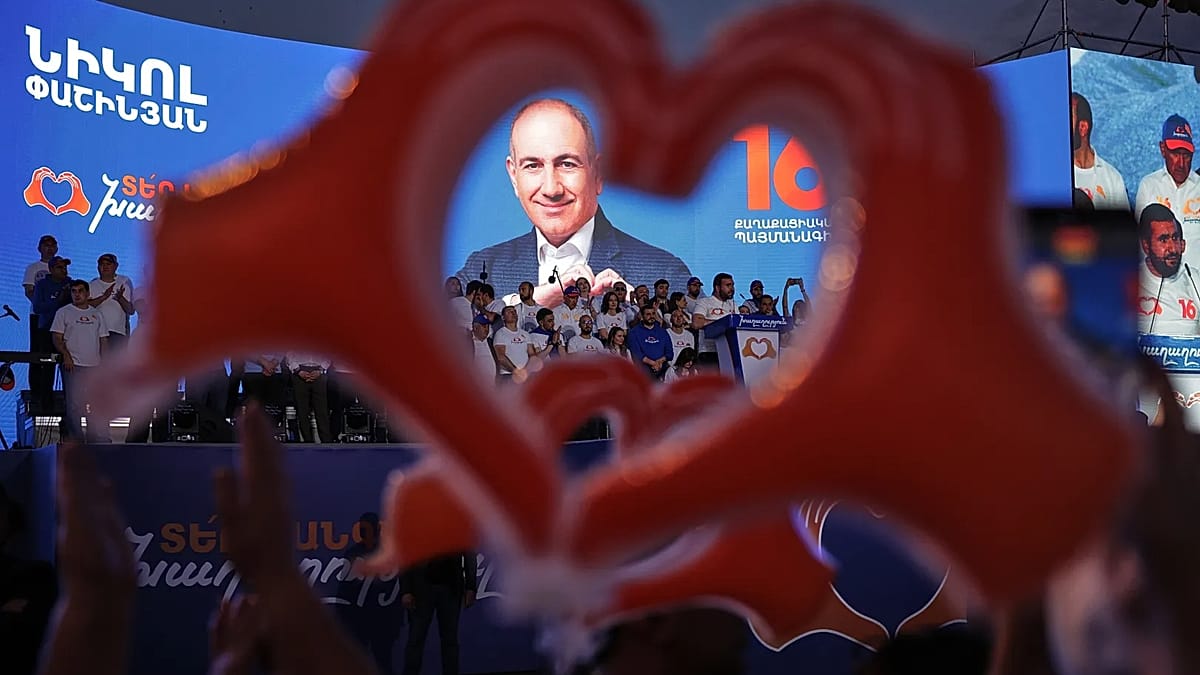
Armenians have delivered a decisive verdict in Sunday's parliamentary election, handing Prime Minister Nikol Pashinyan's Civil Contract party a commanding lead that signals a clear break from the country's Soviet-era alignment. With over 60% of ballots counted, the party stands at 51.2%, far ahead of the Russian-Armenian billionaire Samvel Karapetyan's Strong Armenia alliance at 23%, according to the Central Election Commission.
Turnout reached 59%, reflecting the high stakes of a vote that pitted Pashinyan's vision of a balanced, pro-European future against opposition forces tied to Moscow and the old oligarchic order. Two other groups cleared the 5% threshold: former President Robert Kocharyan's Armenia alliance with 9.9%, and the Prosperous Armenia party with 4.1%.
A Historic Mandate for Change
Pashinyan, who rose to power in the 2018 Velvet Revolution, hailed the result as a “historic victory that will ensure Armenia's eternity and development.” In a press conference in Yerevan, he pledged to “continue the course of rapprochement with the West” while maintaining ties with Russia, insisting that “there is no question of choosing” between the two powers. He also vowed to “institutionalise peace between Armenia and Azerbaijan” and to eradicate the “criminal-oligarchic system” from Armenian politics.
The election unfolded against a backdrop of intense geopolitical maneuvering. Armenia and Russia remain nominal allies, but Moscow has bristled at Yerevan's overtures to the European Union, drawing parallels to the grievances that preceded its 2022 full-scale invasion of Ukraine. The Kremlin has been accused of seeking to sway the vote through misinformation campaigns, hacker activity, and economic pressure, including a ban on several Armenian imports in the weeks before the election.
Pashinyan's campaign focused on the existential stakes for the South Caucasus nation. He warned voters that without a strong majority, Armenia could face a “catastrophic war” with Azerbaijan within months, a message his opponents dismissed as fear mongering. The opposition, in turn, accused authorities of electoral violations and repression, with Armenia's Investigative Committee reporting 59 criminal cases related to multiple voting and other irregularities.
The election also tested Pashinyan's democratic credentials. Eight years after he swept to power on an anti-oligarch platform, critics point to democratic backsliding, though many voters still associate the opposition with Russian influence and entrenched elites. For 63-year-old craftsman Hakob Hakobyan, the choice was clear: “I voted for peace. Only Pashinyan can bring peace.”
International reactions underscored the shifting alliances. US President Donald Trump offered his “TOTAL Endorsement for Re-Election” to Pashinyan, while the European Union has recently unveiled a support package for Armenia. Moscow, however, has watched with unease as another former Soviet republic drifts from its orbit.
Pashinyan's victory sets the stage for a delicate balancing act. He has pledged to pursue a “balanced foreign policy” and develop relations with both Russia and the West, while also seeking normalization with Turkey and Azerbaijan. The coming months will reveal whether his mandate can deliver the stability and prosperity that Armenian voters have chosen.



