After Wednesday's meeting between Vladimir Putin and US envoy Steve Witkoff in St Petersburg, the Kremlin said it was "in principle" ready to resume trilateral negotiations with Ukraine and the US in mid-November, with Abu Dhabi emerging as a possible venue. But the diplomatic flurry masks a familiar pattern: Moscow has repeatedly entertained talks without softening its maximalist demands.
Kremlin aide Yuri Ushakov suggested that the proposals Witkoff brought from his discussions with Volodymyr Zelenskyy and European leaders in Oslo offered little that Russia considered useful. Witkoff, for his part, called Putin a "humanitarian" after the release of an American detainee—a reminder that the Russian president remains wanted by the International Criminal Court over the alleged unlawful deportation of at least 20,000 Ukrainian children.
A separate summit involving Trump, Putin, and China's Xi Jinping is also under consideration, potentially to discuss Ukraine's future without Kyiv at the table. Whether it will take place, or how it relates to the proposed peace talks, remains unclear. Zelenskyy told Fox News that Ukraine could accept a ceasefire along the current front lines without recognising Russian sovereignty over occupied territory—a position Kyiv has articulated before.
Stubb's role and the Kremlin's conditions
Kremlin spokesperson Dmitry Peskov said on Wednesday that Russia could welcome Finnish President Alexander Stubb's involvement in peace negotiations, provided he avoids simply "parroting" Europe's position on Ukraine. Stubb took a leading role in this week's talks in Oslo alongside his Norwegian counterpart and has been floated as a potential EU envoy to future peace talks. But the Kremlin now seems to be dictating the terms under which Stubb can take part before the talks even start.
Meanwhile, former US Army Lieutenant General Ben Hodges told our colleague Shona Murray that President Donald Trump is taking Russia's side and deliberately undermining Ukraine's ability to defend itself. "He was never going to support Ukraine, and was going to take the Russian side, the signs were all there," Hodges said, adding that he does not "trust" the US administration. Read more on Hodges' assessment.
EU budget and Ukraine funding become intertwined
At the same time, the fight over the next EU budget is becoming rapidly intertwined with the search for additional support for Ukraine, as Jorge Liboreiro reports. Next month's extraordinary EU summit, originally planned to advance budget talks, has been extended to two days from 26-27 November to incorporate Ukraine. The stakes are fast rising.
The change of agenda follows President Zelenskyy's request for an additional €70 billion in military and financial support for 2027. EU leaders have agreed to address the massive shortfall, but Brussels is urging other allies—such as the UK, Canada, Norway, Australia, and Japan—to increase their donations so the bloc isn't left bearing the brunt. Explore the funding options.
The next step is for the European Commission to determine how much of the €70 billion the EU will have to fill. The calculation will then help design options to raise the money. As we reported earlier this week, joint debt seems like the likeliest avenue, even if it's costly amid sky-high borrowing costs.
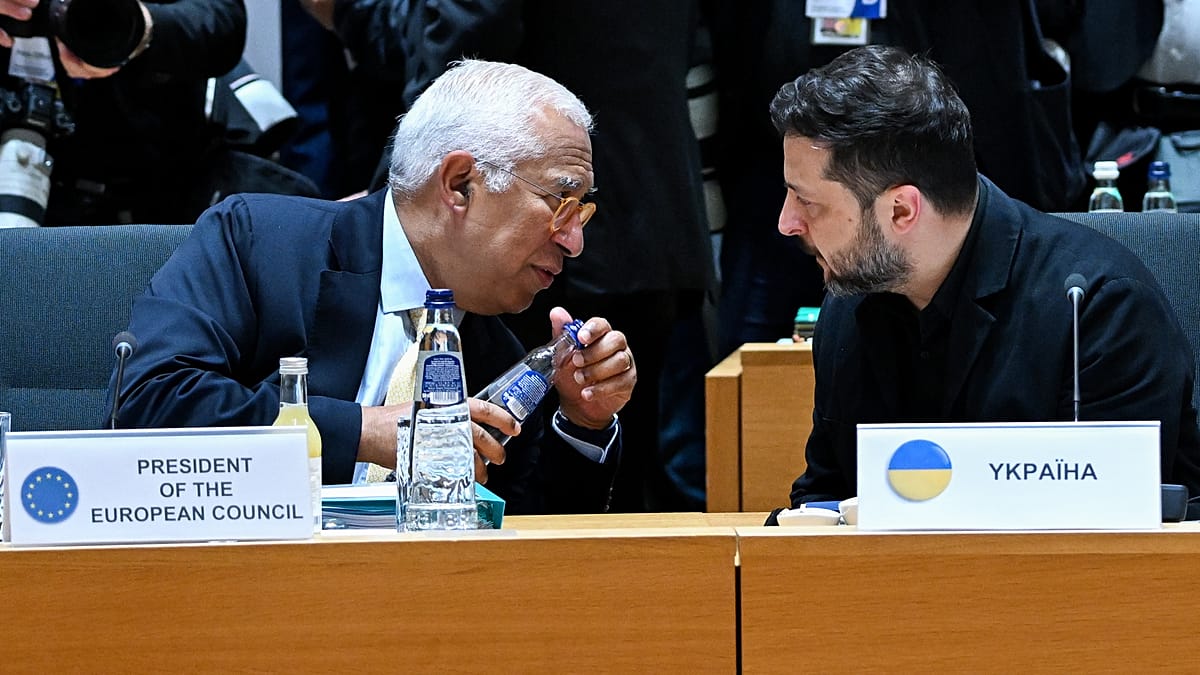
Ahead of the special summit, European Council President António Costa will present a new compromise on the EU budget. The political process has barely moved, as leaders remain split in opposing camps ("Frugals" vs "Friends of Cohesion"). "For Europe's stability, we must approve our next long-term budget by the end of this year," Costa said yesterday, in a new appeal to member states.
Costa's compromise will pay close attention to the so-called new own resources—the EU-wide taxes meant to bring additional revenue to the budget. EU diplomats are split on whether the EU budget and funding for Ukraine should be addressed as one package. The spectre of next year's French presidential election also looms over the debate. "The fact is that these are the most pressing issues for the remainder of the year, definitely," one diplomat said.
Weidel's EU reform plan and Milei's Madrid tirade
Meanwhile, the leader of the far-right Alternative for Germany (AfD), Alice Weidel, presented her plan to radically reform the EU during a visit to the European Parliament in Strasbourg on Wednesday. Emboldened by a major victory in Saxony-Anhalt's regional election last September, the AfD is currently topping national polls. "Our aim is to assume government responsibility after the next federal elections," Weidel said. Her plan echoes the one unveiled by France's Marine Le Pen in Brussels last week. Compare the two far-right agendas.
In Madrid, Argentine President Javier Milei reignited a war of words with Spanish Prime Minister Pedro Sánchez. Milei, who has blamed socialism for Argentina's economic malaise, accused Sánchez of acting like a "shameless dictator" and suggested the Spanish PM was fuelling an "invasion" in Ceuta, the Spanish enclave that saw a mass border breach from Morocco in July. Sánchez, positioning himself as the last bastion against the ultra-right, declared himself "leftie and proud." The exchange underscores the deepening ideological rift between Europe's mainstream and the new wave of populist leaders.