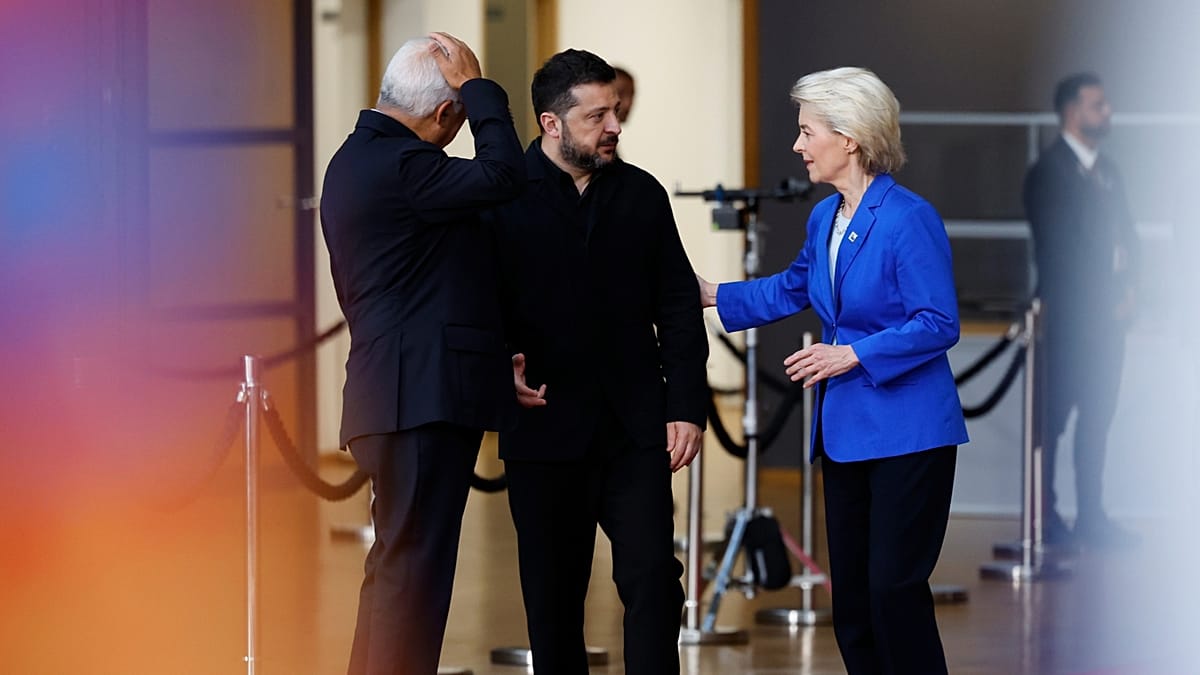
Brussels is confronting a daunting fiscal challenge: finding an extra €70 billion to support Ukraine in 2027. The request, delivered personally by President Volodymyr Zelenskyy at last week's summit, has forced EU leaders to reconsider their financial commitments as Russia's offensive intensifies.
Zelenskyy told the assembled heads of state and government that the war will cost €155 billion next year, with Ukraine needing at least €70 billion more from its allies. "This is a realistic amount," he said, urging the bloc to help Kyiv ramp up domestic drone production and disrupt Russian supply chains. The appeal has landed at a time when the EU's existing support mechanism—a €90 billion loan agreed in December—is proving insufficient.
The loan was designed to cover two-thirds of Ukraine's financial and military needs for 2026 and 2027, assuming the war would wind down by 2026. Instead, Moscow has escalated its attacks, including daytime strikes aimed at crippling Ukraine's economy. Kyiv now estimates it needs an additional $32.6 billion for its budget and $45 billion for its armed forces next year—a combined $78 billion, roughly €70 billion.
After weeks of technical discussions, the European Commission has accepted these figures and concluded that the money must be found. However, the bloc is quick to stress that this will be a joint effort with allies like the UK, Norway, Canada, and Japan. "We always said that we cannot walk this alone," a Commission spokesperson said. "Our partners in general must step up."
Borrowing costs complicate the picture
The most likely option, according to diplomats and officials, is to raise fresh joint EU debt on financial markets, extending the existing credit facility. The EU's AAA rating and strong demand for its bonds have made it a frequent issuer since the pandemic. But the financial landscape has deteriorated sharply since December. Borrowing costs have surged worldwide due to rising oil prices, high public debt, and AI-driven investment demand.
European countries are feeling the pinch, with Belgium now borrowing at rates comparable to Greece, and France paying more than Italy. The yield on the EU's 10-year bond has risen from 2.8% in January to 3.44% in September. While the Commission insists the bloc remains "an extremely competitive issuer," fresh debt would add to the mounting interest burden, making the prospect politically sensitive.
Several countries are expected to opt out of any new joint borrowing. Hungary, Slovakia, and the Czech Republic are already exempted from the €90 billion loan. At last week's summit, Slovak Prime Minister Robert Fico confirmed that he and Hungarian counterpart Péter Magyar would maintain that stance. "We show solidarity in other ways," Fico said. Bulgaria, whose new prime minister Rumen Radev has criticised military aid to Ukraine, is also likely to sit out.
Russian assets as an alternative
In recent weeks, some member states have revived the idea of using the €210 billion in immobilised Russian Central Bank assets held across the bloc. Sweden, the Netherlands, Spain, and Poland have floated this option, which would provide Ukraine with long-lasting financial firepower without adding to EU debt. However, legal and political hurdles remain, and the idea has yet to gain unanimous support.
The negotiations over Ukraine funding are unfolding alongside a bitter fight over the EU's next long-term budget and the lead-up to the French presidential election, where frontrunner Marine Le Pen has vowed to cut all aid to Ukraine. Le Pen's EU agenda could reshape the bloc's fiscal priorities if she wins. The summit also ended with budget deadlock and migration rifts, adding to the sense of crisis.
Despite the challenges, EU leaders have tasked the Commission with exploring all avenues. The joint task force on accession reforms is a positive step, but the immediate funding gap remains. As the war grinds on, the EU must decide how much it is willing to pay—and how to pay it.