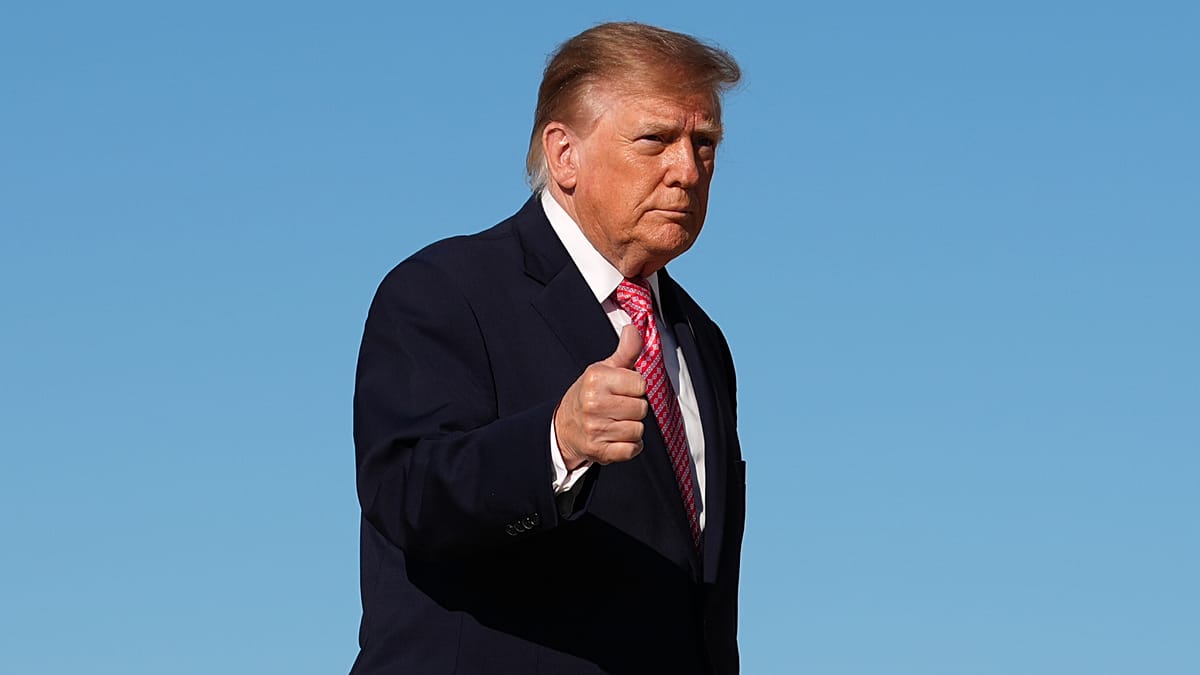
US President Donald Trump has said he is willing to sit down with Russian President Vladimir Putin and Chinese President Xi Jinping in China next month, confirming media reports that the three leaders could meet on the sidelines of the Asia-Pacific Economic Cooperation (APEC) summit in Shenzhen.
Speaking to reporters on Monday, Trump said such a summit would centre on denuclearisation but might also touch on the war in Ukraine. Asked whether he would join Putin and Xi to discuss Ukraine, Trump downplayed that as the main draw. “I would do it, not so much for Ukraine, because Russia, frankly, has been fine with Ukraine. They haven’t been doing much,” he said. “We would have it to talk about nuclear weapons and denuclearisation.”
Pressed on whether Ukraine would come up at a meeting with the two leaders, Trump said he would do “whatever I can do to end the war”.
Beijing and Moscow cautious, Kyiv alarmed
China’s foreign ministry spokeswoman Mao Ning said she had no information about a possible meeting, while Kremlin spokesman Dmitry Peskov said that “given that all three heads of state might potentially attend a summit in China, the topic of such a hypothetical meeting has indeed been mentioned.” But he added that “no substantive proposals or agreements, neither regarding the meeting itself nor its potential agenda and content, have been discussed or put forward by anyone.”
The APEC summit is scheduled for 18-19 November in Shenzhen, a major technology hub in southern China. All three countries are members of the forum.
Ukrainian Foreign Minister Andriy Sybiga bristled at the suggestion of a meeting without Kyiv. “A trilateral meeting between the leaders of Russia, China and the US would do only the opposite: encourage Putin to continue this war,” he said. On social media, he insisted that Putin was “not a global leader; he is a war criminal”.
Peskov, however, argued that “a final settlement is impossible without the participation of someone from Kyiv who is prepared to take on the responsibility.” Putin has repeatedly ruled out meeting Zelensky until after a final peace deal is ready and has questioned Zelensky’s authority to sign an agreement following the expiry of his five-year term under martial law.
Trump, who has renewed his criticism of Ukrainian President Volodymyr Zelensky in recent days, on Monday said it was “time for somebody else to negotiate on behalf of Ukraine.” This echoes his earlier remarks and has drawn sharp reactions from European capitals, where officials worry that sidelining Kyiv could undermine any negotiated settlement.
The prospect of a trilateral meeting comes amid a flurry of diplomatic activity. Earlier this month, Putin proposed a three-way summit with Trump and Xi, shunning Kyiv. Meanwhile, Ukrainian drones hit St Petersburg and the Leningrad region in a major attack, underscoring the ongoing volatility on the ground.
European leaders have been cautious in their response. Many in Brussels and national capitals view any US-Russia-China summit as potentially significant for European security, but they stress that Ukraine must have a seat at the table. The Trump administration's blame game over Ukraine has been criticised as masking deeper US policy failures, and European diplomats are watching closely to see whether Washington will coordinate with its allies.
For now, no formal agreement on a meeting has been announced, and both Moscow and Beijing have downplayed expectations. But the very possibility of a Trump-Putin-Xi encounter in Shenzhen is already reshaping diplomatic calculations across Europe, where the war in Ukraine remains the continent's most pressing security challenge.