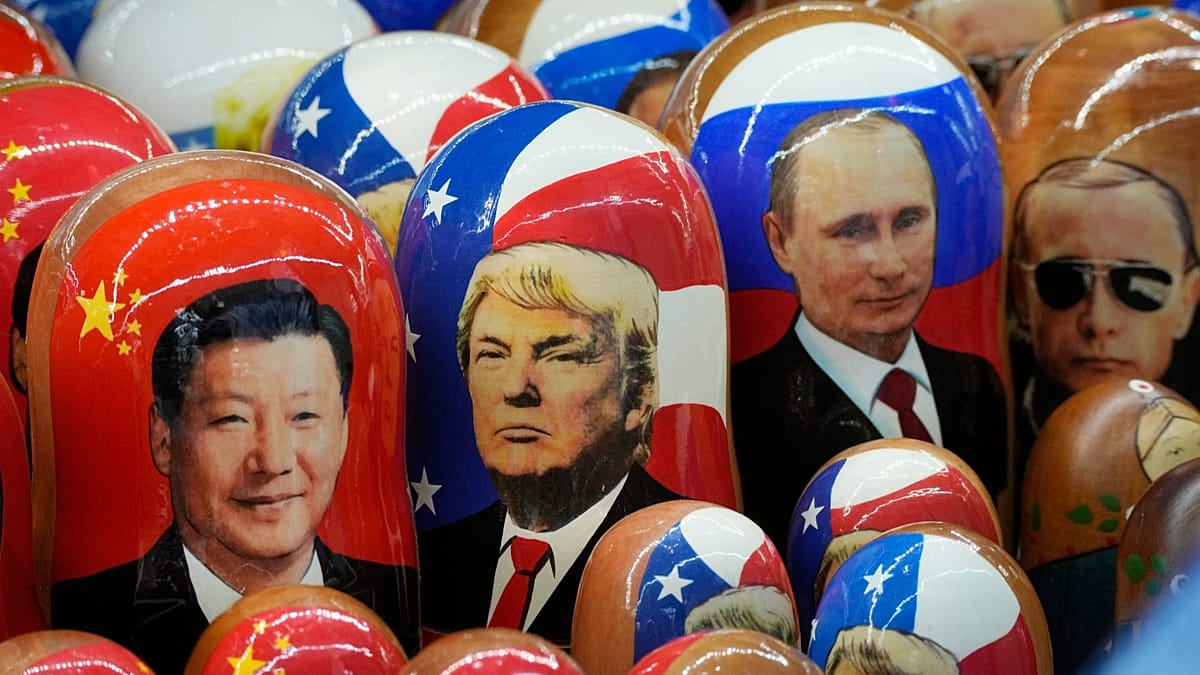
Moscow has floated the idea of a three-way summit involving Vladimir Putin, Donald Trump and Xi Jinping to negotiate an end to Russia's full-scale invasion of Ukraine, according to US media reports. The proposal was made during a phone call between Putin and Trump on 9 October, which also yielded a controversial arrangement on Russian diesel exports to global markets.
Quoting people familiar with the discussions, the Wall Street Journal reported that the Kremlin suggested holding the meeting on the sidelines of the Asia-Pacific Economic Cooperation (APEC) summit in Shenzhen, scheduled for 18–19 November. Kremlin spokesman Dmitri Peskov confirmed that talks were under way, though no agreement has been reached on the format or agenda. A senior US official said Trump has not yet committed to attending but is open to the idea.
Notably, there is no indication that Ukraine would be invited to participate. The prospect of such a meeting comes as Washington seeks to revive direct engagement with Moscow, with Trump arguing that further economic pressure could derail peace efforts. In a post on his Truth Social platform on Sunday, Trump wrote: "My decision on Russia is a very simple one. I am in the process of negotiating Peace in the war between Russia and Ukraine, and don't want to do anything that will drive, foolishly, Russia away from the bargaining table. Great progress is being made, and that includes current hostage negotiations!" He offered no specifics on concessions secured from the Kremlin.
Washington eases sanctions, pressures Kyiv
Trump's remarks followed his decision on 16 October to waive a series of new sanctions and tariffs targeting Russia and its trading partners, just days before they were due to take effect. The move came a week after his agreement with Putin on Russian diesel exports, as Washington seeks to contain fuel prices exacerbated by the conflict in Iran. Trump defended the arrangement by arguing that Russia has refrained from providing substantial assistance to Iran in its confrontation with the US. "Russia is doing very little, if anything, to help the Islamic Republic of Iran, compared to what they could be doing, and I want to keep it that way, and will, unless stupid people get in the way," he wrote.
He also praised Moscow for supplying diesel to global markets at reduced prices, portraying the deal as a contribution to easing international energy pressures. At the same time, Washington has increasingly pressed Kyiv to suspend its campaign against Russian oil refineries—targets Ukraine considers legitimate because of the revenue they generate for Moscow's war effort. The Trump administration reportedly threatened to halt intelligence-sharing and weapons deliveries unless Ukraine complied, further straining relations between Washington and Kyiv.
The tension is palpable across European capitals, where officials worry that the US is making unilateral concessions to Moscow without securing reciprocal steps. As Trump suspends new Russia sanctions, European allies are left to assess the implications for their own security and energy policies.
Zelenskyy warns of 'denial of reality'
Ukrainian President Volodymyr Zelenskyy has warned that easing pressure on Moscow risks prolonging the war, accusing Russia of rejecting diplomatic efforts while intensifying its attacks. His comments followed another overnight bombardment in which, according to Zelenskyy, Russian forces launched 16 ballistic missiles at Kyiv and the surrounding region, along with more than 200 drones across the country, including jet-powered variants. More than ten energy facilities were damaged, leaving at least 550,000 households without electricity. A medical clinic, a school, a metro station and residential buildings were also hit.
Zelenskyy also said Ukraine had again received no advance warning from its partners about the incoming ballistic missiles. "Putin not only doesn't want to end this war – he doesn't even want to take any steps toward de-escalation," he wrote on X. He stressed that Ukraine had responded positively to every ceasefire proposal put forward by its partners, while Russia had continued its attacks. "When deliveries of missiles for Ukraine's air defence are blocked while Russia is granted relief or delays in sanctions, this is, unfortunately, a denial of reality on the part of our partners," he said.
The proposed three-way summit, if it materialises, would mark a significant shift in the diplomatic landscape, sidelining Kyiv and European institutions. European leaders, including those in Berlin and Paris, have repeatedly insisted that any peace negotiations must involve Ukraine directly. The exclusion of Kyiv from such high-level talks would undermine the principle of "nothing about Ukraine without Ukraine," a cornerstone of Western policy since 2014.
Meanwhile, the human cost continues to mount. In St Petersburg, Ukrainian drone strikes on an industrial zone on Sunday caused smoke to billow into the sky, a reminder that the war is not confined to Ukrainian territory. The strikes have drawn criticism from some European quarters, but Kyiv argues they are legitimate military targets. As France counts the cost of violence from such attacks, the debate over escalation and negotiation grows more urgent.
For now, the Kremlin's proposal remains just that—a proposal. But the signals from Washington suggest a willingness to engage with Moscow on terms that Kyiv and many European allies find alarming. The coming weeks will test whether the transatlantic alliance can maintain a united front, or whether Trump's transactional approach will fracture it further.