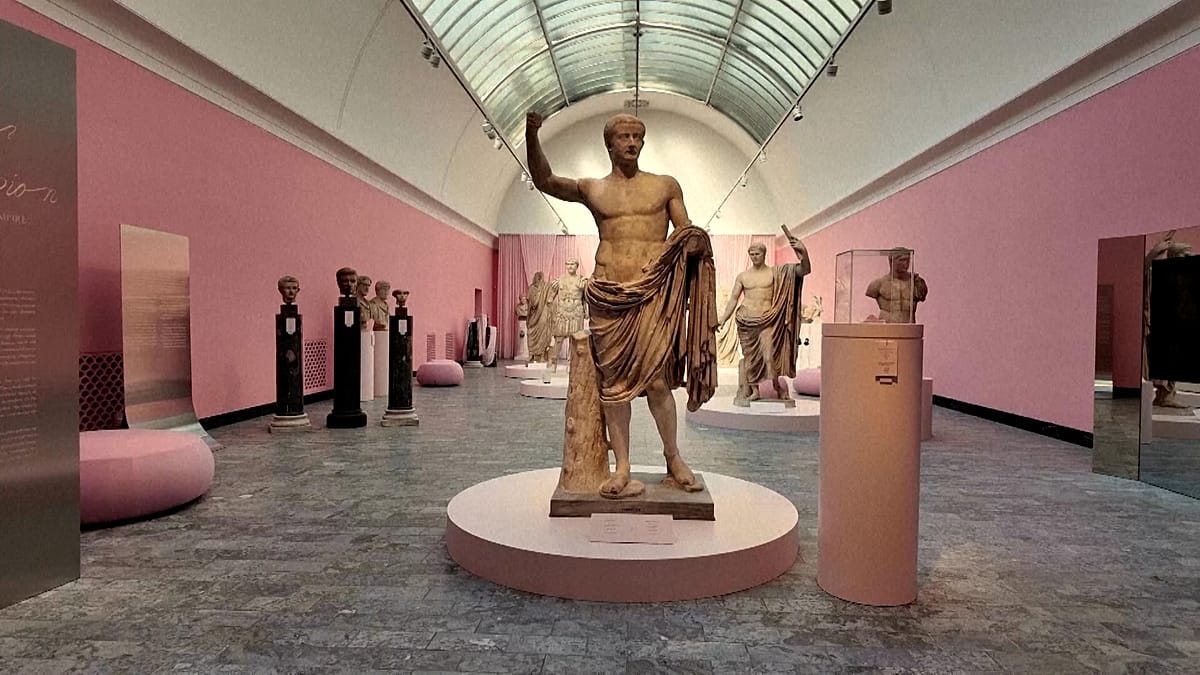
When Emperor Tiberius draped himself in pink, he wasn't making a style statement—he was making a political one. A new exhibition at Copenhagen's Glyptoteket museum, The Power of Fashion in the Roman Empire, argues that in ancient Rome, clothing was as potent a tool of authority as any legion or law.
Running until 29 March 2027, the show brings together 2,000-year-old Roman sculptures, rare surviving tunics, jewellery, and footwear, alongside painstakingly reconstructed colours and period-accurate perfume scents. Visitors can also listen to recorded Roman gossip and insults at dedicated listening stations, offering a glimpse into how contemporaries judged those in power by what they wore.
Colour as a political statement
In Roman society, colour was never merely decorative. Purple, for instance, was reserved for emperors, while pink—a shade derived from expensive dyes—carried its own connotations of luxury and effeminacy. Tiberius, known for his austere tastes, reportedly used such garments to project an image of refined simplicity, even as his critics sniped at his choices. The exhibition explores these tensions, showing how fashion could both elevate and expose a ruler.
The curators have worked with textile experts and chemists to recreate the original hues of ancient fabrics, many of which have faded over centuries. Visitors can see how a toga might have appeared in vivid saffron, deep crimson, or the pale rose that Tiberius favoured. The effect is to make the distant past feel startlingly immediate.
More than clothes
But the exhibition goes beyond garments. It includes a range of accessories—from intricately worked brooches to leather footwear—that completed the Roman look. Perfume, too, played a crucial role in projecting status; the scents on display have been recreated from ancient recipes, offering an olfactory journey through the empire's fragrant trade routes.
Listening stations add another layer, presenting the kind of gossip that circulated in Rome's forums and bathhouses. These snippets reveal how ordinary people discussed their leaders' attire, often with biting wit. One insult, attributed to a senator, mocks a rival's overly elaborate sandals—a reminder that fashion criticism is hardly a modern invention.
The exhibition also draws on recent archaeological finds, including a hoard of Roman silver coins discovered near Cologne, which helps date the period's trade networks. Such discoveries underscore how deeply fashion was embedded in the empire's economy, from dye production in Tyre to silk imports from the East.
A European lens on ancient power
Copenhagen's Glyptoteket, known for its classical collections, is an apt venue for this exploration. The museum's founder, Carl Jacobsen, was himself a collector of Roman portraits, and the exhibition builds on that legacy while offering a contemporary perspective on how dress shapes political identity.
For modern Europeans, the parallels are hard to miss. From the tailored suits of Brussels to the ceremonial robes of monarchs, clothing still signals authority and belonging. The exhibition invites visitors to consider how much—and how little—has changed in two millennia.
As one curator put it, “Fashion was a language in ancient Rome, and the emperors were its most fluent speakers.” The show gives that language a voice, one that resonates across the centuries.