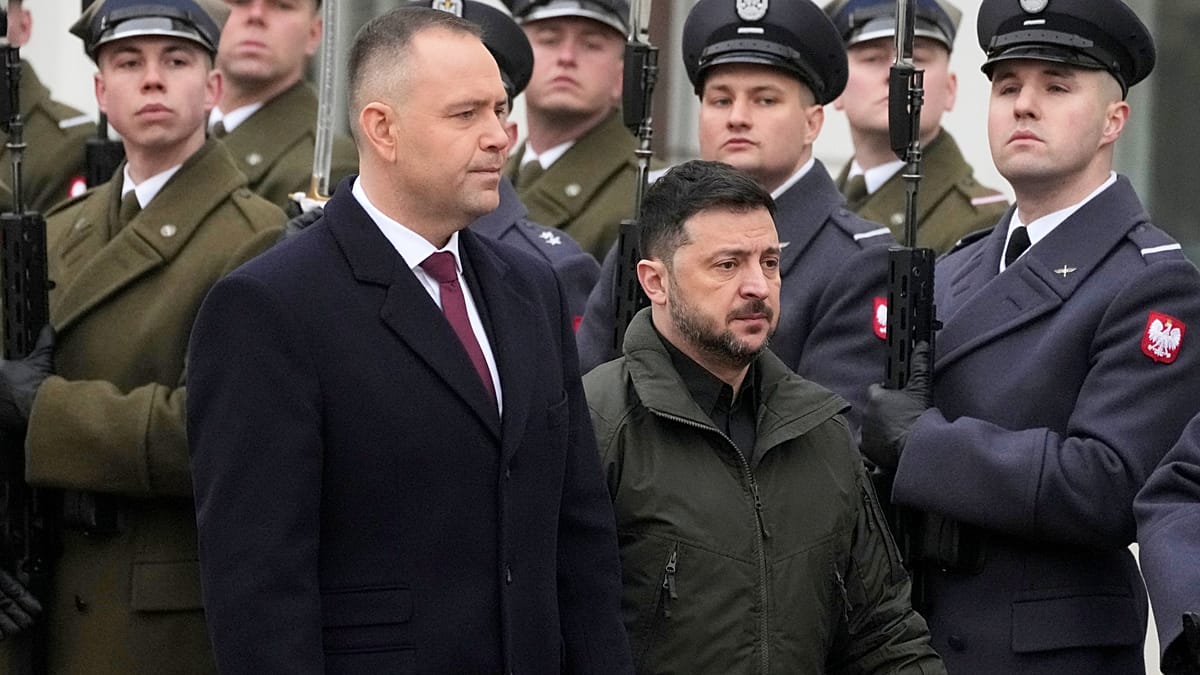
Polish President Karol Nawrocki has stripped Ukrainian President Volodymyr Zelenskyy of the Order of the White Eagle, Poland's highest state decoration, in a move that has reignited historical tensions between Warsaw and Kyiv. The decision, announced via a video posted on X on Friday evening, comes in response to Ukraine's decision to name a military unit after the controversial World War Two Ukrainian Insurgent Army (UPA).
In his statement, Nawrocki emphasized that the revocation "is not directed against the Ukrainian nation" and "does not signify a change in the strategic direction of Poland's security policy." He reiterated that Poland's support for Ukraine in its war against Russia remains unchanged. However, he warned that relations between the two countries were being undermined by "the strengthening of a memory poisoned by crime," calling the move "not merely symbolic; it is also a warning signal." Nawrocki added: "There are boundaries that must not be crossed in Polish-Ukrainian relations."
Ukrainian Backlash and Diplomatic Fallout
Ukraine's foreign minister, Andrii Sybiha, described Nawrocki's decision as a "strategic mistake, from which only Russia will benefit." In a symbolic countermove, Sybiha announced he would return the Commander's Cross with Star of the Order of Merit of the Republic of Poland, awarded to him in 2022. Other Ukrainian officials followed suit: Kyrylo Budanov, head of the Office of the President of Ukraine, and Vasyl Bodnar, Ukraine's ambassador to Poland, renounced their respective Polish Orders of Merit.
Budanov wrote on Telegram on Saturday: "Unfortunately, Polish President Karol Nawrocki has made an unfriendly gesture towards our nation by stripping Ukrainian President Volodymyr Zelenskyy of the Order of the White Eagle previously conferred on him. Without doubt, this is a gift to the Moscow aggressor, who will ruthlessly exploit it against both our countries." Bodnar, in a Facebook post, said he "cannot remain indifferent to a decision he considers historically unjust," adding that Zelenskyy is "a friend of Poland, the head of a state that is bravely defending itself against the Russian aggressor and defending peace in Europe."
Zelenskyy's office has not commented, but the speaker of Ukraine's parliament, Ruslan Stefanchuk, warned that the decision could negatively impact bilateral cooperation. Polish Prime Minister Donald Tusk, a political rival of Nawrocki, wrote on X: "A conflict between Poland and Ukraine delights Putin and shocks our allies. The task facing Presidents Zelenskyy and Nawrocki is to calm emotions, not fuel tensions. The front line runs elsewhere."
Government spokesman Adam Szłapka noted that the Russian authorities, including Dmitry Medvedev, had welcomed Nawrocki's decision. Opposition figures in Poland largely supported the move, while politicians from the Left and the Poland 2050 party cautioned against a deterioration in Polish-Ukrainian relations. The Institute of National Remembrance announced it would launch an information campaign on Ukrainian nationalism.
Historical Context and Legal Questions
The dispute centers on the legacy of the UPA and the Organisation of Ukrainian Nationalists (OUN), which fought for Ukrainian independence during and after World War II. In Poland, the 1943 Volhynia massacres—in which UPA forces killed tens of thousands of ethnic Poles—are widely regarded as genocide. In Ukraine, the events are often framed as part of a broader armed conflict with shared responsibility. The naming of a Ukrainian military unit "Heroes of the UPA" at the end of May drew immediate criticism from Polish authorities, including Tusk, Defence Minister Władysław Kosiniak-Kamysz, and the Ministry of Foreign Affairs.
Zelenskyy received the Order of the White Eagle in April 2023 from then-President Andrzej Duda, in recognition of his contributions to deepening Polish-Ukrainian relations, supporting democracy and security in Europe, and defending human rights. Under Polish law, a president may revoke a decoration on their own initiative after consulting the relevant chapter, or at the chapter's request, if the award was obtained through deception or if the recipient has committed an act rendering them unworthy.
Legal questions have emerged over the revocation's validity. Bartosz Grodecki, head of the National Security Bureau, argued that withdrawing the order requires the prime minister's countersignature. Zbigniew Bogucki, head of the Presidential Chancellery, echoed this view, stating that while conferring orders is a presidential prerogative, revocation likely needs Tusk's approval. Szłapka said the government would adopt a position only after receiving a formal request from the president.
The incident adds to a series of strains in Polish-Ukrainian relations, which have otherwise been robust since Russia's full-scale invasion in 2022. Poland has been a key transit hub for Western military aid and a vocal advocate for Ukraine's EU membership—a topic that remains contentious among some member states. The timing of the dispute is particularly sensitive as European leaders prepare for tough budget negotiations, with frugal states clashing with cohesion advocates over a €2 trillion budget. Meanwhile, Zelenskyy continues to push for fast-track EU membership, citing Ukraine's sacrifices and military strength.
As the diplomatic fallout unfolds, both capitals face the challenge of managing historical grievances without undermining their shared strategic interests—particularly in countering Russian aggression. The coming weeks will test whether the two governments can contain the damage or whether this symbolic rift will have lasting consequences for European security.