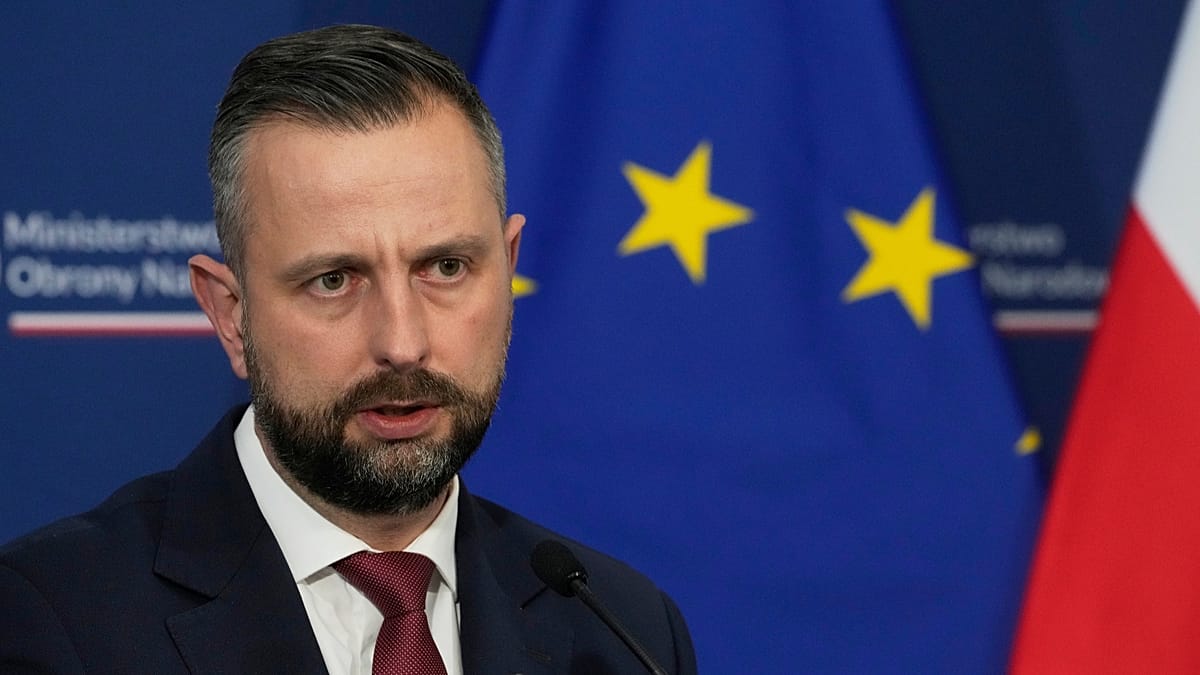
Warsaw is pressing its European partners to rethink defence manufacturing as a matter of urgency. In a press conference on the sidelines of the Warsaw Security Forum on Tuesday, Poland's Deputy Prime Minister and Minister of National Defence, Władysław Kosiniak-Kamysz, argued that the continent can no longer afford a peacetime approach to producing ammunition and weaponry.
“I am actually an advocate for the war-mode when it comes to the production in defence sector,” he said. “This is what the Russian Federation does at the moment. We cannot overlook this fact.”
His remarks come as new intelligence assessments show Russia has shifted its economy onto a full wartime footing well before its full-scale invasion of Ukraine in 2022. According to a recent report from Estonian intelligence, Moscow is projected to spend around 7% of its gross domestic product on its armed forces in 2026. In 2025, Russian factories are expected to turn out roughly seven million artillery, mortar, tank, and rocket rounds, with Russian forces currently expending between 10,000 and 15,000 shells per day in their continued aggression against Ukraine.
By contrast, Europe's defence industry is still struggling with decades of underinvestment and fragmentation. A leaked report on European defence readiness suggests that the 27 EU member states plus Norway will produce only about two million 155mm artillery shells this year — a fraction of Russia's output. The same report estimates that EU member states' total defence spending in 2025 will reach €418 billion, or 2.2% of the bloc's GDP, a figure that has risen sharply since the Cold War but still lags behind the scale of the challenge.
A costly delay
Kosiniak-Kamysz warned that hesitation would carry a heavy price. “It's one of the disadvantages, but also it will impact (and) affect us negatively in future generations,” he said, stressing that the time has come for Europe to prepare to defend itself by multiplying its defence production.
The Polish minister's call echoes a broader push within NATO and the EU to boost military capabilities, particularly after Russia's invasion of Ukraine exposed critical shortages in ammunition stocks. Several European countries, including Poland, have already increased their defence budgets, but Kosiniak-Kamysz insists that piecemeal efforts are not enough.
“We need to look at this as a long-term investment in our security,” he added. “The Russian Federation is not slowing down, and neither should we.”
His comments also come amid growing debate over how to finance European rearmament, with some member states calling for joint procurement and others wary of centralising defence spending. The European Commission has proposed a European Defence Investment Programme, but progress has been slow.
For Poland, which shares a border with Ukraine and has been a vocal advocate for stronger European defence, the urgency is existential. Warsaw has already signed major contracts for US-made tanks and artillery, but Kosiniak-Kamysz argues that Europe as a whole must develop its own industrial base to reduce reliance on external suppliers.
“We cannot outsource our security,” he said. “Europe must be able to produce what it needs to defend itself.”
The debate is likely to intensify ahead of the next NATO summit, where defence spending targets and production capacity will be high on the agenda. For now, Kosiniak-Kamysz's message is clear: Europe must switch to war mode, or face the consequences.