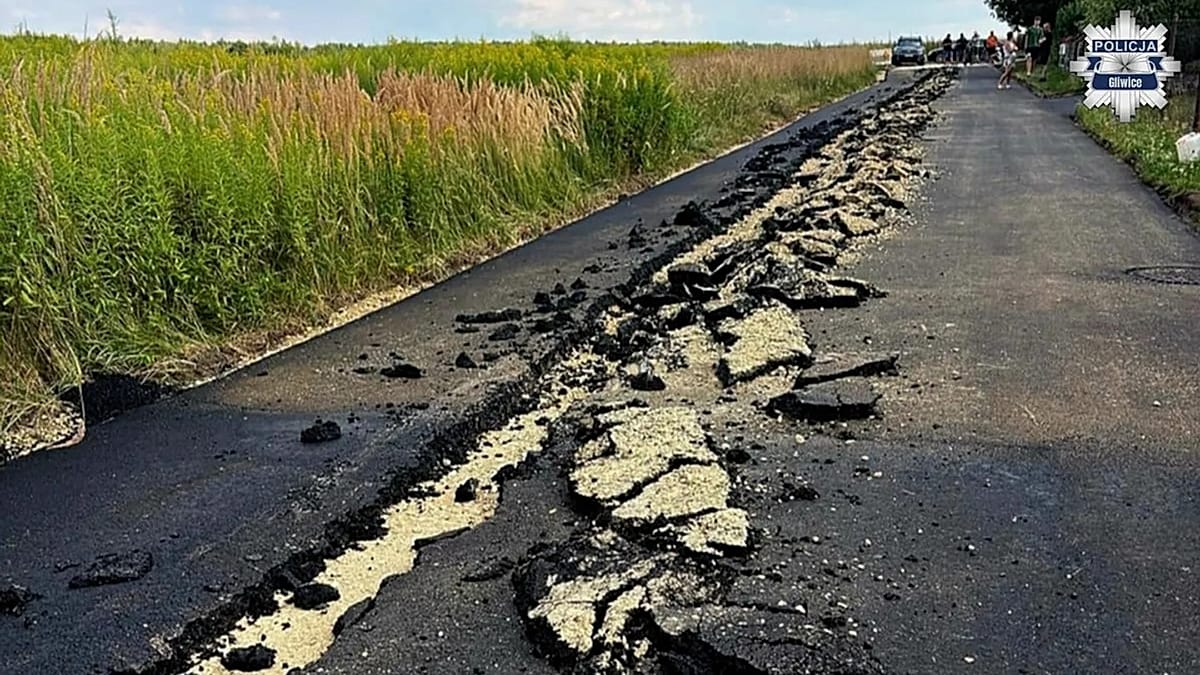
A 60-year-old farmer in the southern Polish city of Gliwice has been remanded in custody for three months after using a tractor to churn up a newly asphalted road. The incident, which took place on Rybacka Street in the Ostropa district, has left local authorities facing repair costs of around €93,056.
The man, whose identity has not been disclosed, allegedly drove his agricultural vehicle onto the fresh surface and used a plough to tear up approximately 200 metres of asphalt. According to the Gliwice Municipal Police, he claimed the road was his property and that the renovation works were illegal. He is also reported to have said he would damage the surface again if given the chance.
Court orders pre-trial detention
On Sunday, the Gliwice-West District Prosecutor's Office charged the farmer with damaging property of significant value, an offence that carries a prison sentence of between one and ten years. Investigators applied for pre-trial detention, arguing that the severity of the potential sentence and the risk of the suspect attempting to evade justice warranted custody. The Gliwice District Court agreed and ordered his detention the same day.
“The court justified the pre-trial detention by the severe custodial sentence the suspect realistically faces and by the possibility that he might take unlawful steps to avoid it,” the court said in a statement.
During questioning, the man admitted to ploughing up the road and repeated his claim that the land belongs to him. However, documents gathered by investigators show that the land is owned by the local authority. The Gliwice Regional Prosecutor's Office emphasised the deliberate nature of the act, stating: “The high degree of the suspect's guilt is demonstrated by the fact that he acted in a planned and deliberate manner, using agricultural machinery to destroy the road which ensured he achieved his intended aim.”
The prosecutor's office also highlighted the broader impact on the community: “The high level of social harm caused by the alleged offence is shown by the fact that residents of neighbouring houses had been waiting for many years for the repair and construction of the road that the suspect destroyed and the consequences of this act affect all residents of Gliwice, who will now have to bear the considerable costs of rebuilding the road.”
Police confirmed that the farmer was sober at the time of his arrest. His tractor was towed to a police impound lot, and it was also discovered that the vehicle lacked mandatory third-party liability insurance.
Mayor condemns damage
Gliwice's mayor, Katarzyna Kuczyńska-Budka, has spoken out about the case. She said that according to estimates by the Municipal Roads Authority, the losses amount to around 400,000 zloty (€93,056). The damage is not limited to the asphalt layer; the road base has also been destroyed, meaning a full reconstruction will be necessary.
The mayor shared a video on social media showing the farmer using his tractor to plough up the fresh surface. She added that this is not the first time the man is alleged to have caused damage to public property.
The Municipal Roads Authority (ZDM) also issued a statement refuting any suggestion that the road was partly privately owned. “The road is entirely owned by the City of Gliwice. It is not a private road, nor a road of which any part belongs to a private individual. It is also untrue to suggest that the lack of consent from a private owner has had any bearing on the renovation or the laying of the asphalt surface,” ZDM stressed.
The case has drawn attention to the challenges of infrastructure maintenance in Poland, where local governments often struggle to fund road repairs. The incident also comes as Poland's economy continues to grow, with the country recently overtaking Belgium and Sweden to become the EU's sixth-largest economy. However, such growth has not eliminated disputes over land ownership and public works.
The farmer's detention will last three months while the investigation continues. He faces up to ten years in prison if convicted. The city has vowed to repair the road as quickly as possible, though the cost will be borne by taxpayers.