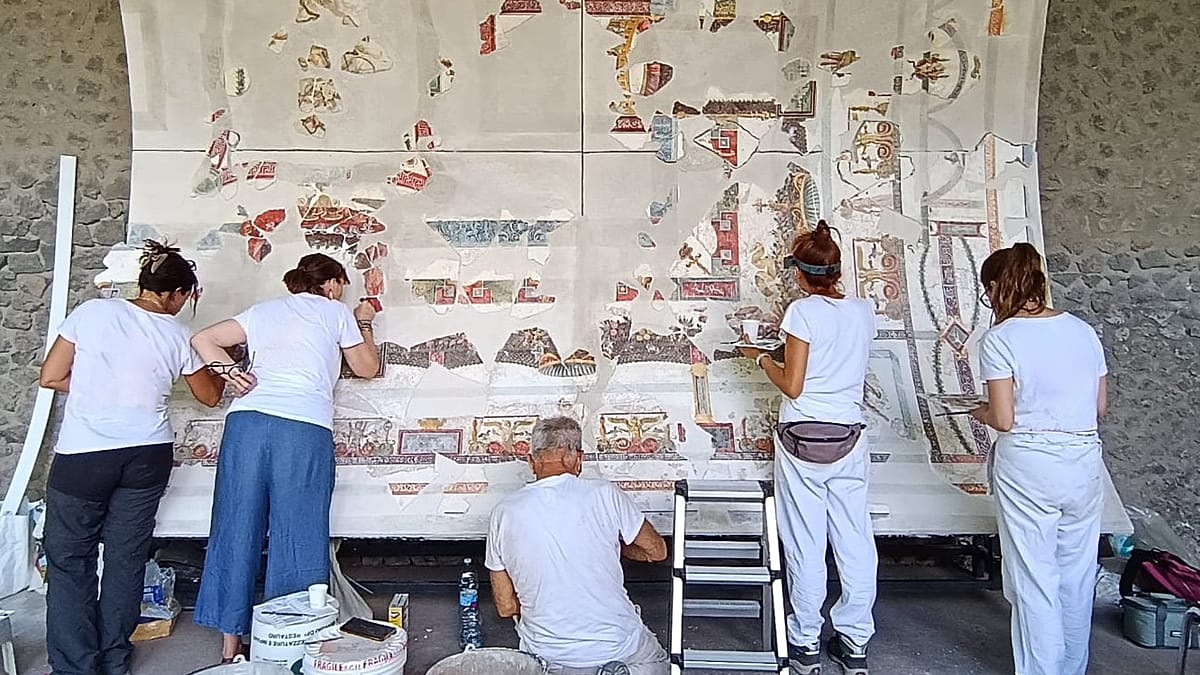
Archaeologists at the Pompeii Archaeological Park have presented a partially reconstructed frescoed ceiling from a banquet hall, offering new insights into the decorative practices of the ancient Roman city. The ceiling, which originally belonged to an upper-floor banquet hall in a house with an adjoining bakery, features scenes from Greek mythology, with the union of Dionysus and Ariadne as its central theme.
The restoration, unveiled on Thursday at the conclusion of an international workshop on new discoveries at the site, employs a curved support structure designed to hold the fresco fragments in a way that replicates the vault's original shape. So far, more than a quarter of the original ceiling has been reconstructed, with the structure allowing additional sections to be added as more fragments are uncovered and restored.
Innovative restoration technique
Gabriel Zuchtriegel, director of the Pompeii excavations, told the Italian news agency ANSA that Italy is a world leader in archaeological restoration, and Pompeii, with its team of restorers, plays a central role in that effort. "That is why we are pleased to share the results of our conservation projects with the world, as they also provide opportunities for research and exchange," he said.
The project is part of the park's 2026 programme focused on Dionysus, building on recent discoveries at the House of Thiasos in Regio IX, where archaeologists uncovered one of the most significant large-scale frescoes found at the site, depicting a procession dedicated to the Greek god. In June, an equid skeleton was also uncovered during excavations in a bakery area of the House of the Chaste Lovers complex.
Pompeii, which was buried under ash after the eruption of Mount Vesuvius in AD 79, continues to yield remarkable finds. The site remains a key destination for those interested in Europe's top sightseeing stops, drawing visitors from across the continent and beyond.
The restoration of the frescoed ceiling highlights the ongoing efforts to preserve and interpret the cultural heritage of the ancient city. As Zuchtriegel noted, the work also provides opportunities for international research and exchange, reinforcing Pompeii's status as a hub for archaeological innovation.