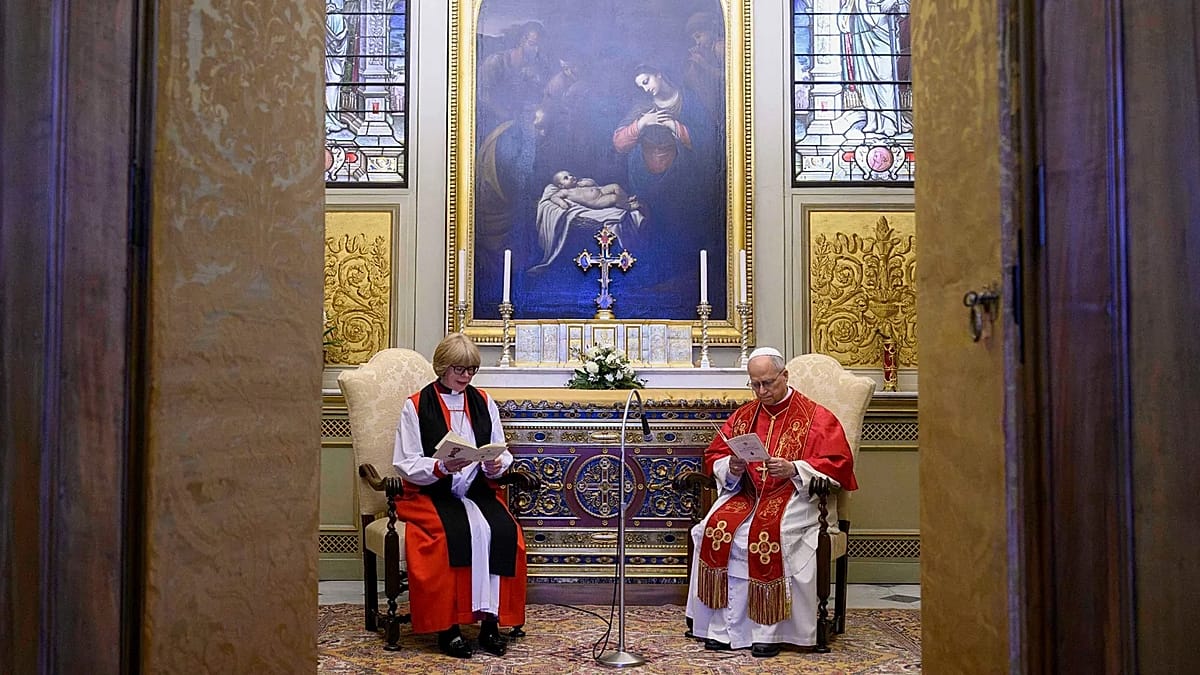
In a significant step for Christian unity, Pope Leo XIV welcomed the newly enthroned Archbishop of Canterbury, Sarah Mullally, to the Vatican on Monday for a private audience that included joint prayer. The encounter, which Mullally described as part of a four-day pilgrimage to Rome, marks her first international trip since becoming the first woman to lead the world's Anglican Christians last month.
The meeting falls on the 60th anniversary of the first formal ecumenical statement between the Anglican and Roman Catholic Churches, signed in 1966 at the Basilica of St. Paul Outside the Walls by Archbishop Michael Ramsey and Pope Paul VI. The milestone underscores decades of gradual rapprochement since King Henry VIII's break with Rome in the 16th century.
Unity for Evangelization
Pope Leo XIV, the 70-year-old leader of the world's 1.4 billion Catholics, quoted his predecessor Pope Francis in telling Anglican primates that "it would be a scandal if, due to our divisions, we did not fulfil our common vocation to make Christ known." He added, "While our suffering world greatly needs the peace of Christ, the divisions among Christians weakens our capacity to be effective bearers of that peace."
The pontiff emphasized that "unity for the sake of a more fruitful evangelisation" has been a recurring theme throughout his ministry. He acknowledged progress on "historically divisive issues" but noted that "new problems have arisen in recent decades," without specifying them. Nevertheless, he urged both churches not to let these challenges prevent them from proclaiming Christ together.
Mullally, 63, a former nurse who is married with two children, echoed the call for collaboration. "In the face of inhuman violence, deep division and rapid societal change, we must keep telling a more hopeful story: that every human life has infinite value because we are precious children of God," she said. "We must therefore work together for the common good, always building bridges, never walls; that the poorest among us are closest to the heart of God."
Divisions Within the Anglican Communion
Mullally's appointment has sharply divided the Anglican Communion, whose 100 million members across 165 countries are deeply split over issues such as women's ordination and the treatment of LGBTQ+ people. While many in England and other Western countries hailed her election as a historic breakthrough, the communion's largest and fastest-growing churches in Africa—part of the conservative Global Anglican Future Conference (Gafcon)—have criticized it and threatened a final break.
Mullally told the pope, who recently returned from a four-nation African tour, that she would follow in his footsteps with a visit to Cameroon and Ghana in July. "Your pilgrimage to Africa was full of life and joy," she said. "It reminded us that despite our sufferings, people long for life in all its fullness and countless people are working each day for this vision of the common good."
Women have been allowed to become bishops in the Church of England since 2014, though the issue remains contentious. The Catholic Church continues to forbid the ordination of women, a point of tension that resurfaced in 2016. Mullally's visit comes six months after King Charles III, the supreme governor of the Church of England, met with the pope and prayed with him for the first time.
The meeting at the Vatican underscores the complex dynamics within European Christianity, where ecumenical efforts coexist with deep theological disagreements. As the continent grapples with secularization and social change, the leaders of two of its largest Christian denominations are seeking common ground—even as their own flocks remain divided.