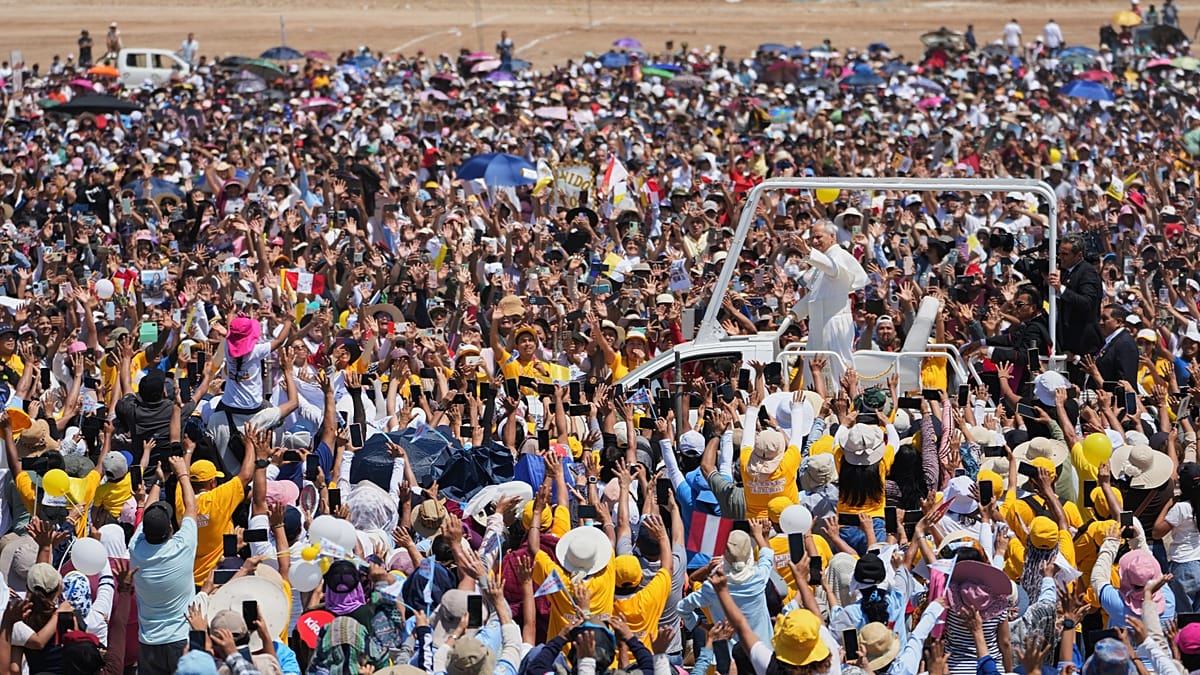
Pope Leo XIV is celebrating Mass in Santa Cruz de Succhabamba, northern Peru, on Saturday as his South American tour continues, drawing enormous crowds eager to see the 71-year-old pontiff. After flying by helicopter from Chiclayo air base, he will return for an evening prayer meeting at the shrine of Saint Toribio de Mogrovejo.
The pope, who was born in Chicago but served as a missionary and bishop in Peru and holds Peruvian citizenship, returned to his former hometown of Chiclayo on Friday. There, he presided over an open-air Mass attended by roughly 500,000 people.
"What a joy it is to return to Chiclayo!" Leo said. "Thank you for your affection, support and prayers, especially for my health during this time of trial which, with God's help, I am overcoming."
But the massive gatherings have heightened fears among health authorities in Latin America, which is experiencing a surge in measles cases this year. From January to the end of October, 57,666 confirmed cases were recorded across 17 countries and territories in the Americas—almost five times more than in the same period last year—and at least 81 deaths have been reported.
Before the pope's visit, the Pan American Health Organization (PAHO) assessed the public health risk of measles as "very high" given the expected religious mass gatherings. The concern is largely tied to low vaccination rates in some countries, particularly Argentina and Peru.
"We're seeing children not going to school, children being hospitalized," said Daniel Salas Peraza, head of immunization at PAHO. "It's a very complex situation."
Vaccination gaps and rising cases
Measles is a highly contagious airborne disease that can lead to severe complications and is potentially fatal. An effective and relatively cheap vaccine is available, but to stop the disease from spreading, at least 95% of a population must be fully vaccinated. According to WHO data for 2025, only Uruguay had reached that threshold. In Peru, coverage stood at 90% for the first dose and 82% for the second; in Argentina, the figures fell to 84% and 55%, respectively.
Peru has recorded almost 3,000 cases in 2026, the fourth highest number in the Americas after Guatemala, Mexico, and the United States. In the five cities on the pope's itinerary—Lima, Chiclayo, Cajamarca, Cusco, and Pucallpa—170 infections have been detected so far this year.
In the run-up to the visit, Peruvian authorities stepped up vaccination campaigns, focusing on areas with higher transmission rates. They also brought forward vaccination for children between six and eleven months and targeted people up to 29 years old. By the end of September, 1.2 million doses had been administered since the push began in April, with more than two million additional doses available.
The situation is also delicate in Argentina, where authorities issued a warning at the end of October about the health risks linked to the pope's visit. Up to four million people were expected in Buenos Aires province. Experts are additionally worried about government cuts to health spending, which have scaled back the structures responsible for planning, funding, and monitoring immunization campaigns.
Uruguay, for its part, has launched a period of enhanced epidemiological surveillance that will continue until 29 November, weeks after the pope's departure. Authorities have intensified appeals for the public to complete their vaccination courses, aiming to detect any new infections quickly and limit the spread of the virus after the large gatherings.
As the pope's tour continues, health officials across the region remain on alert, balancing the spiritual fervor of the faithful with the urgent need to contain a preventable disease. The coming weeks will be critical in determining whether the mass events lead to a further spike in cases or whether the intensified vaccination efforts can keep the outbreak in check.