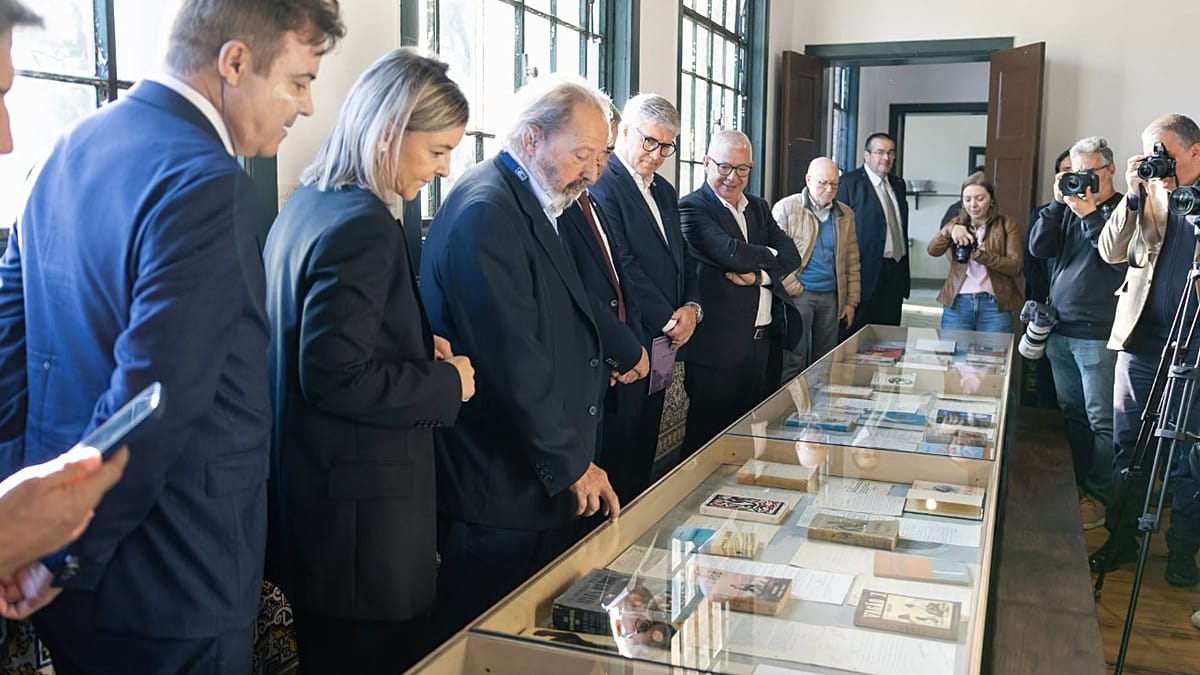
After more than two decades of debate and delays, a former primary school in the small Portuguese town of Vimieiro has reopened as a centre dedicated to understanding the dictatorship of António de Oliveira Salazar and the resistance that opposed it. The building, constructed between 1937 and 1940, is where Salazar was born, and it now houses the Estado Novo Interpretive Centre – Regime and Resistance (CIEN-RR).
The centre, which opened on 23 October, is located in the municipality of Santa Comba Dão, in central Portugal. Its scientific coordination is led by the Associação Ephemera, founded by historian José Pacheco Pereira, an institution known for collecting and preserving contemporary historical materials, including archives, books, periodicals, manuscripts, pamphlets, photographs, and objects.
The facility will host exhibitions, debates, conferences, and research activities, alongside a thematic library and reading room. The goal is to provide documents and materials that help visitors grasp what life was like under the Estado Novo, without concealing the building's historical connection to Salazar. The old school retains elements from that era, and project leaders say preserving this context is part of historical interpretation, not a tribute.
First exhibition on censorship
The inaugural exhibition, titled “Only What Is Known To Exist Exists: Censorship under the Estado Novo,” draws on the Ephemera collection to examine how the dictatorship controlled information and cultural expression, affecting the press, literature, and music. It offers a window into the mechanisms of repression that sustained the regime for decades.
At the opening ceremony, Portugal's Secretary of State for Culture, Alberto Santos, argued that “studying the dictatorship is a responsibility of democracy.” He added that doing so “in a place so directly associated with the figure of António de Oliveira Salazar” increases the responsibility “to know the regime, to understand how it managed to last for so long, what it meant to live under its power” and what lesson it leaves for the future.
The opening marks the culmination of a process that spanned several municipal terms and sparked controversy over how to address Salazar's memory in his hometown. The new venue aims to establish itself as a place of historical knowledge and reflection, rather than a museum dedicated to the former ruler.
“We do not want to turn this interpretive centre into a museum to the dictator, we want instead to create an interpretive centre that studies not only the regime, but also the resistance to the regime,” stressed Luís Nunes, deputy mayor of Santa Comba Dão, in comments to the Lusa news agency.
The centre's scientific committee includes Marçal Grilo, Irene Pimentel, José Manuel Sobral, José Pedro Castanheira, Luís Nunes, Maria Inácia Rezola, Luísa Tiago de Oliveira, and Rui Feijó. At the inauguration, historian Pacheco Pereira noted that most of them are people who “before and after 25 April played a role in defending freedom and democracy.”
The Estado Novo, which lasted from 1933 to 1974, was one of Europe's longest-lived authoritarian regimes. Its legacy remains a sensitive topic in Portugal, and the new centre is part of a broader European effort to confront difficult histories. Similar initiatives across the continent, from Germany's Stasi museums to Spain's Valle de los Caídos reinterpretation, show how societies are grappling with the physical remnants of dictatorship.
The choice of location is particularly symbolic. Vimieiro, a small village, was the birthplace of the man who ruled Portugal for nearly four decades. By turning the school where he was born into a space for critical study, the project seeks to reclaim the site from hagiography and place it in the service of democratic memory.
The centre's opening comes at a time when Portugal is increasingly reflecting on its authoritarian past, including the colonial wars and the role of the secret police. The CIEN-RR is expected to become a reference point for scholars and students, as well as for ordinary citizens interested in understanding how dictatorship functions and how societies resist it.
As the first exhibitions and research activities get underway, the centre will also contribute to ongoing debates about memory and justice in Europe. Its success will depend on its ability to attract visitors and researchers, and to foster a nuanced understanding of a period that still shapes Portuguese politics and society.