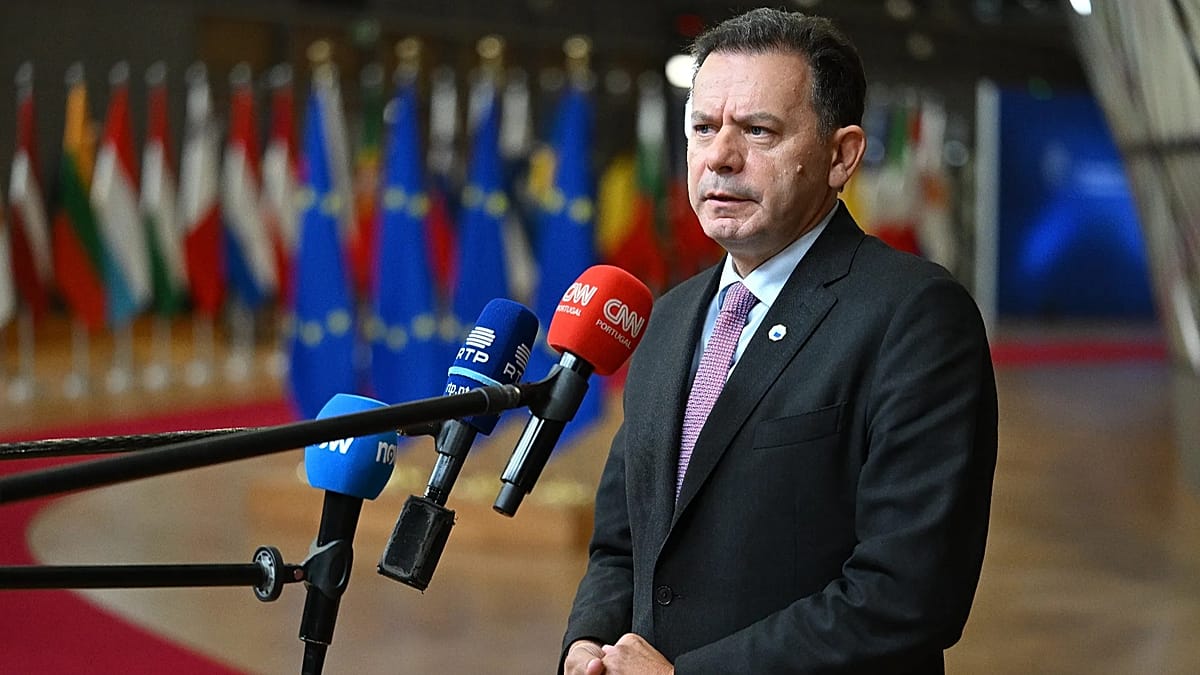
In a televised address on Thursday evening, Portugal's prime minister, Luís Montenegro, presented a broad set of measures aimed at cushioning households from rising prices, particularly at the fuel pump. The speech, timed for the main evening news bulletins, came days after his minority government survived a no-confidence motion in parliament.
Montenegro, who leads the centre-right Social Democratic Party (PSD), framed the package as a responsible response to a prolonged period of economic strain. "Here I am, putting myself on the line," he said, signalling that the government was willing to commit politically to the plan.
What the package includes
The Council of Ministers formally approved several measures that had been announced earlier. The most visible is a one-off pension bonus to be paid in December: €200 for pensions up to €537, €150 for pensions up to €1,704, and €100 for pensions up to €1,611. The tiered structure is designed to give proportionally more support to the lowest-income retirees.
The government also approved a reduction in the number of personal income tax (IRS) brackets, from the current structure to six. Because the tax is progressive, the change will also affect the remaining brackets. Montenegro said the reform was aimed above all at "middle-class households", who have felt the squeeze from inflation and stagnant wages.
However, the IRS changes are still a draft law that must be approved by the Assembly of the Republic. The government's portal has published the new withholding tables with simulations, but the final shape could still be altered by parliament.
On fuel prices, the main instrument remains the discount on the tax on petroleum products (ISP). Montenegro said the discount would stay in place until the end of the year, representing a total reduction of around €1.3 billion. He added that the discount "will probably rise to 25 cents as early as next week", up from the current 23 cents, in anticipation of further increases in global oil prices.
The government is also extending targeted support to sectors most exposed to fuel costs, with a total package of €38 million. This covers taxis, freight transport, social solidarity institutions, firefighters' associations and farmers. The solidarity bottled gas scheme, which helps low-income households with cooking gas, will also continue.
In a move to ease commuting costs, the government is extending the green rail pass to the urban areas of Lisbon and Porto. The pass, which costs €20 a month, allows unlimited travel on all rail lines except the Alfa Pendular high-speed service.
No VAT cut, despite pressure
Montenegro used the address to explicitly rule out one measure that has been repeatedly demanded by the opposition and adopted by several other European countries: cutting VAT on basic foodstuffs from 6% to zero.
"I will not swap cutting VAT on some foodstuffs from 6% to zero for the 800 million euros we are returning to families through IRS and the pension supplement," he said.
The Socialist Party (PS) and the far-right Chega have both called for a VAT reduction, arguing it would provide immediate relief at the supermarket till. Several EU member states, including Spain, France and Italy, have used VAT cuts to combat food inflation.
Montenegro acknowledged those examples but rejected them for Portugal. "I have every respect for the choices of the opposition parties and for the choices of my fellow heads of government in the European Union," he said. "I will not trade our fiscal and financial policy for that of other countries, even those closest to us, such as Spain, France or Italy."
The contrast with Spain is particularly striking. Fuel is cheaper across the border, prompting Portuguese drivers to make the trip to Spanish petrol stations. The government's decision to keep the ISP discount rather than cut VAT is an attempt to address that without undermining the tax base.
Montenegro repeatedly invoked the country's experience with the international bailout of 2011-2014, arguing that short-term populism would lead to long-term pain. "Do not count on me, or on the government, for illusions today that come with a heavy price to pay tomorrow," he warned.
He also acknowledged that the current situation "may drag on". Earlier in the day, at a conference, he had criticised what he called the "stupid" course of the conflict in the Middle East, which has contributed to energy price volatility.
The package is a delicate balancing act for a minority government that must negotiate with other parties to pass legislation. The IRS reform, in particular, will require parliamentary support. The pension bonus and fuel discounts are already in effect, but the broader fiscal strategy will be tested in the coming weeks.
As public transport costs rise across Europe, Portugal's green rail pass extension is a notable exception. But the government's refusal to touch VAT sets it apart from many of its EU partners, a choice that will continue to fuel debate in Lisbon.