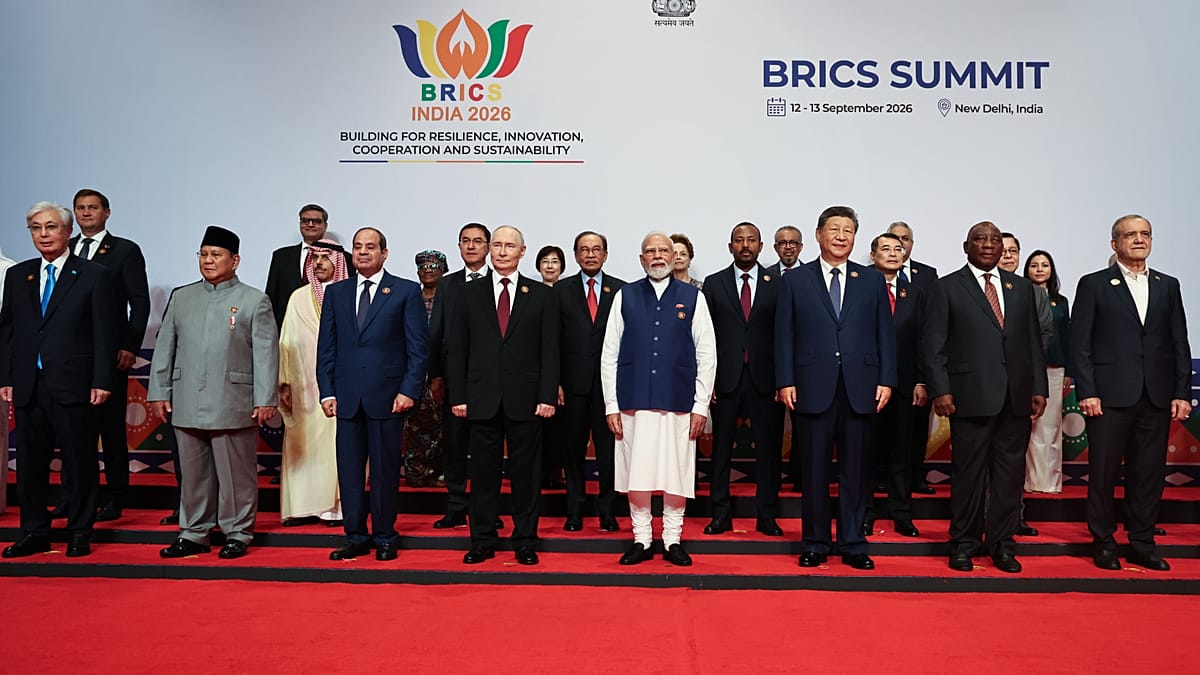
The Russian embassy in South Africa has come under scrutiny after sharing an AI-generated image that appears to show President Vladimir Putin taking a group selfie with the ten BRICS leaders at September's summit in New Delhi. The verified X account posted the picture, which drew more than two million views, with the caption "BRICS is a superpower." But the image is not real.
No credible news outlet has published the photo as authentic, and the summit's official website does not feature it. Euronews' fact-checking team, The Cube, ran the image through detection tools, which flagged it as AI-generated. OpenAI's detector found a SynthID watermark originating from OpenAI. Additionally, the official BRICS India 2026 logo and slogan—"Building for Resilience, Innovation, Cooperation and Sustainability"—do not match the fabricated version, which reads "Stronger together for a brighter tomorrow." The Russian embassy did not disclose that the image was synthetic.
A growing trend among European politicians
While this particular image may seem harmless, it is part of a worrying pattern: European politicians and public institutions are increasingly publishing AI-generated content without labeling it as such. Sometimes used for misleading purposes, these images and videos can significantly undermine public trust.
In Portugal, André Ventura, leader of the far-right Chega party, recently posted an AI-generated video of a woman with six fingers, seemingly to push an anti-immigration narrative. The clip shows a hijabi woman looking up and down at a white, non-hijabi woman in a short dress, with the caption: "If it were the other way around, it'd be racist and xenophobic. They come to our countries... Why do they not get used to respecting our values?" Despite numerous comments pointing out the video's artificial nature, Ventura did not disclose its AI origin, and it remains active on his profile.
This phenomenon is not confined to Europe. High-profile figures like US President Donald Trump have become notorious for sharing AI-generated images and videos in their communications. But in Europe, the trend is particularly pronounced among right-wing and far-right parties, according to a 2026 study by the European non-profit AI Forensics.
Consequences for democracy
The AI Forensics research, which focused on the French municipal elections, found that AI is used not only for photorealistic imagery but also for stylized, cartoonish visuals to reinforce key campaign messages, including anti-immigrant narratives. The study warned that the lack of disclosure could endanger public trust in the electoral process. Most of the material examined carried no explicit AI disclaimer, even when watermarks were present.
Since August of this year, the EU's AI Act has generally required realistic AI-generated or manipulated content to be clearly disclosed. However, enforcement remains a challenge, and many politicians continue to flout the rules. The Russian embassy's post is a stark reminder that even state actors are exploiting this loophole.
As AI tools become more accessible, the line between real and synthetic is blurring. For European citizens, the ability to distinguish fact from fabrication is essential to making informed decisions. The lack of transparency from public figures—whether in Moscow, Lisbon, or Paris—risks eroding the very foundations of democratic discourse.
For more on how AI is being weaponized in the region, see Russian hackers using AI for espionage and EU defence chief's warning on hybrid attacks.