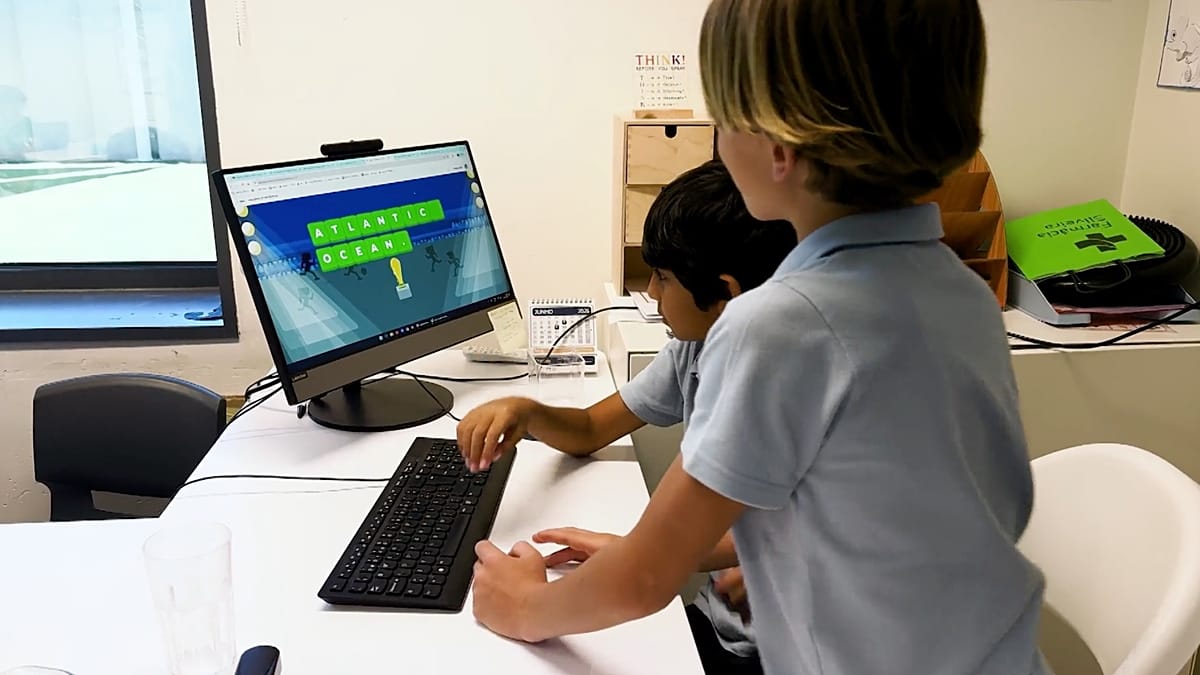
On the last day before summer break, a primary classroom in Lisbon's PaRK International School buzzes with quiet concentration. Tablets in hand, pupils navigate colourful puzzles, build simple games, or take a virtual tour of the International Space Station. They are not just playing — they are learning to code through ubbu, a Portuguese platform designed for children aged six to fourteen.
Teacher Teresa Cary sees the deeper value. "It looks like they're playing games, but they're actually working on lots of different things," she says. "They need to understand how to use a computer, how to make a robot do something. They need logic, it's actually maths."
Ubbu was created by Code for All, a startup founded in 2015 by João Magalhães and a group of friends in Portugal. The team saw a gap between the speed of technological change and the readiness of schools to prepare children for it. "We believed no one was prepared for the speed at which technology was entering our lives," Magalhães recalls. "We built a solution for any teacher, school or government that wanted to introduce digital literacy, computational thinking, creativity, and now AI and cybersecurity."
Today, ubbu is available in four languages and reaches roughly half a million children through more than 8,000 teachers in 20 countries, including Portugal, Spain, and several other European nations. The platform uses visual coding blocks instead of text-based programming, making it accessible to young learners who have not yet mastered typing or syntax.
More than just games
Each lesson is embedded in a narrative tied to the UN Sustainable Development Goals. André Ribeiro, who creates pedagogical content for ubbu, explains: "All the narratives are linked to the UN Sustainable Development Goals. They create ethical content and learn to use technology for good." For instance, pupils might program robots to cooperate in extinguishing a forest fire, or design a simulation that shows the impact of pollution on oceans.
Project manager Joana Miranda highlights the importance of responsible technology use. "Knowing how to use technology safely, responsibly and ethically is incredibly important," she says. The platform also aims to close the gender gap in tech. "We're achieving a 50-50 audience in schools. Girls see role models and realise there are women in science, technology and engineering," Miranda adds.
Making these skills accessible to every child is central to ubbu's mission. Through partnerships with companies and foundations, the platform is offered free of charge to public schools in disadvantaged areas of Portugal. One such school is Amadora Oeste Agrupamento de Escolas, on the outskirts of Lisbon, where teacher Isabel Cunha has seen a transformation in her classroom. "It captured my pupils' attention, and from there we explored many different topics," she says. "After only a year, they know how to use computers and tablets safely, how to navigate the web, I can already see great progress."
The rise of coding education in Portugal comes as the country makes strides in digital infrastructure and renewable energy. In July, solar power became Portugal's top electricity source for the first time, a sign of the country's forward-looking approach. Ubbu's expansion across Europe also reflects a broader continental push to equip young citizens with digital skills, a priority for the EU's Digital Education Action Plan.
For teachers like Cary, the benefits extend beyond the screen. "They learn to collaborate, to debug, to think critically," she says. "Those are skills that will serve them no matter what they do later."
As ubbu continues to grow, its founders hope to see coding become as fundamental as reading and writing. "We want every child, regardless of background, to have the chance to create with technology, not just consume it," Magalhães says. With half a million young learners already on board, that vision is steadily becoming a reality.