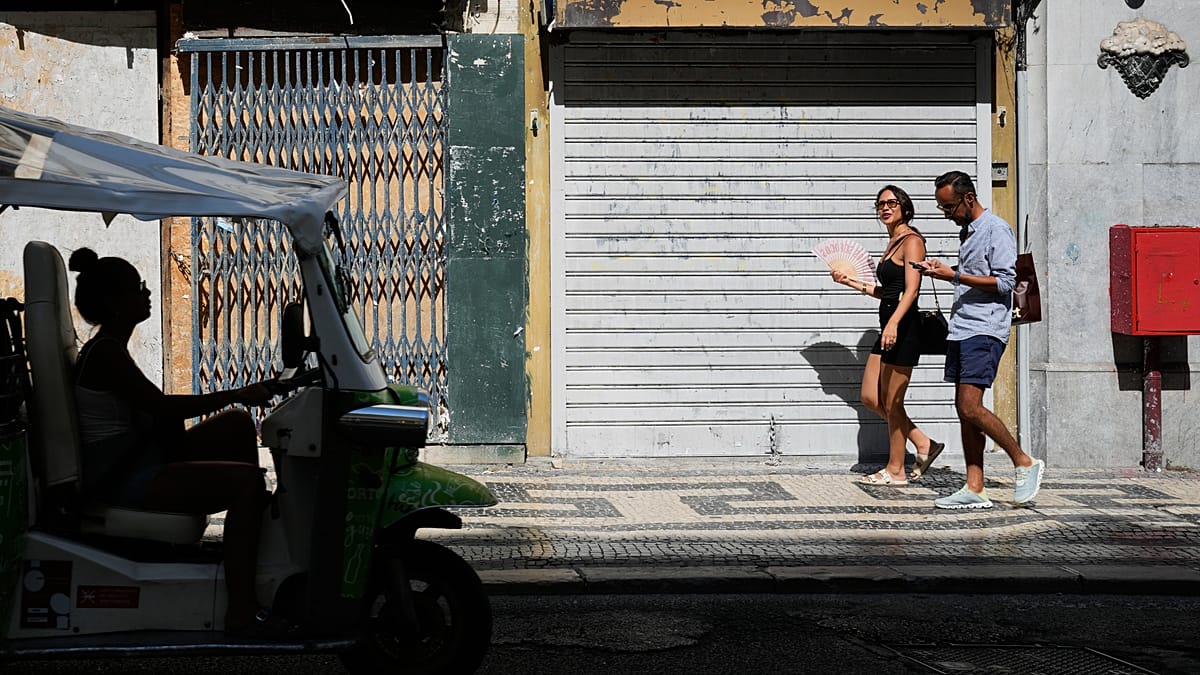
Portugal is facing an unprecedented heatwave season. By early July 2026, the country had already recorded six heatwaves — the same number as in all of 2025 — covering 59 days of extreme temperatures. The episodes struck in February, March (twice), April, May, and June, according to the Portuguese Institute for Sea and Atmosphere (IPMA).
“We have already had six heatwaves, the same as the total for last year. And we are only in July. On top of that, the intensity — in other words, the difference in temperatures compared with what is normal — is greater,” Francisco Ferreira, president of the environmental association Zero, told Euronews.
On the European Day for Victims of the Global Climate Crisis, a coalition of 12 organisations — including Zero, Quercus, Geota, Greenpeace Portugal, WWF Portugal, and the Portuguese Network of Ambassadors of the European Climate Pact — delivered an open letter to the government headquarters at Campus XXI in Lisbon. The letter is addressed to Prime Minister Luís Montenegro, the ministries of Environment and Energy, Health, and Infrastructure and Housing, as well as the National Association of Portuguese Municipalities. It labels extreme heat a public health emergency and calls for urgent intervention measures in urban centres.
Concrete Demands for Adaptation
The signatories are not asking for vague promises. They want a national network of climate shelters — public and private spaces such as libraries, swimming pools, parks, and air-conditioned shops that can offer refuge during heatwaves. They also demand accelerated building renovations to combat energy poverty, and the installation of air-conditioning in nurseries, care homes, and day centres.
“The idea is to really have assets available, climate refuges — meaning shaded areas, green spaces, air-conditioned zones — which can take different forms, from services and shops to public institutions,” Ferreira explained.
The open letter states that municipal climate adaptation plans are “a fundamental step” for local resilience. Yet Portugal is lagging behind its own legal deadlines. “In Portugal we are obliged to draw up Municipal Climate Action Plans, which should have been ready by February 2024, and yet here we are in 2026,” Ferreira stressed. “More than these plans, what is really needed is to move into practice, because with the summer we are having and also with the situations we have already seen in recent years, the need to respond is increasingly urgent if we are to reduce morbidity.”
The symbolic street action accompanying the letter delivery saw participants wrap themselves in towels and hold placards reading “Lisbon is not a sauna!” — a pointed reminder that the capital, like many Portuguese cities, was not designed for the heatwaves now battering it.
Why Action Has Stalled
According to Ferreira, several factors explain the slow pace of adaptation. “Municipal priorities are sometimes elsewhere, and they have not given this response the prominence and importance it deserves,” he said. “In some cases, especially in small municipalities, there is a lack of technical capacity. It is not easy to prepare this kind of plan, whether in terms of reducing emissions or in terms of climate adaptation.”
Cost is another major barrier. “The changes sometimes involved in climate adaptation are expensive. In the future they will work out cheaper, there is no doubt. They will improve the quality of life of residents and of everyone who uses the cities. But they require costly investment and are therefore often difficult for local authorities to approve.”
The letter warns that extreme heat is no longer a distant risk. “It is a threat to public health, quality of life and the safety of our cities. We also know that this risk is not distributed equally. Those who live in neighbourhoods with little green space, streets that are excessively paved, heavy traffic and scarce shade are more exposed.”
Portugal is not alone in facing this challenge. Across Europe, cities from Paris to Athens are grappling with how to adapt to rising temperatures. The European Environment Agency has repeatedly warned that heat-related mortality could triple by the end of the century if no action is taken. Portugal’s experience — with six heatwaves already in 2026 — offers a stark preview of what may become the new normal for the continent.
For now, the coalition’s demands sit on the prime minister’s desk. Whether they translate into action will determine how many lives are lost — or saved — in the summers to come.