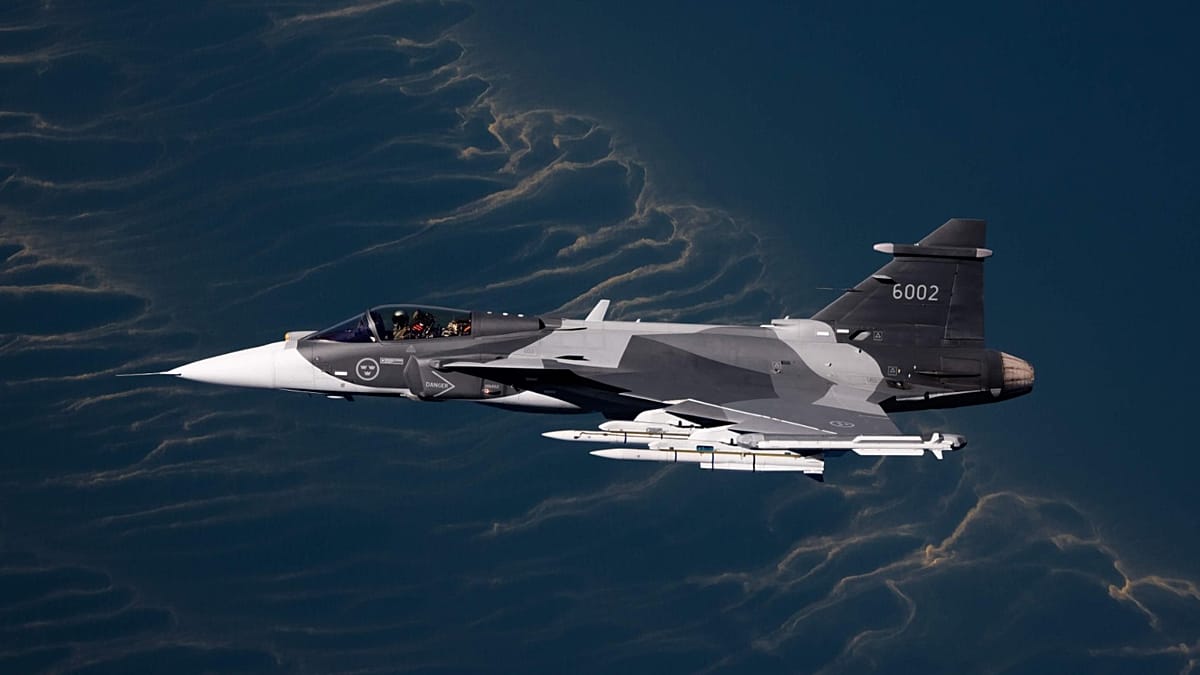
Swedish defence manufacturer Saab has signed a partnership with Portuguese industrial group Vangest to produce components for its Gripen E/F fighter jets, marking a notable step in the Nordic company's effort to broaden its European supply chain. The agreement, announced on Wednesday, covers the manufacture of eight complex parts at Vangest's facilities in Marinha Grande, a town known for its mould-making tradition, located about 130 kilometres north of Lisbon.
Vangest, which has built a reputation in moulds and plastic components for industries ranging from automotive to medical devices, has been steadily expanding into aerospace. The company said the partnership is part of Saab's strategy to "expand its international manufacturing network and strengthen the production capacity of the Gripen E/F". The deal is expected to create "new skilled jobs" in the region, though no specific figures were provided.
Johan Segertoft, head of Saab's Gripen business unit, said in a statement that the collaboration "gives Portuguese industry a concrete role in the Gripen programme". He added that Saab is committed to "the development of Portugal's aerospace industry". The Swedish firm cited Vangest's "advanced manufacturing capabilities and experience" as the reason for the choice, and hinted at potential for "expansion in the coming years".
Strategic timing amid F-16 replacement debate
The announcement lands at a moment when Portugal is preparing to launch a process to replace its ageing fleet of F-16 fighter jets. The Gripen is one of several models under consideration, alongside contenders such as the US F-35 and the Eurofighter Typhoon. Saab's statement explicitly notes that selecting the Gripen "would offer more opportunities" to deepen the cooperation, aiming at the "development of Portugal's aerospace and defence industry and strengthening its role in the European defence industrial landscape".
The move reflects a broader trend of European defence companies seeking to build resilient supply chains within the continent, especially as governments push for greater strategic autonomy. Saab's decision to source components from Portugal, a smaller EU member state, also aligns with efforts to distribute defence manufacturing across the Union. The partnership could serve as a template for other Nordic or European firms looking to integrate Southern European suppliers.
For Portugal, the deal is a boost to its industrial ambitions. The country has been trying to position itself as a hub for aerospace innovation, with clusters in Évora and the Lisbon region. Marinha Grande, historically a centre for glass and mould production, is now pivoting towards high-tech manufacturing. The new jobs, though modest in number, are seen as a signal that Portuguese firms can compete in the demanding aerospace sector.
Neither Saab nor Vangest disclosed the financial value of the contract, the investment involved, or a timeline for the start of production. Analysts suggest that the initial batch of components is likely to be small, but the partnership could grow if Portugal decides to purchase the Gripen. The Portuguese Air Force's F-16s have been in service for decades, and the need for modernisation is becoming urgent, with some experts warning that delays could compromise operational readiness.
The Gripen E/F, a single-engine multirole fighter, has been marketed as a cost-effective alternative to heavier twin-engine jets. Saab has already secured orders from Sweden and Brazil, and the aircraft is being pitched to several European nations. The Portuguese decision is expected within the next few years, and the outcome will have significant implications for the country's defence posture and its industrial partnerships.
In the meantime, the Vangest deal is a concrete example of how European defence cooperation can extend beyond traditional powerhouses. It also comes at a time when the EU is exploring ways to bolster its defence industrial base, including through joint procurement and investment in critical technologies. The Airbus's interest in the UK-Japan-Italy fighter programme after the Franco-German collapse shows that European defence collaboration is in flux, with new alliances forming.
For workers in Marinha Grande, the announcement brings cautious optimism. The region has faced industrial decline in recent decades, and any new investment is welcome. Local officials have long argued that the area's skilled workforce and engineering heritage make it an ideal location for advanced manufacturing. The Saab partnership could be the first of several such deals, especially if Portugal's defence procurement favours European solutions.
Observers note that the timing of the announcement, just as Portugal prepares to launch its fighter tender, is no coincidence. Saab is clearly seeking to build goodwill and demonstrate its commitment to Portuguese industry. Whether that will be enough to sway the decision remains to be seen, but the partnership is a tangible step in that direction.
As Europe grapples with security challenges and the need to modernise its armed forces, collaborations like this one highlight the potential for smaller nations to play a role in the continent's defence ecosystem. The Iberian general strike possibility and other regional issues may dominate headlines, but the quiet work of building industrial capacity is equally important. For now, Vangest and Saab are writing a new chapter in European defence manufacturing.