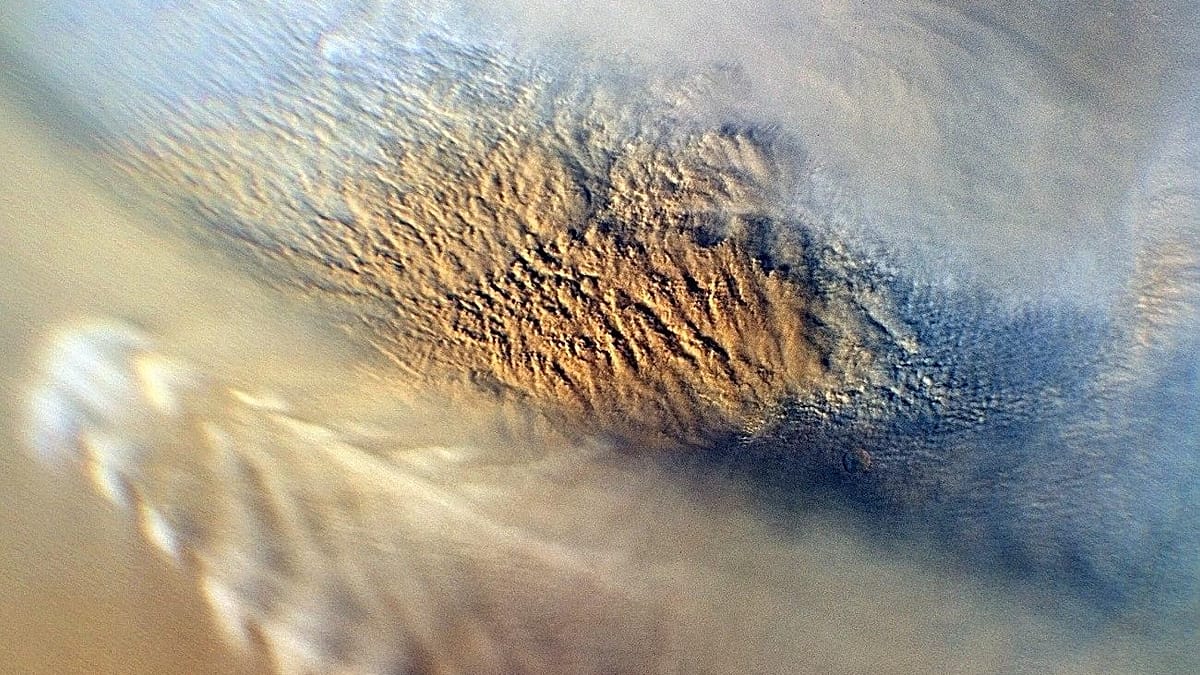
Two researchers from the Faculty of Sciences of the University of Lisbon (CIÊNCIAS ULisboa) and the Institute of Astrophysics and Space Sciences (IA) have published a study in the Journal of Geophysical Research: Planets that could make future landings on Mars significantly safer. Francisco Brasil and Pedro Machado led an effort to simultaneously measure the altitude and propagation speed of atmospheric waves on the Red Planet, using data from the European Space Agency's Mars Express mission.
Why Martian clouds matter for landing
Mars has a very thin atmosphere, with far fewer molecules than Earth's. As Francisco Brasil explained, this means the frictional force during descent is extremely low — "almost like free fall." That is a stark contrast to Earth, where launching a rocket requires overcoming substantial atmospheric drag. Since 1960, roughly half of all Mars exploration missions have ended in failure, often because landers crashed onto the surface. "We did not have much information about how the atmosphere was structured," Brasil noted. "They ended up nearly in free fall and crashed. And we do not want that to happen to humans."
The study focuses on characterising atmospheric waves, which are key to understanding how energy moves through the Martian atmosphere. By measuring cloud altitude and wind speeds, the team can help engineers design better entry, descent, and landing systems. "To land on a planet, we need to know how that atmosphere is distributed in terms of layers," Brasil said. The data came from a high-resolution camera aboard Mars Express, which has been orbiting Mars for 23 years and is now extended until 2029.
Clouds are rare and seasonal
Like Earth, Mars has an inclined axis, giving it seasons. But clouds are sparse and appear mainly during the northern hemisphere summer, when polar caps of carbon dioxide and water ice evaporate to form the Aphelion Cloud Belt. "Only at that time in the Martian year can we observe more clouds," Brasil explained. The clouds then evolve, responding to atmospheric dynamics. This seasonality means that mission planners could choose to land during periods of lower turbulence, improving safety.
The research also has broader implications. Understanding Martian atmospheric waves can serve as a "natural laboratory" for studying similar phenomena on Earth, such as those linked to climate patterns. The work builds on Europe's long-standing investment in planetary science, with Mars Express providing a unique vantage point that no other mission currently offers.
In recent years, the success rate for Mars landings has improved, thanks to better cushioning systems like specialised parachutes and airbag-like shock absorbers. But as humanity prepares for crewed missions, the need for precise atmospheric data becomes even more critical. "Knowing in advance which season Mars is in, we could choose a time with less turbulence," Brasil said, "so that a smoother landing can be achieved."
This study is a reminder of how European science — from Lisbon to Darmstadt — continues to push the boundaries of space exploration. For more on how citizen scientists contribute to environmental monitoring, see our story on Citizen Photos Help Scientists Track Marine Life in the Canary Islands. And for a look at how European researchers use ground data to predict heatwaves, read How European Scientists Use Ground Data to Predict Heatwaves.