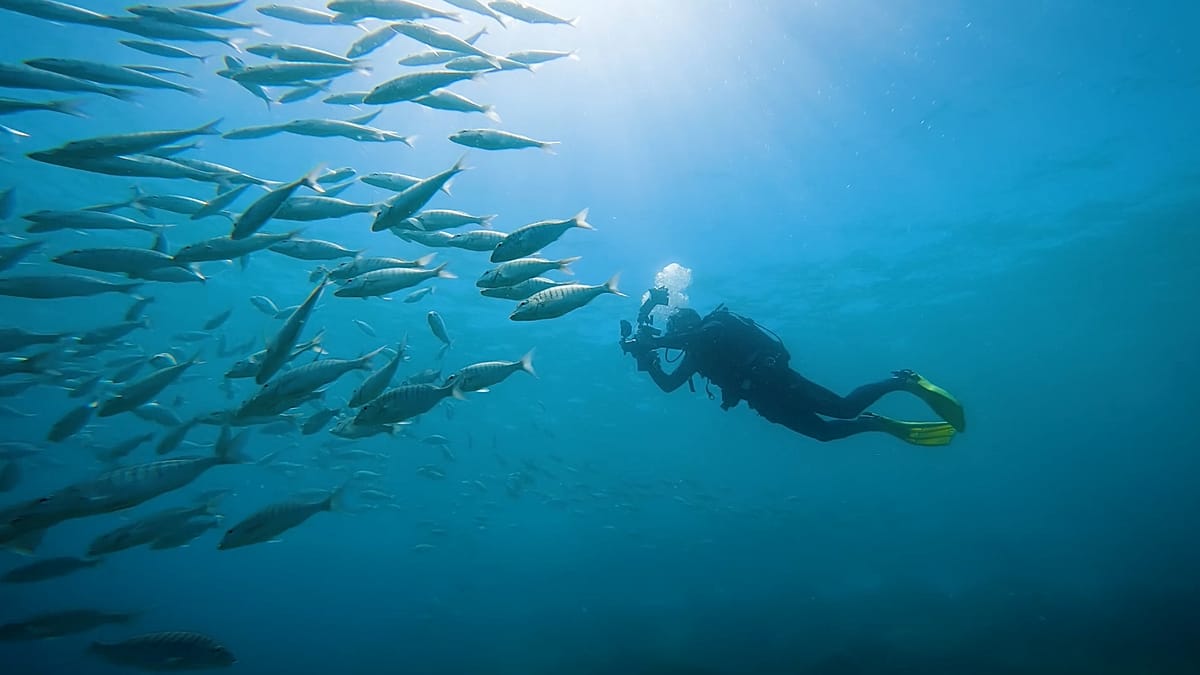
Off the coast of Lanzarote, a diving instructor snaps a photo of a tiny sea slug. That image, uploaded to a European platform, becomes part of a growing dataset that helps scientists monitor the health of the Atlantic Ocean in real time. This is the essence of RedPROMAR, an EU-funded citizen science project that turns everyday beachgoers and divers into data collectors.
RedPROMAR, co-financed by the Government of the Canary Islands, invites members of the public to photograph marine flora and fauna and upload their images to a central platform. Since its launch, the project has recorded and validated more than 85,000 sightings, cataloguing over 5,000 species in the waters of Macaronesia—the region encompassing the Canary Islands, Madeira, the Azores, and Cape Verde.
Divers as Citizen Scientists
Dennis Rabeling, a diving instructor at Euro-Divers Lanzarote, is one of the project's most prolific contributors. Diving daily, he has uploaded thousands of photos and helped identify three species previously unknown in the Canary Islands. One of them, a small sea snail, now bears his name: Gibberula Dennisi. “With RedPROMAR, if you upload your photos, you become another pair of eyes on the water,” Rabeling explains. “Today, during a thirty-minute dive, we saw around twenty or thirty species, perhaps even more.”
Each geotagged image is verified by a team of experts. Marc Martín Sola, a marine biologist at Gesplan and a RedPROMAR technician, describes the process as a jigsaw puzzle. “Citizen science data is like a jigsaw puzzle, in which observers provide us with small pieces that, taken individually, may not make sense,” he says. But when assembled, those pieces offer valuable insights to scientists and policymakers.
Early Warning for Alien Species
Beyond cataloguing biodiversity, the platform serves as an early-warning system for the arrival of alien species and the proliferation of organisms linked to human activity or climate change. “There are specific times when we receive a lot of reports, a lot of sightings of a particular species, and this usually coincides with ‘arribazones’ – the mass arrival of organisms, whether alive or dead, on the coast,” Martín Sola notes. In 2024, the project recorded over a hundred sightings of a single species in just a few months. “Citizen science enables us to detect and record these sudden surges that might otherwise go unnoticed by the scientific community,” he adds.
The project also extends into education. Secondary school pupils from IES Yaiza in Lanzarote, under teacher Juan Francisco Rodríguez García, have studied how human activities affect the marine environment, recorded a podcast on tropicalisation, and visited Órzola in northern Lanzarote to learn about local species and RedPROMAR’s work. Student Aroa recalls her surprise: “I didn’t even know most of the species. I hadn’t heard those names before at all. Take the manatee, for example. When an animal tries to bother it, it releases a kind of purple ink to scare it away. It’s really amazing.”
Funding and Expansion
RedPROMAR’s total budget is just under two million euros, with 85% funded by the European Cohesion Policy and the remaining 15% by the Canary Islands Government. Originally focused on the Canary Islands, the project has expanded to Cape Verde, Madeira, and the Azores, creating a network of observation across the North Atlantic.
This approach mirrors broader European efforts to leverage citizen science for environmental monitoring. Similar projects across the continent, from the Baltic to the Mediterranean, are using public contributions to track biodiversity and climate change. The success of RedPROMAR highlights how relatively modest investments can yield substantial data, empowering local communities while informing regional conservation strategies.
As the project grows, it offers a model for other regions facing rapid ecological change. By turning every diver, snorkeller, and beach walker into a potential scientist, RedPROMAR demonstrates that the health of the ocean can be monitored not just by experts, but by anyone with a camera and a willingness to contribute.