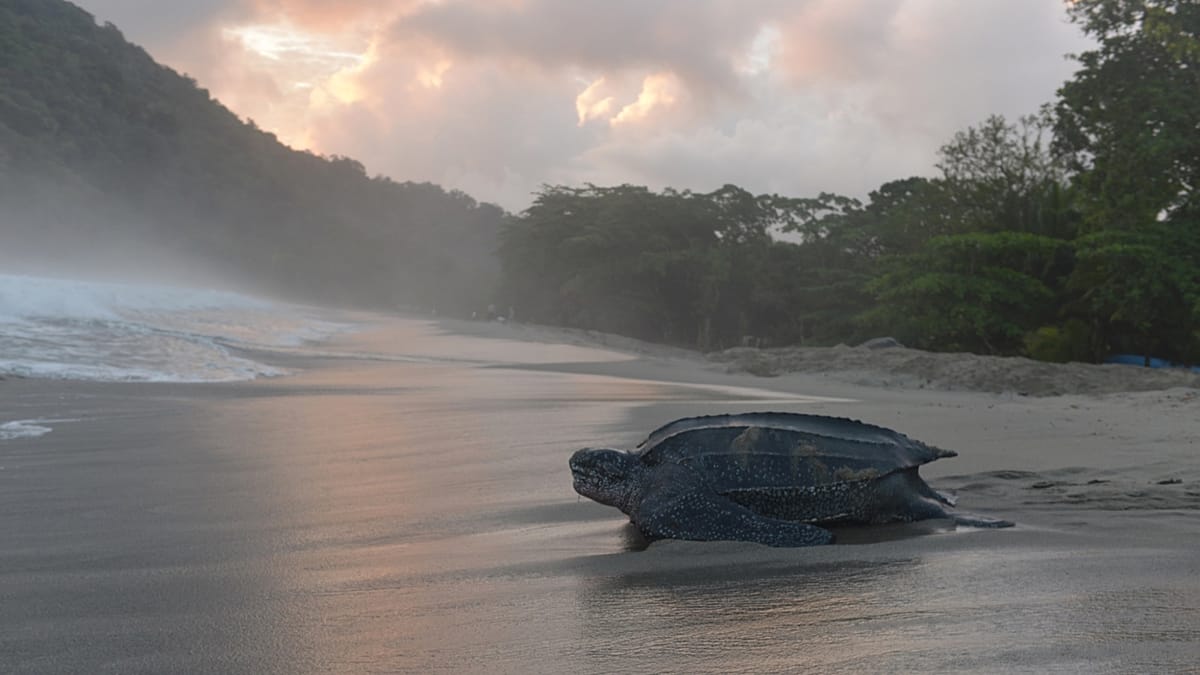
Leatherback turtles, among the most threatened marine vertebrates on the planet, are losing ground across much of their range. Classified as vulnerable on the IUCN Red List since 2013, their populations continue to decline, largely because industrial fishing vessels operate with little restraint in the open ocean.
Now a report from Greenpeace International, titled Well Connected, argues that a coordinated network of fully protected ocean sanctuaries in the Atlantic high seas could significantly reduce the dangers these turtles face. The study identifies 17 sites that, if fully protected under the UN Global Ocean Treaty, would cover more than 31% of the Atlantic high seas and shield over 35% of the danger zones where leatherbacks encounter industrial fishing gear.
Slow progress on ocean protection
The report lands as delegates gather in Yerevan, Armenia, for the opening of the UN biodiversity conference (CBD COP17) on Monday 19 October. There, the first official assessment will be made of progress toward the global target agreed in 2022: to protect 30% of the world's ocean by 2030. Scientists say that is the minimum needed to give marine ecosystems a realistic chance of recovery.
Greenpeace, however, warns that governments are moving at a snail's pace. According to the report, at the current rate of designation, it would take 265 years to reach the 30% target. “Governments must urgently close the glaring gap between commitments and action,” the organisation said in a statement.
The Atlantic high seas are particularly critical for leatherback turtles, which migrate thousands of kilometres between feeding and nesting grounds. Yet there are currently no fully or highly protected areas in this vast region, leaving turtles exposed to the persistent threat of commercial fishing gear, including longlines and gillnets.
How a connected network would help
The proposed sanctuaries would include existing marine protected areas (MPAs) that need upgrading to full protection, sites already under consideration by governments, and several new locations. Together, they would form a connected network allowing migratory species to travel, feed, and breed without encountering deadly fishing gear or ship strikes.
“Having a network of connected fully protected ocean sanctuaries would make sure that incredible migratory species like whales and turtles are protected along their journeys, free from the threat of being killed by industrial fishing or being struck by cargo ships,” said Lukas Meus, an ocean campaigner at Greenpeace International. “This is the only way to allow them to travel, eat and breed safely. Delegates meeting in Armenia need to agree on big bold solutions to put them back on track.”
The report's findings echo broader concerns about the health of the world's oceans. In recent years, conservation efforts have shown that recovery is possible for some species, including tuna and certain turtle populations, but only when protections are enforced.
For Europe, the issue carries particular weight. Several EU member states, including France, Spain, and Portugal, have large fishing fleets operating in the Atlantic, and the EU has been a vocal advocate for the Global Ocean Treaty. The bloc's commitment to the 30% target will be closely watched in Yerevan.
Greenpeace is urging governments to move beyond rhetoric and adopt the proposed sanctuary network as part of the treaty's implementation. The organisation argues that fully protected areas, where no extractive or destructive activities are allowed, are the most effective tool for safeguarding biodiversity.
As the COP17 talks get under way, the fate of the leatherback turtle—and countless other species—may hinge on whether delegates can translate ambitious words into concrete action.