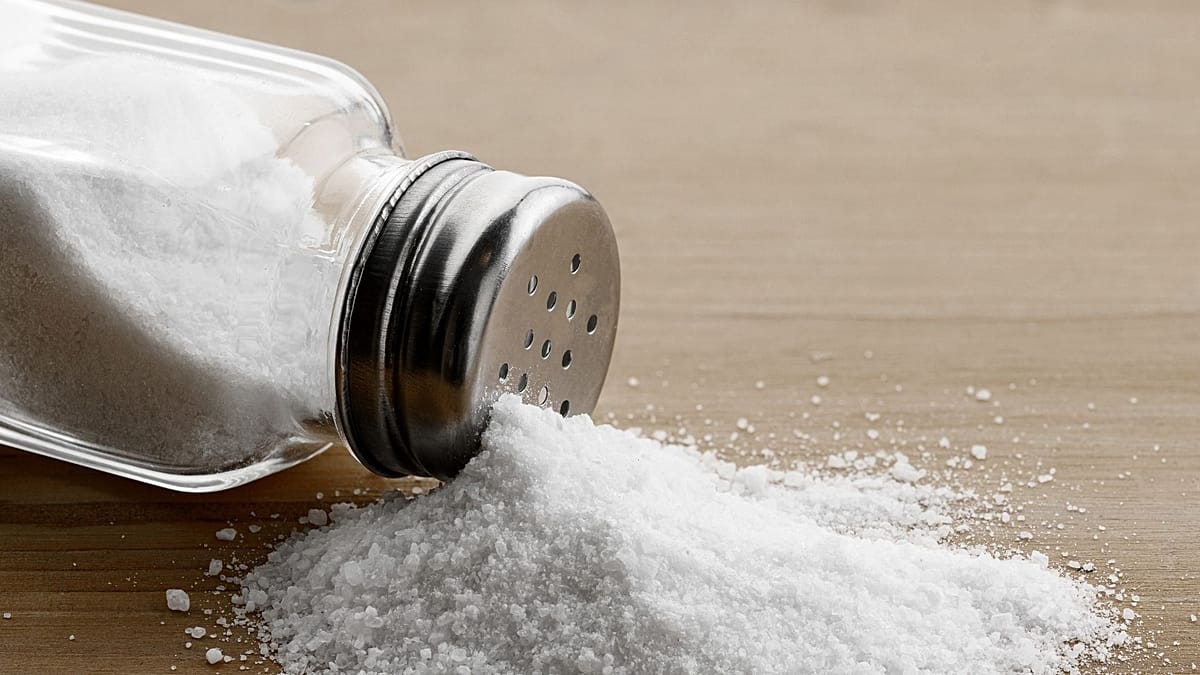
Swapping ordinary table salt for a potassium-enriched version could prevent nearly three million deaths worldwide every year, according to new research that underscores a low-cost strategy against high blood pressure and its deadly consequences.
The study, led by researchers at The George Institute for Global Health in Australia, modelled the impact of such a switch across 193 countries. It found that a global transition could avert 2.96 million deaths and 10.17 million new cases of cardiovascular disease and chronic kidney disease annually.
“Consuming too much sodium and not enough potassium are well established causes of high blood pressure – a major risk factor for life-threatening conditions like strokes, heart attacks and kidney disease,” said Bruce Neal, senior professorial fellow at The George Institute, in a press release.
How potassium-enriched salt works
Potassium-enriched salt replaces some of the sodium chloride in conventional salt with potassium chloride. It looks, tastes and cooks like regular salt, but it tackles two dietary imbalances linked to hypertension: excessive sodium intake and insufficient potassium consumption.
“Switching to potassium-enriched salt addresses both these dietary issues at the same time, with substantial health benefits,” Neal added.
High blood pressure affects roughly 1.4 billion adults aged 30 to 79 worldwide, according to the World Health Organization. Cardiovascular disease remains the leading cause of death and disability globally, accounting for 19.2 million deaths in 2023.
Even partial adoption brings gains
The researchers examined several scenarios, including replacing salt used in household cooking, switching salt in processed and restaurant foods, and targeting people already diagnosed with or treated for hypertension.
Even a partial transition could deliver substantial gains. Replacing household salt alone could prevent an estimated 1.85 million deaths and 6.19 million cases of cardiovascular and kidney disease each year. Switching salt used in processed and restaurant foods could prevent a further 1.56 million deaths and 5.46 million cases.
In Europe and North America, more than 70% of dietary salt intake comes from processed foods and restaurant meals, not salt added at home, according to Neal. “To realise the maximum benefits from switching to potassium-enriched salt, we need to see the food industry in Europe and North America ... get on board,” he said.
The potential benefits are particularly significant in countries with large populations and high levels of cardiovascular disease. A complete switch could prevent an estimated 1.08 million deaths annually in China, followed by India with almost 400,000. In the United Kingdom, the researchers estimate that replacing all conventional salt could prevent nearly 13,000 deaths and around 60,000 cases of cardiovascular and kidney disease each year.
Risks and next steps
Wider adoption is not without potential risks. People with advanced kidney disease, as well as those taking certain medications that increase potassium levels, may be vulnerable to hyperkalaemia – an excessive concentration of potassium in the blood.
“Risks for this group can be managed effectively through patient education, product labelling, and clinical oversight,” said Vivek Jha, a nephrologist and senior professorial fellow at The George Institute in India.
The World Health Organization endorsed the use of potassium-enriched salt in 2025 as a way to reduce blood pressure and cardiovascular disease risk. Neal acknowledged that a worldwide transition would be ambitious, not least because of the need to expand production of potassium chloride to meet demand.
“While a global shift from regular salt to a potassium-enriched substitute is aspirational, this is a starting point to get countries thinking about the opportunity – with much greater potential and at much lower cost than many drug-based treatments,” he said.